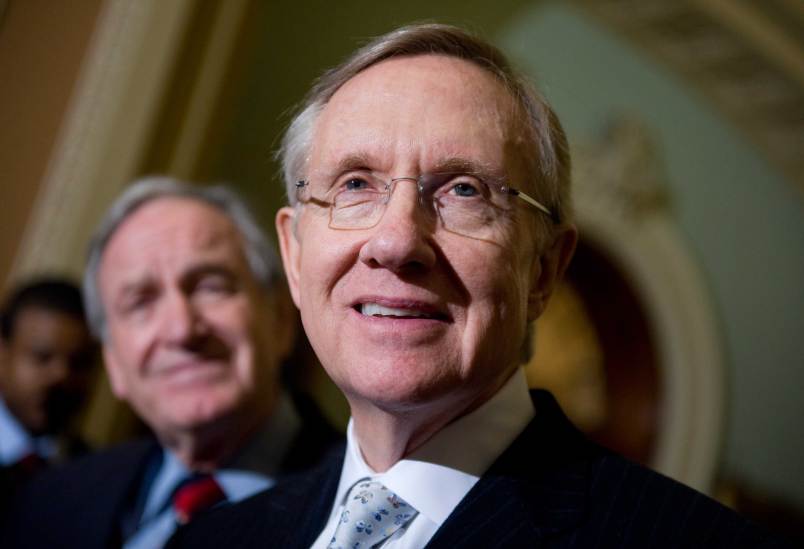
Senate Majority Leader Harry Reid doesn’t want any screwing around on financial reform, so he’s recommending that votes on amendments, and indeed the final bill, be kept to majority rule: no filibusters, no supermajority requirements.
“I would hope also that we don’t get locked into something that appears to be the order of the Congress around here that everything has to have 60 votes. On our side we’re willing–I can’t speak for everyone by I think I’m going to certainly–I’m more within my power to tell my senators, let’s just have a 50-vote margin,” Reid said on the Senate floor this morning. “Why do we need to have 60 votes on everything we do around here? That makes it so much more difficult, and I think that’s unnecessary.”
So common has the filibuster become in the Senate that often, by agreement between the majority and the minority, all votes on amendments are held at a 60 vote threshold–retaining the supermajority requirement, but avoiding the time-consuming nature of a more standard filibuster.
Both Reid, and the bill’s principle author Sen. Chris Dodd (D-CT) say they hope to wrap up their work on the bill by next week. “We have to finish it by next week and we’ll finish it one way or the other by next week,” Reid said. “We have so much more to do.”