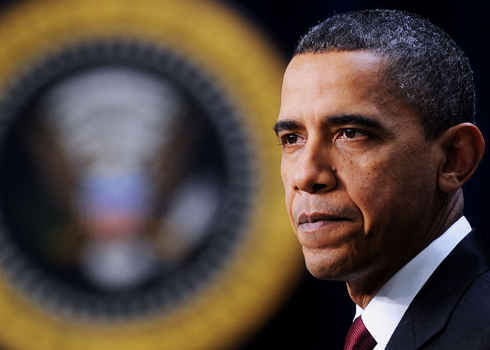
President Obama is facing one of the most difficult political challenges of his two and a half years in office in making the case to a skeptical American public and an impatient Congress that the longest war in U.S. history is still worth fighting and funding while he incrementally withdraws troops.
Obama is scheduled to outline his plans for a Afghanistan troop drawdown in a primetime address on Wednesday. The following day he will travel to Fort Drum in upstate New York to begin selling the proposal to the American people, the same day Secretary of State Hillary Clinton testifies before the Senate Foreign Relations Committee.
Speculation has varied in the last day about the exact timeline and numbers of the withdrawal, but Obama is expected to announce a plan to drawdown 33,000 troops by the end of 2012 with at least 5,000 to exit by the close of this year, according to administration officials and media reports.
When Obama launched the surge in Afghanistan in 2009, he promised to begin bringing some of the troops home by July 2011.
The political stakes could not be higher for the President. The American public is experiencing more combat fatigue than ever when it comes to Afghanistan, and the Congress is embroiled in a heated debate over Obama’s foreign policy and whether the War Powers Act requires Obama to seek Congressional approval for continued military action in Libya with the House planning a vote on yanking troops from Libya later this week.
In trying to sell his drawdown plan to the public, Obama also faces pressures from the right and the left, and a voter base with a long memory of his campaign promises to end the wars in Iraq and Afghanistan and bring troops home for good.
Senate Armed Services Committee Chairman Carl Levin (D-MI) has called for a withdrawal of 15,000 by the end of the year, while the Sen. John McCain (R-AZ), has urged Obama to limit any drawdown to 3,000 troops by the end of this year.
A majority of Democrats, including Levin, are supporting a robust withdrawal of troops while the GOP remains divided. Most Republicans want a less drastic drawdown, while a handful of Tea Party enthusiasts, led by Sen. Rand Paul (R-Ky), and his father Rep. Ron Paul (R-TX), are calling for fiscal restraint, arguing that the U.S. cannot afford to continue spending the billions required to remain there and are calling for a wholesale withdrawal as soon as possible.
White House spokesman Jay Carney said Tuesday that the decision is Obama’s alone and he will make it on the merits — what he believes is best for the U.S. military and the nation’s strategic interests in the area.
“He is in charge of this process and he makes the decisions and this decision will be the commander in chief’s,” Carney said.
Levin said his support for a more aggressive withdrawal is based on the significant gains the U.S. has made in training Afghan troops in the last 18 months since the surge began.
“We have tracked this very carefully,” Levin said Tuesday on the Senate floor. “There has been a significant increase in the amount of Afghan troops partnering with us and when the Afghans see Afghan troops in the lead, they understand that the Taliban’s argument that they are being occupied [by the U.S.]” is really a fallacy.
Other advocates of a slower withdrawal say the U.S. military presence needs to remain strong in order to build on this progress in training the Afghan military, especially considering the fragile state of the country’s central government.
Sen. Lindsey Graham (R-SC), a strong advocate of the 2010 surge, said the U.S. is on the verge of achieving the goal of training the Afghan military so it can protect itself against the Taliban and other threats and warned against a precarious withdrawal.
“I want to make sure that our nation is never attacked again from Afghanistan,” Graham said. “Please tell those who are left behind, Mr. President, that are still fighting, that you haven’t lost sight of the prize – that their children will never have to go back and fight there in the future.”
Sen. John McCain (R-AZ) was more blunt. Before a Senate vote confirming Leon Panetta’s nomination to succeed Robert Gates as defense secretary, McCain urged Panetta “to accept modest reductions and not do anything to jeopardize the hard-won gains in Afghanistan.”
Gates, who retires at the end of the month, has recently warned against a rapid troop reduction.
But other senators expressed a far more jaundiced view of any purported U.S. successes in Afghanistan – military or otherwise.
Sen. Joe Manchin (D-WV) said he could only base his opinions on what he saw on a recent Afghanistan trip.
“I did not see improvement. I saw deterioration,” Manchin said Tuesday. “I saw corrupt leadership…and I can only speak to a feeling of common sense…if 10 years is not enough [to establish stability], how long are we going to be staying there and spending billions when we can’t repair the bridges or fix the roads in our states.”
Retiring Sen. Jim Webb (D-VA), an outspoken advocate for swiftly withdrawing U.S. forces form both Iraq and Afghanistan, refused to comment on the drawdown before Obama makes his announcement Wednesday night.
“I’m reluctant to jump the gun and comment, especially considering my background,” he said in a brief interview.
Graham and McCain, two longtime advocates of greater international military intervention, for the first time in their careers are facing strident isolationist tendencies in their own party as Tea-Party aligned lawmakers prioritize spending cuts over continuing to fund overseas nation-building efforts. Even though President George Bush campaigned against expensive nation-building efforts, after the 9/11 attacks, Republicans almost uniformly defended the wars in both Afghanistan and Iraq even as they descended into a chaotic and deadly insurgency and teetered on civil wars.
While Speaker John Boehner (R-OH) has supported the President’s actions in Afghanistan and robust level of troops remaining there, he has been more critical of Libya, echoing the concerns from more conservative, populist factions of his party.
Even though more Republicans are calling for an end to the Afghanistan war and attempt to tie the President’s hands when it comes to U.S. military action in Libya, Senate Republicans may end up serving as the President’s backstop. McCain on Tuesday introduced a resolution authorizing limited force in Libya, which was co-sponsored by Sen. John Kerry (D-MA), as well as Levin, Graham, Jon Kyl (R-AZ), Dick Durbin (D-IL), Dianne Feinstein (D-CA), Lindsey Graham (R-SC), Joe Lieberman (I-CT), Roy Blunt (R-MO), Ben Cardin (D-MD) and Mark Kirk (R-IL).
Kirk said any withdrawal in Afghanistan should be based solely on the gains made in training the Afghan army and warned against the dangers of fanning the flames of isolationism.
“We should always be a big tent party,” he told TPM, “but the long-term results of isolationism can be very dangerous.”
Kirk pointed to the last strong isolationist movement in the country during the 1930s when the U.S. was trying to avoid being drawn into WWII. The reluctance to get involved only empowered Japan, Kirk said, and led to what Winston Churchill called an avoidable war.
Sen. Orrin Hatch (R-Utah), who the Tea Party is targeting for not being conservative enough, has shifted to the right since his colleague former Sen. Robert Bennett (R-Utah) lost his seat in a primary challenge last November. Even so, he said he’s leaning towards supporting McCain’s bill authorizing the use of limited military force in Libya.
The real problem in Libya, he told TPM, is Obama’s unwillingness to go in aggressively right from the start and take out Qaddafi.
The whole question of the War Powers Act wouldn’t be in play right now “if this had been done right,” Hatch said, “but the President didn’t have the guts to do it.”