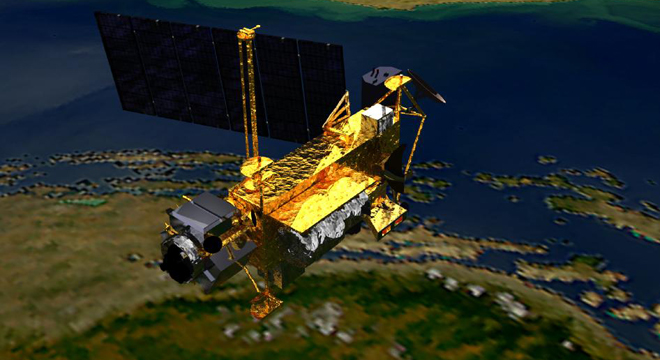
NASA officials on Friday warned the public on all six inhabited continents to be on the lookout for falling fragments of a deactivated satellite that the agency expects to scatter over a 500 mile radius.
“We won’t know precisely where it’s going to come down until it actually does,” said Nick Johnson, NASA chief scientist for orbital debris, of the decommissioned Upper Atmosphere Research Satellite (UARS), which is expected to strike the earth in late September or early October.
NASA hopes to narrow the likely area of impact down to a more manageable level as the satellite approaches, but currently, technically anywhere between the 57 north and south latitude lines is still fair game. That’s roughly everything North of Antarctica up until Alaska and Northern Siberia. If you live in Greenland, you won’t have to worry.
NASA scientists sought to dampen fears that the 20-year-old, $750 million satellite poses an imminent risk to life, limb and any human residences or buildings. They said there was a “1 in 3,200” chance that anyone would be impacted by debris.
“Throughout the entire 54 years of the space age there has been no report of anyone anywhere in the world being hit by or impacted by any re-entering debris,” Johnson said.
The 6.5-ton, school bus-sized climate satellite, which was launched from the space shuttle Discovery back in 1991 to study the chemical composition and processes of Earth’s atmosphere, was slated for a three-year mission.
But it outlasted its creators’ original hopes and continued to beam back data and make discoveries for another 14 years, finally breaking down once and for all in 2005.
Now what’s gone up must come down, especially since space junk orbiting the earth is approaching dangerously high levels.
NASA has used up all of the satellite’s remaining propellant to get it into an orbit that the agency thinks will allow much of the satellite to burn up upon re-entry, but much of the debris, including a single 300-lb. chunk, is probably going to make it through to the ground somewhere intact.
In that case, NASA says it is still “highly unlikely” to hit a populated area. But just to be safe, the agency will begin posting weekly updates on the status of satellite, then daily for the last four days it is airborne, then another update at 24, 12, six and two hour updates.
But according to Johnson, even at the two hour mark, there is still “a lot of uncertainty” over where the pieces of the satellite will actually come down. It all could fall within a 6,000 mile radius, which is why the agency will be issuing so many alerts in advance.
As of Thursday, NASA reported “the orbit of UARS was 152 miles by 171 miles (245 km by 275 km) with an inclination of 57 degrees.”
We’ll update when we receive more details on the satellite’s location from NASA.
You can also follow along here and read all about the satellite’s tech specs here.