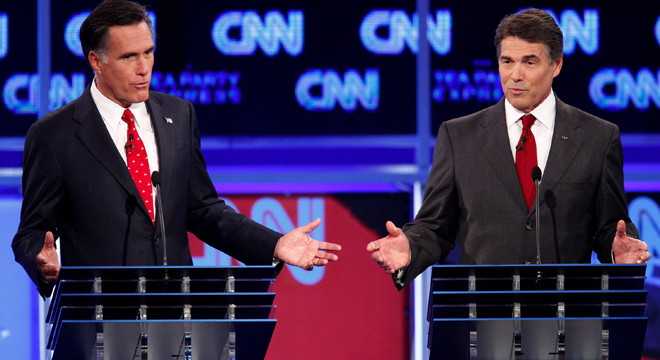
Rick Perry’s recent attacks against Mitt Romney over his support for White House’s Race To The Top program is more than just a passing hit job: it reveals a large and mostly unspoken division within the GOP over education.
“There is one person on this stage that is for Obama’s Race to the Top and that is Governor Romney,” Perry said in last week’s debate, adding that “that is not conservative.”
Actually, Mitt Romney wasn’t the guy on the stage who supported Race To The Top, (although he had plenty of nice things to say about it). That would be Newt Gingrich. The former Speaker of the House actually toured the country with Education Secretary Arne Duncan and the Rev. Al Sharpton to promote it.
“I agree with Al Sharpton, this is the number one civil right of the 21st century,” Gingrich said of education policy in a joint Meet The Press appearance in November 2009, adding that Obama showed “real leadership” on the issue.
There will be another fan on the debate stage if Chris Christie joins the race. He’s called Duncan a “great ally to try to reform education for kids across America.” Christie’s biggest beef with Race To The Top wasn’t that he didn’t like the program, it’s that his state bungled the application to compete for its funding. Another administration backer is the other fantasy candidate Mitch Daniels, who gushed over Duncan and Obama’s education initiatives in a speech at conservative think tank AEI this year.
The gaping partisan divide in Washington today has turned even once routine issues like raising the debt ceiling and issuing disaster relief into apocalyptic fights. So it’s a little surprising that one of the most important planks of domestic policy, education, is among the few relatively nonpartisan topics over the last decade.
It began with President Bush, who courted the middle by passing a No Child Left Behind bill — with help from John Boehner and Ted Kennedy alike — that included national education standards. Obama further scrambled the equation by taking an approach even more popular with conservative think tanks that focused on rewarding states that voluntarily reform their school systems with grants and prizes, most notably through the $4.35 bill Race To The Top program. Many of the individual ideas endorsed by the White House, including expanding charter schools and provisions designed to increase teacher accountability, are tough sells to teachers unions and popular even with Republican critics like Perry.
“On substance, there’s not much daylight even between Obama and the various Republicans candidates as far as elements of school improvement,” Rick Hess, director of education policy studies at the conservative American Enterprise Institute, told TPM. “They’re all broadly supportive of charter schooling, they’re all in favor of data systems that let you measure teacher effectiveness and overhauling tenure, they’re all in favor of doing something about persistently lousy schools.”
According to Hess, the primaries are obscuring their common ground as the candidates are loathe either to side with Obama on any individual program or undercut their anti-Washington message by talking up their plans for federal education policy.
Perry himself is a good illustration of the blurry partisan lines on education. He has been a leading critic of Race To The Top, which he argues pressures states into adopting national standards. In the last debate, he sold himself as a “vocal” opponent of No Child Left Behind, telling the audience that “the federal government has no business telling the states how to educate our children.” But back in 2002, Perry sang a different tune, happily accepting money from the Bush program and bragging in a press release that “Texas was a model for President Bush’s No Child Left Behind legislation.”
While the administration’s emphasis on using incentives to power progress and willingness to clash with key parts of its base fits in well with technocratic Republicans, the Tea Party’s rise has led much of the conservative base to revolt against the very notion of federal education policy. Presidential candidates Michele Bachmann, Ron Paul, and Gary Johnson have all called for the Department of Education to be abolished entirely and plenty of conservative lawmakers are on record backing the idea as well.
Perry, while not going quite as far, has adopted many of the same rhetorical frames. In Fed Up! he wrote that Republican NCLB supporters are “losing sight of the fact that perfectly laudable policy choices at the local level are not appropriate (much less constitutional) at the federal level.” Still, he’s not Ron Paul: in announcing his decision to drop out of the Race To The Top competition, he argued that the federal government should “make the money available to states with no strings attached,” rather than cancel the entire program.