Public anger over the weak economy and populist resentment of the developing world’s role in eliminating U.S. jobs will divide both parties on Capitol Hill this week, as a coalition of Democrats and Republicans make a major push to punish China for keeping its currency artificially weak.
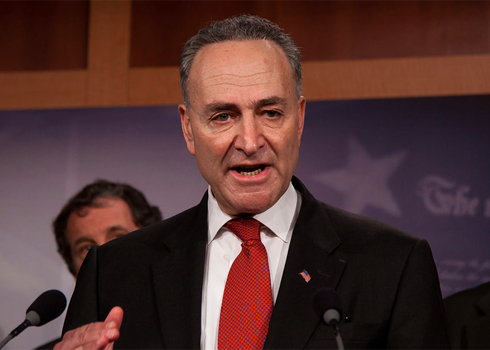
Led by Sen. Chuck Schumer (D-NY), the Senate is expected Monday to advance long-standing legislation intended to stop Chinese currency manipulation by making it easier for companies and workers to take legal action against illegal Chinese trade practices, and by forcing the federal government to impose economic penalties on China until Beijing allows the exchange rate between the dollar and the yuan to fall.
Economists say the yuan is undervalued by up to 40 percent — a distortion that likely explains the massive trade imbalance between the U.S. and China, and the loss of hundreds of thousands (or more) American jobs as manufacturers set up shop there to save money. Reversing this would act as a form of monetary stimulus in the United States, and the idea is that the threat of these penalties will force China to raise the value of its currency.
That’s created a bipartisan coalition large enough in theory to pass the bill and force President Obama — who doesn’t like the legislation — to sign or veto it. The Obama administration, like the Bush administration before it, views the measure as an encroachment on their diplomatic efforts that could backfire and cause a trade war.
But the Republican party isn’t quite prepared to seize the populist mantle and widen the schism between the White House and Congressional Dems. Powerful conservative interest groups — most notably the Chamber of Commerce and the Club for Growth — like that doing business in China is cheap and wants to keep it that way. Those groups have tremendous sway in the Republican controlled House, and particularly with GOP leadership. Last Congress, a similar bill passed overwhelmingly in the House — 348-79. But then Minority Leader John Boehner (R-OH) and his lieutenants all opposed it suggesting they aren’t interested in rubber-stamping the Senate bill.
But these aren’t normal times. Public vitriol about Congress’ unwillingness to do anything about jobs is molten. The public is angry at China. And so Republican leadership might just decide to let the chips fall where they may — and maybe, if they’re lucky, force a civil war in the Democratic party if Obama whips out the veto pen. So far the White House will only say it’s reviewing the legislation and shares the bill’s goals, hoping perhaps House Republicans will prevent Obama from having to take a public stand on it.