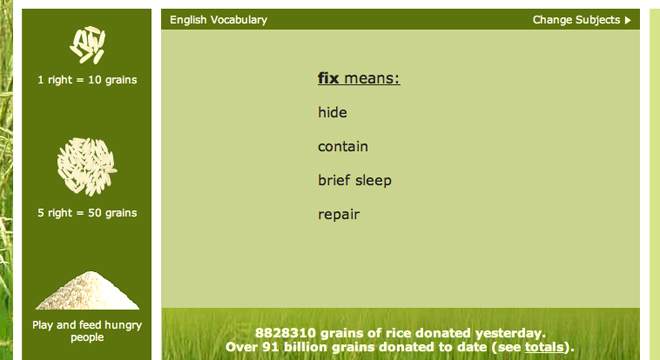
The United Nations is hoping that Chinese gamers will use their skills to help fight world poverty. But just how many of them will bite on Freerice, a free online English vocabulary game that donates grains of rice to a hungry child for every correct answer, remains to be seen.
“Freerice has been a global phenomenon in English, French, Italian and Spanish and is now reaching a critical and influential part of the global population,” said Nancy Roman, communications director for the UN’s World Food Program (WFP), in a post on the WFP website.
“China has more internet users than any other country in the world – they are curious, ambitious and looking for ways to improve their mastery of English,” Roman added.
The game is designed for students to allow them to practice their English and other subjects while at the same time, contributing to the fight against global poverty.
Specifically, the rice earned by their correct answers will be “donated to students in impoverished areas in China and other parts of Asia, according to Qin Wei, director of Disaster Relief Program Department of China Foundation For Poverty Alleviation,” China Daily reported.
“We are in partnership with the WFP to provide food to remote mountainous areas like Yunnan province in southwestern China, and the rice will also be sent to southeastern Asian countries via its school feeding program,” Qin told the newspaper.
Freerice was launched in 2007, having been developed by Indiana programmer John Breen, the man behind several other online global poverty-fighting websites including www.poverty.com and The Hunger Site, which, like Freerice, are funded through online advertising.
Since, then, the game has been translated into English, French, Italian and Spanish and counts 40,000 players a day, or 1.2 million unique players a month, who’ve collectively donated 100 billion grains of rice, enough to feed 4.8 billion people for a day, according to the WFP. It’s also added a number of other educational subjects, including chemistry, art, and math to its minigame portfolio. The Chinese port also contains unique flash minigames.
The Chinese port was developed by the WFP along with Chinese software developer Shanda Games, which has had humungous commercial success in the country with its massively multiplayer online games (MMOGs and MMORPGS) Magical Land, The World of Legend and Dragon Nest.
“We have always believed in the internet as a force for good,” said Shanda President and CEO Tan Qunzhao, Reuters AlertNet reported. “Young people in particular are looking for games that entertain and educate at the same time.” He continued:
“Freerice not only does both – it also allows its players to contribute to the fight against hunger at the same time. We are delighted to be involved with such an innovative and worthwhile product, which has already been so successful in other languages.”
Getting Freerice to catch on in China is a prescient step, considering China set to become the largest online gaming market in the world by 2014, overtaking the United States in total sales. Currently, U.S. companies account for 26 percent of all interactive game sales globally, compared to 12 percent for Chinese companies. But over the next three years, China is expected to increase its market share to 25 percent, compared to the U.S., which is anticipated to see a decline to 22 percent.
And there’s reason to believe that the WFP knows what it is doing in the gaming sphere, having already another wildly successful educational and hunger-fighting game, Food Force, back in 2005, designed to teach schoolchildren the WFP’s efforts to end hunger around the world. The game was downloaded 4 million times in its first year.
But just like in the U.S., Chinese gamers, particularly the largest demographic of young, school-aged users, aren’t necessarily looking to boost their educational skills when they play games. Rather, they’re looking to get away from their studies and have a good time.
In fact, just as in the U.S., the trend in China is moving towards social games, that is, those in which the gameplay is centered around your interactions with friends and based upon or modeled after popular social networks.
China is also seeing explosive growth in mobile gaming, but of course, most mobile phones don’t support the full browsing experience, especially Flash, which is an intergal part of the China verison of Freerice.
It’s unclear at this time if Freerice will offer social and/or mobile gaming features. We’ve reached out to the WFP and John Breen for more information and will update when we receive a response.