EMILY GERTZ
More dour news out of the U.N. climate talks in Durban on Wednesday: Latin American countries including Venezuela joined the U.S. and Saudia Arabia in raising objections to the details of a “Green Climate Fund” designed to raise $100 billion per year by 2020 to allow developing countries to begin adopting low-carbon technologies and kick fossil fuels, as well as mitigate and adapt to the worst impacts of global warming.
This Green Climate Fund was supposed to be formally established at COP17, the international climate talks going on this week and next in Durban, South Africa.
But the Latin American countries, lead by Venezuela, have said that they are opposed to the fund being run by the World Bank, which they view as a proxy of the U.S., the Financial Times reported Thursday.
Ahead of the conference, the U.S. and Saudi objected to the fund for other reasons.
The United States, historically the world’s greatest CO2 polluter, wants “more emphasis on the role of the private sector” in the fund, as opposed to contributions from governments, according to Reuters. The U.S. also wants “an explicit reference that contributions to the fund could also come from developing countries, although there is nothing to stop a developing country doing so under the current draft.”
Top global oil exporter Saudi Arabia wants more explicit language around compensation for lost oil income, according to Reuters, should the world in fact significantly cut back on consumption of the black juice.
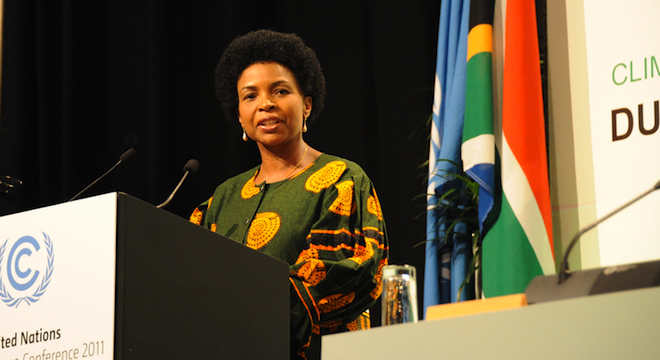
Developments are serious enough that COP17 president Maite Nkoana-Mashabane, South Africa’s Minister of International Relations and Cooperation, is undertaking informal negotiations with delegates, reported South Africa’s Daily News.
Nkoana-Mashabane is reportedly encouraging delegates to accept the compromises in the fund blueprint, made over four months and seven meetings in advance of COP17, so that the fund will be green-lit during the Durban confab.
At the Wednesday plenary, as seen in this video from Think Progress, U.S. lead negotiator Jonathan Pershing charged that the process to set the terms of the fund was too rushed, leading to “errors and inconsistencies that could result in confusion and impede the board’s work.” The U.S. wants “a small amount of further work” to be done on the document, said Pershing, adding that ths U.S. is committed to seeing this work completed at Durban.
U.S. and Saudi objections were expected, as they had been voiced at the final climate fund meeting held prior to COP17. But the objections from some other nations appear to have been less anticipated.
Since achieving full consensus of all 194 nations is how the UN climate treaty process rolls, any opt-outs would push the establishment of the Green Climate Fund past the end of the Durban talks.
“What we have is a situation where the transitional committee actually came up with a reasonably good compromise document,” Saleemul Huq, a senior fellow at the International Institute for Sustainable Development (IISD), told OneClimate. “Some countries want to re-open the document and have bits and pieces that they want to change. And if one country does that, then other countries want to do that, and we’re back to square one again.”
But Huq remains optimistic, he said, that the conference’s South African leaders have what it takes to solve the diplomatic impasses at COP17, which include the future of the Kyoto Protocol climate treaty itself. “They have a history of bridging great political divides when they ended apartheid, which was a huge political issue with extremes of political position,” he told OneClimate. “So they know how to bring groups together and find common ground in a consultative manner. So I have great faith that they’ll be able to do that here.”