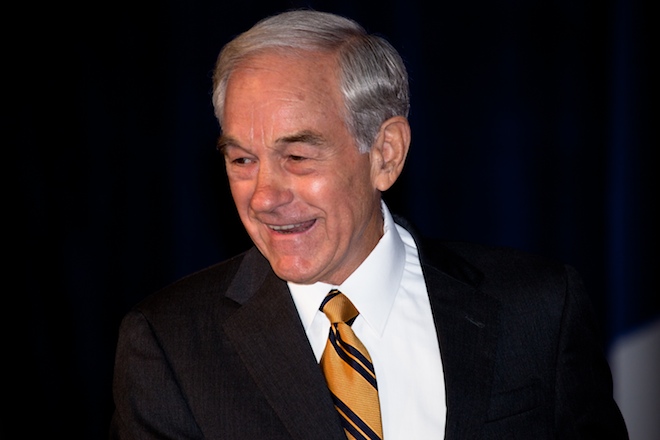
Four years ago, a mostly unknown, former third party nominee, Ron Paul rapidly turned into a national phenomenon as thousands of supporters, donors, and volunteers organized a vast online network devoted to boosting his libertarian campaign.
It was a little surprising even for Paul. “To tell you the truth, I hadn’t heard about this YouTube and all the other Internet sites until supporters started gathering in them,” he told the Washington Post in 2007.
The Paul campaign had so much money they almost seemed unsure what to do with it. Their TV spots for example, were almost laughably low-quality.
But his campaign has advanced leaps and bounds since 2008 and he has the slick ads, solid fundraising, and impressive ground game to prove he wasn’t just a flash in the pan. Polls show him with a lead in Iowa and he could finish strong in New Hampshire even if a victory may be out of bounds. The campaign is hoping to place top three in both, a feat that looks well within the realm of possibility.
I think he’s got a ceiling in New Hampshire,” Pat Griffin, a Republican strategist in the state, told TPM. “But the floor is much higher than anyone expected it would be.”
While a number of anti-establishment Republicans have seen meteoric rises driven by national media attention with little campaign organization to speak of, most notably Herman Cain and Newt Gingrich, Paul has focused on old-fashioned campaigning in Iowa and New Hampshire while largely avoiding the spotlight. There were no wild swings in the polls, just a steady uptick in Iowa as various rivals have fallen to the wayside or dropped out.
“We had been told we had a certain number of supporters that we could never break, we had this glass ceiling we’d suffer,” Paul spokesman James Barcia told TPM. “But what we did was begin with that naturally…then by working on the the ground operation, just old fashioned retail politics, we’ve been able to build on it incrementally.”
According to Barcia, the campaign is regarded as more “disciplined” now by ’08 veterans, having built up its own institutions to harness the grassroots energy from its last run — much of which took place entirely outside the official campaign itself at the time. Unaligned Republican officials in Iowa say Paul’s volunteers have been an impressibly visible and focused presence through the campaign.
“The campaign is definitely more substantial this time around,” New Hampshire media coordinator Kate Schackai said. “I was actually in the same role back in 2007, and we got off the ground this time faster, earlier, and with more strength from the get-go.”
Paul’s always had a strong base of young supporters and the latest PPP poll shows him taking the lion’s share of under-45 voters. Which creates an additional challenge: the Iowa and New Hampshire primaries are smack dab in the middle of winter break at most colleges, meaning some supporters registered to vote at their campus could be trapped at home or on vacation elsewhere.
“It’s our hope that the enthusiasm for Ron Paul gets the youth vote out regardless of the school calendar, and that this enthusiasm makes up for any differences in youth turnout in a caucus state like Iowa versus New Hampshire,” Barcia said.
Paul still is a long shot — to put it mildly — for the nomination. His anti-war, pro-drug legalization stance as well as his well-documented ties to the militant fringe make him antithetical to large swaths of the GOP electorate. But in addition to building momentum for his unique message, a big showing could still have a major impact on the race. Paul has launched many of the toughest attacks against Newt Gingrich and if he can keep the ex-Speaker’s support down, he may help head off a long and difficult primary challenge for Mitt Romney.
Then there’s the option that Paul himself has repeatedly denied but keeps Republican operatives up at night: a third party or independent bid. Many of Paul’s supporters are independents and he could potentially take a swath of GOP-leaning voters with him.