Here we go again.
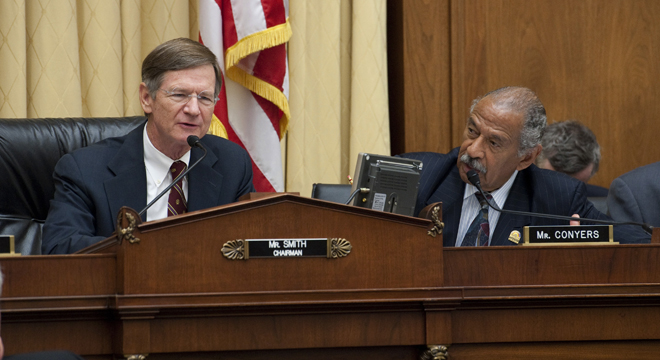
The U.S. House of Representatives will resume a contentious markup hearing on the Stop Online Piracy Act (SOPA) in February, according to an announcement posted online late Tuesday by the bill’s sponsor, Rep. Lamar Smith (R-TX).
As Smith wrote:
“Due to the Republican and Democratic retreats taking place over the next two weeks, markup of the Stop Online Piracy Act is expected to resume in February.
“I am committed to continuing to work with my colleagues in the House and Senate to send a bipartisan bill to the White House that saves American jobs and protects intellectual property.”
The news comes a blow, and perhaps a further catalyst for the growing chorus of critics of SOPA, many of whom have declared Wednesday, January 18 to be a day of protest against the bill and its counterpart in the Senate, the PROTECT IP Act (PIPA), which is due to be voted upon on January 24. Google, Wikipedia, Reddit and many other popular websites are changing or “blacking out” their U.S. homepages on Wednesday to protest the bills.
Both bills would give the U.S. Attorney general the power to seek court orders to takedown foreign websites accused of piracy by content copyright holders. Some of the largest copyright holders — including Hollywood and the American recording industry — are among the bill’s most outspoken supporters.

But leading Web companies, along with many entrepreneurs and tech writers, are dead-set against the legislation, saying it is too broad and would ruin the functioning of their websites, especially when it comes to user-posted content, which would need to be more strictly monitored for copyright “infringing activity” should the legislation pass.
Smith, who first introduced SOPA in October, is also the Chairman of the House Judiciary Committee, a smaller segment of the House that is responsible for “marking up” SOPA, or voting on specific amendments to the bill before it can be voted upon by the full House.
Smith led the first part of the markup hearing in mid-December 2011, but that first part alone lasted nearly 15 hours over a two-day span, during which time only about half of the amendments to SOPA were actually voted upon. The rest still need to be considered.
But due to the Congressional holiday recess, Smith finally adjourned the hearing on December 16, 2011, saying at the time that he would consider the request of the few SOPA opponents in the committee to hold extra hearings on the technical effects the bill could have on American cybersecurity.
It’s unclear if Smith will actually hold those cybersecurity hearings before or at the same time that the markup hearing on SOPA resumes in February 2012. Smith’s office declined to comment further to TPM, but he alluded to as much in the announcement Tuesday:
“To enact legislation that protects consumers, businesses and jobs from foreign thieves who steal America’s intellectual property, we will continue to bring together industry representatives and Members to find ways to combat online piracy.”
On Friday, Smith also threw the SOPA critics a bone when he announced he would be removing one of the most criticized requirements of his bill — DNS blocking, which would have forced Internet Service Providers (ISPs) such as Comcast, AT&T and Verizon to serve up error messages when users attempted to navigate to foreign websites accused of piracy.
At that time, Smith also sounded open to additional hearings, writing: ” I feel we should remove Domain Name System blocking from the Stop Online Piracy Act so that the Committee can further examine the issues surrounding this provision.”
Chart by Clayton Ashley