The long-awaited Facebook initial public offering became a reality on Wednesday when the company filed its prospectus paperwork with the Securities and Exchange Commission, revealing it intends to raise $5 billion when it goes public, “as soon as practicable.”
While less than the $10 billion initial value speculated by earlier reports, the amount would still make Facebook the largest Web IPO in history, besting Google’s $1.9 billion IPO in 2004. It also says nothing in particular about the overall value of the company, which is expected to be between $75 billion and $100 billion, consistent with earlier reports.
Morgan Stanley was named as the lead underwriter for the Facebook IPO, followed by JP Morgan Chase, Goldman Sachs, BofA Merrill Lynch, Barclays Capital and the surprise boutique firm Allen & Company, in that order.
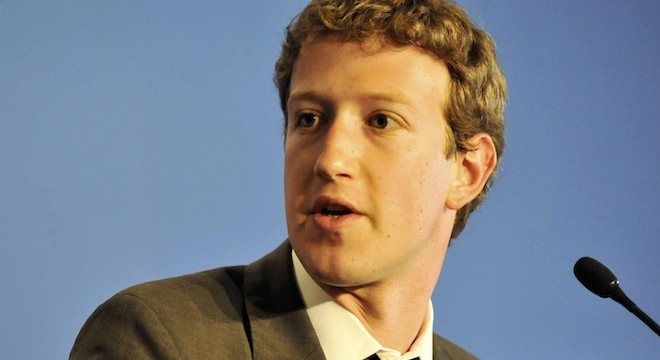
The S-1 filing included a staggering array of detail about Facebook’s business operations that had previously only been speculated upon, including a lengthy letter from founder and CEO Mark Zuckerberg, in which he espouses the “Hacker Way,” which he describes as “an approach to building that involves continuous improvement and iteration.”
According to the filing, the 27-year-old Zuckerberg received a base salary of $500,000 in 2011, plus a $220,500 bonus for the first half of the year, a comparatively minor sum given the monstrous worth of his company, and one that is set to drop to just $1 annually beginning in 2013.
And yet, due to his 28 percent stake in the company, he’s worth an estimated $16 billion, according to the filing. The filing further revealed that Zuckerberg receives a “comprehensive security program,” including Facebook-paid security features on his residence and the use of a private jet for his personal travel and that of family members.
But filing was also notable for the numerous blanks it contained, including precisely when the company intends to begin trading and on which stock exchange, although Facebook’s S-1 narrowed that down to two options: the New York Stock Exchange (NYSE) and the NASDAQ, the latter of which is traditionally favored by tech companies.
Facebook will have to fill in those blanks at some point throughout the IPO process, which could last up to 12 weeks — putting the likely opening trade date in May — as the SEC reviews the prospectus and sends comments back to Facebook and Facebook updates its filing to be in compliance with the agency.
Still, the Facebook S-1 was an event in and-of-itself, with numerous journalists and other Web users poring over the documentation as soon as it hit the SEC’s website just before 5 pm ET, such that the traffic overwhelmed the SEC site and caused it to suffer intermittent access. It also marked a “coming of age,” for the social Web — by far the largest social media company to go public, on the heels of Zynga, Groupon and LinkedIn, which all saw their stocks hit bumpy waters soon after going public in 2011.
Here’s what we know about Facebook know thanks to the S-1 filing:
Facebook said its mission is “to make the world more open and connected.”
Facebook priced its IPO at $5 billion, or $0.000006 par value per share (the minimum price per share Facebook will sell. It will obviously be much higher than this when it actually hits the market).
Facebook intends to begin selling shares of its stock “as soon as practicable.”
Facebook’s lead underwriter is Morgan Stanley, followed by JP Morgan Chase, Goldman Sachs, BofA Merrill Lynch, Barclays Capital and Allen & Company, in that order.
Facebook reported revenue of $3.7 billion for all of 2011, compared to $1.9 billion a year before and just $777 million in 2009.
Facebook stated: “In 2009, 2010, and 2011, advertising accounted for 98%, 95%, and 85%, respectively, of our revenue. As is common in the industry, our advertisers typically do not have long-term advertising commitments with us…Our advertising revenue could be adversely affected by a number of other factors.”
Facebook said that game company Zynga (maker of “Farmville” and “Words With Friends”) accounted for 12 percent of its revenue in 2011.
Facebook has $3.9 billion in cash or liquid assets.
Facebook reported 845 million monthly active users in December 2011, an increase of 39 percent from the year before.
Facebook reported 2.7 billion “Likes” and comments per day on average during the fourth quarter of 2011.
Facebook reported 425 million monthly active users on mobile devices during the same period.
The Facebook mobile app “is the most frequently downloaded app across all major smartphone platforms in the United States.”
Facebook names a number of risk factors that it warns prospective investors to consider before buying into the company, including, but not limited to: Loss of advertisers, loss of key personnel including Mark Zuckerberg and chief operating officer Sheryl Sandberg, competition from the likes of Google, Microsoft, and Twitter and regional social networks Cyworld in Korea, Mixi in Japan, Orkut (owned by Google) in Brazil and India, and vKontakte in Russia, and actions by government to restrict access to Facebook.
Facebook spent $51 million acquiring patents in 2011, up from $33 million in 2010.
Facebook has 56 issued patents and 503 filed patent applications in the US and 33 corresponding patents and 149 applications abroad. Facebook’s issued patents expire between May 2016 and June 2031.
We learn a number of things about Facebook’s offices and office culture from the filing and Zuckerberg’s letter, including the fact that “Done is better than perfect” and “This journey is 1% finished,” are motivational slogans posted on some walls, and that the company is happy with its current office space and not planning on expanding in the near future, writing “We believe that our facilities are adequate for our current needs.”
Facebook acknowledges the ugly ownership lawsuit brought by New York woodchip salesman Paul Ceglia, who alleged Zuckerberg agreed to give him a 50 percent ownership stake in the company prior to it being developed, but the filing states: “We continue to believe that Mr. Ceglia is attempting to perpetrate a fraud.”
Randi Zuckerberg, Mark’s sister, received over $260,000 from the company over the three years she was employed as Marketing Director (2009-2011). She’s resigned from the company to start her own firm in August 2011, but she still tweeted “YAY!!!!” after the filing.
Not from the filing, but in reaction to it: Facebook’s ousted, embittered co-founder and former CFO Eduardo Saverin — whose testimony was the inspiration for the book “The Accidental Billionaires” and the subsequent movie adaptation “The Social Network” — posted a favorable reaction to the IPO on (where else?) Facebook, writing “Here it is, what a ride! Site first launched February 4, 2004.”