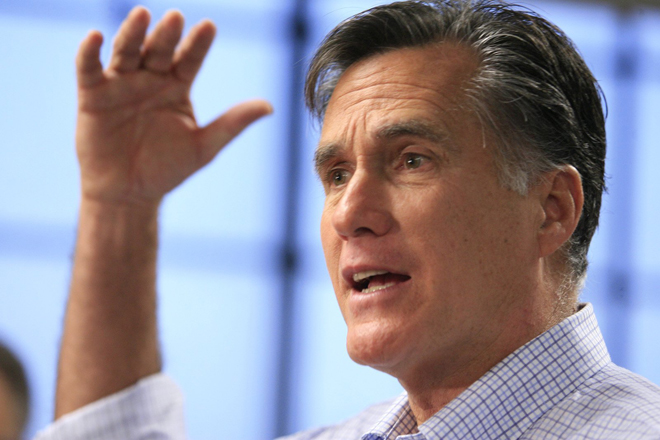
Mitt Romney is stuck in the worst possible position this week in Michigan when it comes to the auto bailout. On the one hand, he’s being pilloried by both Democrats and the local press for his confusing criticism of the federal intervention that rescued the auto industry. On the other hand, his claim that he would have rescued Detroit too — maybe even with similar measures! — is drawing jeers from conservatives as well. That’s right, the Tea Party isn’t happy with his bailout position either.
At issue is confusion over just what the “bailout” was. Romney, who even in his “Let Detroit Go Bankrupt” days in 2008 hinted that the government would need to provide help to keep the car companies alive, can’t fully embrace the idea that taxpayer money should have gone to GM and Chrysler without angering the right. So instead he keeps winking at Michigan voters that the Obama administration’s managed bankruptcy solution in mid-2009 was exactly what he would have recommended himself and GM would still be posting record profits if they had just taken his advice sooner without all those bailouts beforehand. Left unsaid is that in order to make that managed bankruptcy work without destroying the companies, the government had to step in with tens of billions of additional dollars in loans to keep them afloat.
Romney doesn’t like to talk about this part, alluding only to vague “help” from the federal government that he would have provided as president (and driving Detroit columnists insane in the process). This week he at least hinted for the first time that this “help” could have included direct loans. But for conservatives, using taxpayer money to ease GM and Chrysler through bankruptcy at all was a bailout. For Tea Partiers, it’s one of the ultimate bailouts.
“It was a managed bankruptcy and taxpayers were there the whole way,” Daniel J. Ikenson, director Cato’s Herbert A. Stiefel Center for Trade Policy Studies, told TPM. “I’m not sure what distinction Romney is trying to draw, but he’s awfully good at trying to flip flop.”
Mark Meckler, co-founder of the Tea Party patriots, said in an interview that a central Tea Party objection to the White House’s process was that the car companies received government loans and special treatment rather than going through a normal private sector bankruptcy.
“We have a bankruptcy system that applies to everyone else,” Meckler said.
And while Romney has tried to avoid the whole “direct loans” question, he’s explicitly endorsed measures like guaranteeing private sector loans or car warranties, which are still considered taxpayer bailouts on the right. According to Wayne Brough, chief economist of Freedomworks, even Romney’s rhetorical claim this week that “of course I wouldn’t have allowed [Chrysler and GM] to be liquidated” was a betrayal of conservative principles.
“It’s playing into the whole moral hazard question,” he said. “If in fact companies are thinking that way, it’s not the way a market works.”
As a smokescreen to distract from this fundamental conflict with the right, Romney plays up his opposition to other, less important, issues — how much the unions had to concede versus bondholders, for example — that play well with conservatives. But on the most basic question of the entire bailout, he’s simultaneously positioning himself as an anti-bailout crusader while all but insisting had he been in charge he would have bailed out the industry. And, as is often the case when one tries to please everybody, now nobody is happy.