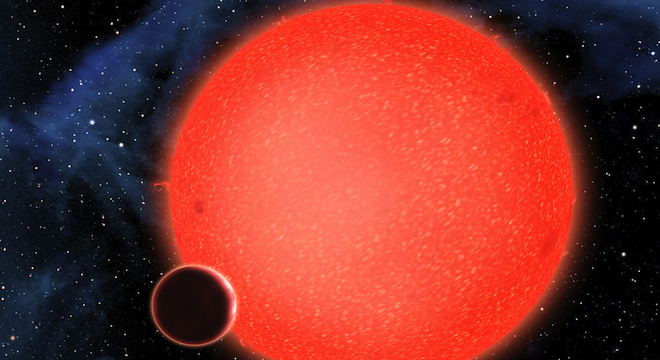
In the wake of NASA’s announcement on Tuesday that scientists had identified a remarkable planet made up primarily of steam using the Hubble Space Telescope, the leader of the project, Zachory Berta of the Harvard-Smithsonian Center for Astrophysics, took the time to describe the planet in greater detail to TPM.
Firstly, to dispense with the burning question on everyone’s minds: There’s almost no chance of life on GJ 1214b, located 40 light years away from Earth, orbiting a red dwarf star in the constellation Ophiuchus. GJ 1214b is simply too close to its star — just over a million miles away — and thus too hot, as Berta explained.
“The coolest temperature you can find on the planet is about the temperature of a hot oven,” Berta told TPM via email. “That’s too hot for the complex molecules of life to survive. It would be like putting a beautiful green, leafy plant into an oven and baking it at 450F for a billion years, it just wouldn’t work! If the planet were about 4 times as far away from its star as it is, it could be cool enough that maybe we could start talking about life surviving and thriving on it.”
Berta’s team theorizes that the planet formed further out from its star and moved steadily closer over eons, baking.
Still, establishing the planet’s atmospheric makeup is an important discovery in our quest to unlock the secrets of the Universe.
“We’re learning more about the diversity of worlds out there in the Galaxy, the many possible ways that planets can form,” said Berta. “I think that’s a very important step in placing our solar system, and Earth, in context.”
As to whether the planet is representative of an entirely new class of planets or not, Berta said “we need to find more of them to know for sure.”
Furthermore, scientists aren’t really sure if the planet is made up primarily of pure water vapor, water mixed with other compounds, or something else entirely.
“Knowing what we know about the abundance of elements in the Universe, water is the most likely culprit,” said Berta.
However, because the planet’s surface temperature is far above the boiling point, that water is mostly in steam form.
“There’s probably very little liquid water as we know it,” Berta acknowledged, “Much of it would be in solid or more gaseous form, and mixed in with lots of other constituents, including some hydrogen and helium.”
As far as the other “solid” forms of water that could be occurring on the planet, Berta previously said that it could exist in such states unknown on Earth or anywhere else in the universe, such as “hot ice” or “superfluid water.”
“We don’t know how deeply the envelope of water on the planet extends down into the planet, so you could get down to really high pressures and temperatures, where water behaves very strangely,” Berta elaborated to TPM.
The Hubble space telescope provided a closer view of the planet’s atmosphere than any other instrument to date, including the ground-based telescopes that were the first to spot GJ 1214b in 2009. Hubble’s infrared close-up ruled out that the planet had a hazy atmosphere primarily of hydrogen, instead indicating it was made primarily of water, but scientists will need to get even closer to be sure exactly how much.
“With more observations, we’ll be able to figure out the exact quantities of many different kinds of molecules on GJ1214b, exactly how much water, carbon dioxide, methane, etc… are in the atmosphere,” Berta explained. “The picture we have of GJ1214b’s atmosphere is right now only a sketch, we need more observations to fill in the details!”
The ultimate observation tool — the James Webb Space Telescope, a successor to Hubble that’s slated to be 100 times more powerful — is still under construction and slated for a 2018 launch, although it has been delayed, seen its costs balloon and been targeted by Congressional budget slashers.
Still, Berta is confident that there are enough telescopes and planetary scientists working right now to get an even better picture of GJ1214b ahead of the launch of the James Webb Telescope.
“By making a serious investment of telescope time using the big telescopes we have right now, we should be able to start to fill in the picture of GJ1214b and its internal structure and atmosphere,” Berta said.