Social news aggregation apps are a dime-a-dozen these days, but News.me, a startup company that features programming veterans of the New York Times, GQ, among other notables, is hoping that its new iPhone app will win converts with its “less is more” philosophy.
News.me’s first product was a subscription iPad app developed by the New York Times R&D Lab in conjunction with Betaworks and launched in April 2011. The initial News.me product was acquired by Bitly, the link-shortening company, and eventually spun out as a separate company.
The new iPhone app, launched Thursday, takes a familiar approach of allowing users to scan their Twitter and Facebook contacts lists for links to news articles that their friends have shared, much like competitors Flipboard, Trove, Zite and Pulse.
But what distinguishes the News.me for iPhone app is two main things: Its news prioritization system and its in-app commenting system.
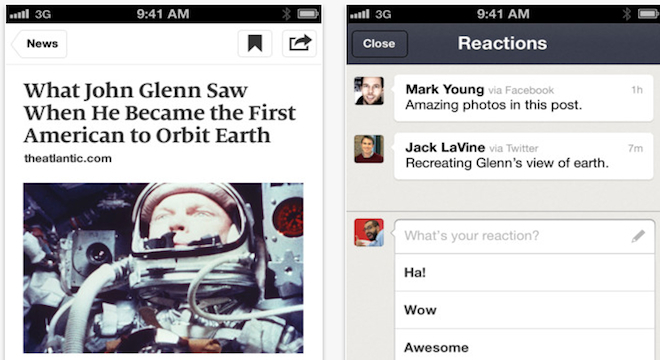
News.me’s story stream — a vertical column of article headlines, photos and summaries — prioritizes at the top those articles that have been most shared or commented on by a user’s social networking contacts. The app shows the tweets and Facebook comments about those stories underneath them.
Users can then comment on those stories within the app itself — choosing from five preset reactions “Ha!” “Wow,” “Awesome,” “Sad,” and “Really?” or supplying their own original comments — without broadcasting them comments to Facebook or Twitter.
It’s an approach that will be familiar to users of the hit iPhone photo app Instagram, which offers similar in-app commenting, to which News.me has already inspired comparisons.
In this way, News.me hopes to whittle down both the torrent of news that’s being shared on Facebook and Twitter and the commentary surrounding it, centralizing it on only those stories and comments that are most popular.
“One thing we’ve heard from beta testers is that ‘you don’t have to think too carefully about saying something in this app'” News.me General Manager Jake Levine told TPM in a Skype conversation. “That’s because your News.me group is a smaller, more manageable group than Facebook or Twitter.'”
Indeed, Levine said that News.me’s goal was to allow users to build their own social networks from the ground up based around news. When commenting on News.me, the comment only appears to other users of News.me. But users can choose to tweet out stories or post them on Facebook or email them to other users.
In fact, in many was it was email itself that inspired the small News.me team of six to pursue a “less is more” philosophy in the iPhone app.
“Looking at the place where people share news the most today, it isn’t Twitter or Facebook but email,” said Levine, citing a study of digital news sharing commissioned by the New York Times in advance of the paywall it introduced in March 2011. “What is special about email is that with every news email you send, you are building your network from scratch. And when you think about that network, it’s maybe 6, 10, or 15 people you talk with regularly with about news content, not the 300 people on Twitter or 500 on Facebook.”
To date, a daily News.me email that rounds up the top 5 “most important” stories as judged by the app is still the young company’s most popular product, harkening back to the early Internet days of listserves.
One other major asset of News.me: The app downloads all of the articles being shared and commented upon on its network for offline viewing in a clean, black and white user interface, the same way that popular iPhone app Instapaper does, to the delight of commuters.
But the question remains: Does the world really need another social news aggregator app, and even if it does, is News.me the one?
“We have a hypothesis about how people are going to use this, but we’re going to learn tremendous amount in next 30 to 60 days,” Levine said.
Editor’s Note: News.me’s current editor Josh Petri was an intern at TPM from August 2011 to December 2011. TPM is not affiliated with News.me in any way.