All eyes are on Ohio, the one state above all others on Super Tuesday where Mitt Romney could potentially nail down the nomination with a victory — or where a win by Rick Santorum could put him back into contention in the Republican race for president. But beyond tomorrow, the eyes of the country will still be on Ohio, for the general election — both for the presidential race, and for the re-election campaign of Democratic Sen. Sherrod Brown.
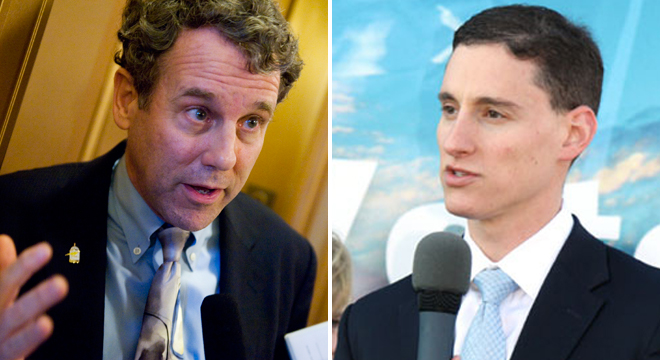
Brown was elected to the Senate in the 2006 Democratic wave, defeating incumbent Republican Sen. Mike DeWine by a margin of 56%-44%. Before that, he was first elected to the Ohio state Senate way back in 1974, at the age of only 22; then Ohio secretary of state in 1982. He was defeated for re-election in 1990, then made a comeback to the U.S. House of Representatives in 1992, where he served until his election to the Senate.
His opponent is state Treasurer Josh Mandel — whose political career path seems in many ways a younger, Republican version of Brown’s. He was elected to the state House in 2006, at age 29, and was then elected Treasurer in the 2010 Republican wave, defeating the appointed Democratic incumbent by 55%-41%.
So what kind of year will 2012 turn out to be? And how will these two candidates manage it?In the latest TPM Poll Average of the race, Brown has a lead over Mandel of 46.3%-35.9%:
But don’t expect his double-digit lead to stay that way forever. For example, in February’s Quinnipiac poll, Brown led by a margin of 48%-35%. Underneath the surface, however, Brown’s favorable rating is 41%, his unfavorable number is 26%, with 31% who had no opinion. Mandel’s favorables, however, were at only 16%-12% — with a whopping 71 percent who had no opinion. And as the campaign heats up, and Mandel becomes more visible and raises his name recognition, he is bound to start closing the gap.
“The race is going to naturally tighten for two key reasons,” a Democratic source in Ohio told TPM. First, Mandel for now appears to have been more focused on raising money, rather than campaigning. In the latest FEC figures through February 15, he has raised $5.8 million and has $4.3 million on hand. This is almost as much as Brown’s total haul of $6.5 million and $5.3 million on hand — and Brown has had a whole Senate term to build up a war chest.
Furthermore, the source pointed to the great amount of outside spending that has come in from independent groups. Quite notably, the Chamber of Commerce has been actively running attack ads since late last year, and he was also included in a recent wide-ranging buy across multiple states.
But with that said, the source indicated that jobs would be the major issue of the campaign, and Brown currently has two major avenues to attack Mandel. The first is Mandel’s past support for Gov. John Kasich’s anti-public employee union law, S.B. 5, which was overturned in a referendum this past November. The other is the Obama administration’s bailout of the auto industry — which Republicans have roundly spoken out against, but has ultimately worked out for people in the Rust Belt.
The source said: “I think there are a lot of ways to contrast who’s on the side of Ohio’s middle class, and we’ll do that.”
On the other side, a Republican source in Ohio touted Mandel’s energy ability to campaign, once things get going — in his race for state representative in 2006, he knocked on nearly 20,000 doors.
The source also predicted that a race would be waged against unpopular policies in Washington. “I think that the president is going to be held accountable for the job losses in Ohio,” the source said, later adding: “We’re going to illustrate how Sherrod Brown says one thing in Ohio, and does another thing in Washington.”
Health care reform could also be an issue, with Republicans set to highlight how Brown was one of the 60 votes needed to pass the Obama administration’s health care reform initiative.
The source also pointed to another way the race will get national attention: Republican Sen. Marco Rubio will be coming all the way from his stomping grounds of Florida and Washington, to campaign for Mandel.
Don’t forget that Ohio is one of the country’s biggest swing states. In 2008, it voted for President Obama by 52%-47%, and is likely to be contested again all the way to November this year. And with many of the same issues at hand in both races — the economy and health care, for example — the Senate race could bear just as much of a close watch.