Mitt Romney has grown so accustomed to defending his old health care position to the right that he may have trouble defending his new one from the left.
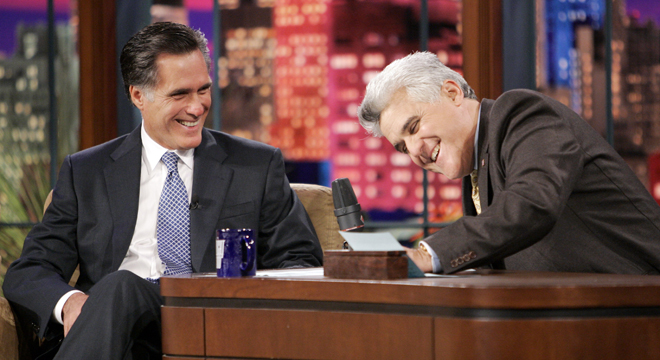
The presidential candidate was so jarred by a simple line of questioning from — of all people — Jay Leno on Tuesday night about coverage for Americans with pre-existing medical conditions to the point that he seemed to suggest a new position out of thin air.
Leno pressed Romney repeatedly on what to do about uninsured children and certain workers whose jobs don’t allow them to obtain coverage. Romney at first stressed that he would work to make sure “people with pre-existing conditions, as long as they have been insured before, they are going to be able to continue to have insurance.” But when Leno continued, Romney seemed to propose going further than his own plan allows.
“We’ll look at a circumstance where someone is ill and hasn’t been insured so far,” Romney said, “but people who have the chance to be insured — if you are working in the auto business, for instance, the companies carry insurance, they insure their employees, you look at the circumstances that exist — but people who have done their best to get insured are going to be able to be covered.”
The trouble is, Romney hasn’t suggested any way people who have been ill can obtain insurance in the first place.
Romney has been under fire in recent weeks for omitting crucial details from his policy proposals that make them easily adapted to both sides of the debate. But in this case his out-of-thin-air help for the sick suggestion seems more like a slip of a tongue, if a telling one.
Asked about Romney’s Leno comments, the Romney campaign clarified to TPM that the former Massachusetts governor will find ways to prevent insurers from dropping people who get sick, so long as those people maintain continuous coverage. They offered no proposals regarding sick people who haven’t been able to get in the first place.
In fact, the only time Romney raised the specter of such cases in the Leno interview was to mock a hypothetical middle-aged man who tries to get insurance after becoming sick.
“If they are 45 years old and they show up and say, ‘I want insurance because I have heart disease,’ it’s like, ‘Hey guys. We can’t play the game like that. You’ve got to get insurance when you are well and then if you get ill, you are going to be covered,'” Romney said.
The trouble is that, as Romney is surely aware from his work in Massachusetts, that 45-year-old guy who could have had insurance but chose to take his chances is hardly the face of pre-existing condition discrimination. Millions are in danger of losing insurance for reasons well beyond their control. Most notably, as Leno pointed out, children suffering from chronic illness.
Many workers are forced to rely on part-time and freelance work that doesn’t include benefits, a statistic that Romney often cites on the trail. Benefits designed to keep insurance in place continuously (as Romney encourages) like COBRA are often too expensive to possibly maintain, expire during long-term unemployment or never kick in as laid-off workers in a variety of circumstances (like when their employers’ business goes under) do not qualify. Then there are other cases where those with pre-existing conditions may end up uninsured through no fault of their own: the college graduates who struggle to get a job with coverage after graduation, a stay-at-home spouse with a pre-existing condition who loses family coverage in a divorce, for example, or whose spouse moves from a private family plan to Medicare.
Jonathan Gruber, the MIT economist who helped craft Romney’s Massachusetts health care law, told TPM that Romney had little to offer people facing such struggles without renewing his past support for universal coverage.
“Without a ban on insurance market discrimination, you can’t cover pre-existing conditions exclusions — and without a mandate, you can’t effectively have such a ban,” he said.
Meanwhile, the Obama campaign is already seizing on Romney’s dismissal of the imaginary 45-year-old seeking coverage.
“Only in Mitt Romney’s world of tax cuts for billionaires and elevators for his cars would denying health care coverage to Americans with pre-existing conditions make sense,” Obama spokeswoman Lis Smith said in a statement.
Add it up, and the Leno exchange is a striking reminder that, even after a year of campaigning, Romney will enter the general election on shaky ground, forced to passionately defend many of the same disturbing health care practices that he devoted his governorship to ending in Massachusetts.