

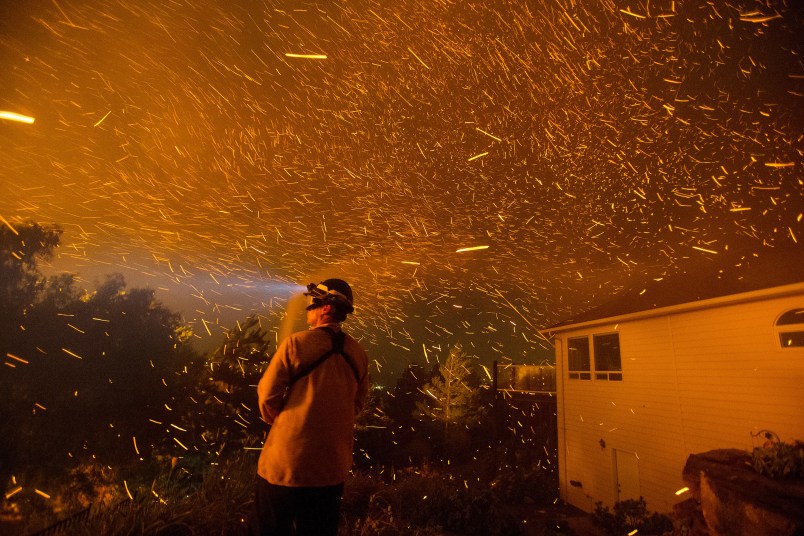
WENATCHEE, Wash. (AP) — From just across the Wenatchee River, Dominick Bonny watched a whole neighborhood in his central Washington town burn as a wildfire destroyed two dozen homes and forced hundreds to flee.
“With the wind blowing away from us, it was like we were watching a natural disaster within arm’s reach,” he said.
Wildfires hit parts of central and eastern Washington over the weekend as the state is struggling with a severe drought. Mountain snowpack is at extremely low levels, and about one-fifth of the state’s rivers and streams are at record low levels.
Eastern Washington has been experiencing temperatures into the 100s, and last week Washington Gov. Jay Inslee issued an emergency proclamation that allows state resources to quickly be brought in to respond to wildfires.

A Chelan County Sheriff’s deputy races to check that all residents have left their home as flames approach houses at Quail Hollow Lane in Wenatchee, Wash.
Washington’s struggles with wildfires come as Alaska, its fellow Pacific Northwest state, is facing more and harsher wildfires this year.
In Wenatchee, the wildfire fueled by high temperatures and strong winds roared into town Sunday afternoon. The blaze ignited in brush just outside Wenatchee, quickly burning out of control about 120 miles east of Seattle.
Rainfall on Monday provided some relief, but hot, dry conditions and wind posed continuing challenges. The flames have burned more than an estimated 4 square miles, officials said. Three firefighters suffered minor injuries, but no injuries to residents were reported.
Fire crews concentrated Monday on preventing any more homes from being burned, State Patrol Trooper Brian Moore said. Crews worked to put out hot spots in already burned areas.
Elsewhere in central Washington, a new wildfire was reported burning late Monday south of the small town of Mansfield, about 40 miles northeast of Wenatchee. The state Emergency Management agency authorized state assistance to fight that fire, which reportedly has burned more than 3 square miles. There were no reports of any homes being threatened.
Tom Bryant surveyed the smoldering ruins of his home in the hills above Wenatchee and said he and his wife had to race out of the house at the last minute as the fire advanced Sunday night.
On Monday, he pointed to a Mustang sports car that was a burned wreck and to his BMW motorcycle that was destroyed in the garage.
“It’s going to be tough to replace,” Bryant said. “It hurts, but it’s just stuff. It’s painful.”
He was unable to save photographs and important documents, Bryant said. “That’s where all our stuff is,” he said, pointing to a burned file cabinet.
Evacuations were mainly in the north end of town and included a Wal-Mart store, the Chelan County Emergency Management office said. The store did not burn, but several commercial buildings were near the blaze, Washington State Patrol Trooper Darren Wright said.
Emergency management officials late Monday morning also briefly issued a shelter-in-place order after ammonia started leaking from a fruit warehouse. They later said it had dissipated and was no longer a threat.
The Blue Bird warehouse, which uses ammonia for cold-storage, was among a few commercial buildings to burn.
Bonny, who lives just outside Wenatchee, called the speed of the blaze “just mind-blowing.”
Phil Bentz, who lives on the same side of the river as the fire, said his home hadn’t been evacuated. “We were waiting for someone to knock on the door, but they didn’t come. So far, so good,” Bentz said.
About noon Monday, fire trucks poured water on a burning warehouse in downtown Wenatchee, sending big black clouds into the air over the city. Farther north of town, scorched hillsides showed where the flames were stopped just short of irrigated apple orchards and residential subdivisions.
Officials know the fire started in brush on the edge of town, but they are still trying to determine what sparked it. Sweltering heat above 100 degrees, tinder-dry brush and strong winds helped fuel it.
Last month, Inslee declared a statewide drought emergency.
State Lands Commissioner Peter Goldmark has banned all outdoor fires on state land protected by the Natural Resources department, and campfires have been banned at state parks and on state-controlled ocean beaches.
Hilda Emerson, 37, was among the people who fled the flames Sunday.
“I went and grabbed what I could — my computers, irreplaceable stuff, toys for my daughter — and I left,” she said. “I never had to do this before.”
She and her 4-year-old daughter, Nissa, spent the night on cots set up by the Red Cross in the gymnasium of Eastmont High School in East Wenatchee.
___
Associated Press writers Bob Seavey and Courtney Bonnell in Phoenix and Chris Grygiel and Gene Johnson in Seattle contributed to this report.
Copyright 2015 The Associated Press. All rights reserved. This material may not be published, broadcast, rewritten or redistributed.





Welcome to Climate Change World.
Can’t prove it but it’s a good bet.
It’s fire ‘season’, like tornado and hurricane ‘season’ or baseball.
Big fires happen and have as long as I can remember, whether they are worse now or not would take some serious data searching I think to prove. We lost 250 homes in upper San Bernardino, CA in '81 I think due to being the hot and dry season, and 70 mph Santa Ana winds that happen every year but were worse and all came together that year.
We watched fires dancing in the mountains at night from our porch in the valley for entertainment during the summer every year for over 30 years. It was the norm.
It has been the norm in California since time immemorial, but in Washington state where I live, the number, severity, and devastation of fires has steadily increased. Last year whole towns were eradicated and the year before, hundreds of buildings and homes and thousands of livestock were lost. Last year I was evacuated from my home for six weeks due to the proximity of fires, topping the three week evacuation from the year before. I live in the woods, and I understand the current fire ecology is a product of many factors, but climate leads the list; this year the watershed I live in had 7% of its average snow pack, high temperatures normally associated with mid- to late-summer arrived weeks ago, and thunderstorms have increased in frequency and intensity.
Yes, but droughts of this magnitude do not happen regularly. There shouldn’t be a “drought season”, but now we have a years-long one for the West and Pacific Northwest. Pacific Northwest Snowpack Near Lowest Levels on Record | The Weather Channel
Yes. Luckily there are scientists tasked with doing that data searching.

Notice how the graph isn’t very high for '81, and yet I was there, the fires were huge and fueled by some of the strongest Santa Ana winds that I had ever been in. You couldn’t walk into them.
I know the climate is getting much drier there but I also know that there are a lot more people there and many fires are human caused.
That fact has to factor in somehow or some way.