

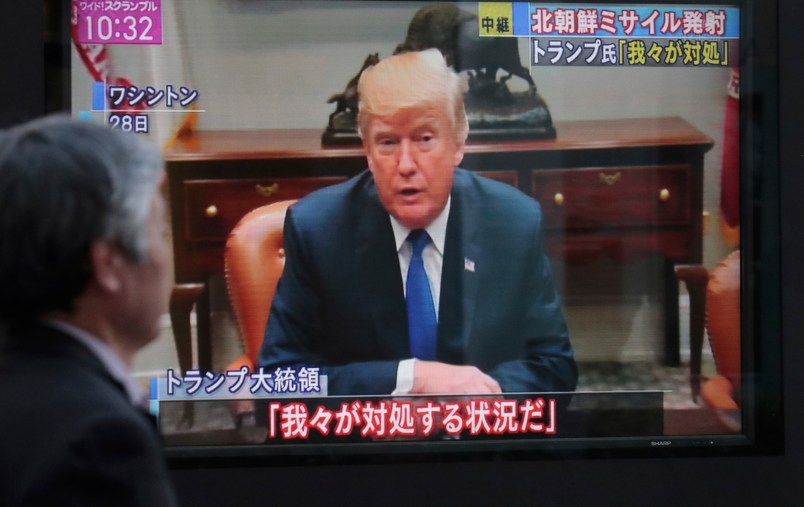
WASHINGTON (AP) — The Trump administration threatened new sanctions on North Korea on Wednesday after the reclusive government shattered 2½ months of relative quiet with its most powerful weapon test yet, an intercontinental ballistic missile that some observers believe could reach Washington and the entire U.S. Eastern Seaboard.
President Donald Trump tweeted that he spoke with Chinese President Xi Jinping about Pyongyang’s “provocative actions,” and he vowed that “additional major sanctions will be imposed on North Korea today. This situation will be handled!” Trump’s top diplomat, Rex Tillerson, said the U.S. could target financial institutions doing business with the North.
The U.N. Security Council, meanwhile, was due to hold an emergency meeting Wednesday afternoon.
The fresh deliberations about new forms of punishment for North Korea came after its government said it successfully fired a “significantly more” powerful, nuclear-capable ICBM it called the Hwasong-15. Outside governments and analysts concurred the North had made a jump in missile capability.
A resumption of Pyongyang’s torrid testing pace in pursuit of its goal of a viable arsenal of nuclear-tipped missiles that can hit the U.S. mainland had been widely expected. But the power of the missile and suddenness of the test jolted the Korean Peninsula and Washington. The launch at 3:17 a.m. Wednesday local time — early Tuesday afternoon in the U.S. capital — indicated an effort to perfect the element of surprise and obtain maximum attention in the U.S.
In a government statement released through state media, North Korea said the Hwasong-15, the “greatest ICBM,” could be armed with a “super-large heavy nuclear warhead” and is capable of striking the “whole mainland” of the U.S. The North said the missile reached a height of 4,475 kilometers (2,780 miles) and traveled 950 kilometers (590 miles) before accurately hitting a sea target, similar to the flight data announced by South Korea’s military.
After the launch, it said leader Kim Jong Un “declared with pride” that his country has achieved its goal of becoming a “rocket power.” State TV said Kim gave the order Tuesday, and it broadcast a photo of Kim’s signed order where he wrote: “Test launch is approved. Taking place at the daybreak of Nov. 29! Fire with courage for the party and country!”
The firing was a message of defiance to the Trump administration, which a week earlier restored North Korea to a U.S. list of terror sponsors. It also ruins nascent diplomatic efforts, raises fears of war or a pre-emptive U.S. strike and casts a deeper shadow over the security of the Winter Olympics early next year in South Korea.
A rattled Seoul responded by almost immediately launching three of its own missiles in a show of force. South Korean President Moon Jae-in expressed worry that North Korea’s missile threat could force the U.S. to attack the North before it masters a nuclear-tipped long-range missile.
“If North Korea completes a ballistic missile that could reach from one continent to another, the situation can spiral out of control,” Moon said at an emergency meeting in Seoul, according to his office. “We must stop a situation where North Korea miscalculates and threatens us with nuclear weapons or where the United States considers a pre-emptive strike.”
Moon has repeatedly declared the U.S. cannot attack the North without Seoul’s approval. But Washington may act without South Korean input.
The launch was North Korea’s first since it fired an intermediate-range missile over Japan on Sept. 15 and may have broken any efforts at diplomacy. U.S. officials have sporadically floated the idea of direct talks with North Korea if it maintained restraint.
The missile also appeared an improvement on North Korea’s past launches.
If flown on a standard trajectory, instead of Wednesday’s lofted angle, the missile would have a range of more than 13,000 kilometers (8,100 miles), said U.S. scientist David Wright, a physicist who closely tracks North Korea’s missile and nuclear programs. “Such a missile would have more than enough range to reach Washington, D.C., and in fact any part of the continental United States,” Wright wrote in a blog post for the Union for Concerned Scientists.
Japanese Defense Minister Itsunori Onodera said the missile landed inside Japan’s special economic zone in the Sea of Japan.
A big unknown, however, is the missile’s payload. If, as expected, it carried a light mock warhead, then its effective range would have been shorter, analysts said.
In his call with Xi, Trump made clear “the determination of the United States to defend ourselves and our allies,” according to a White House statement. Trump also “emphasized the need for China to use all available levers to convince North Korea to end its provocations and return to the path of denuclearization.”
The Trump administration bolstered U.S. sanctions against North Korea last week and imposed new restrictions on North Korean shipping firms and Chinese companies that deal with the North.
China’s state-run Xinhua news agency said Xi told Trump that China remained determined to clear the Korean Peninsula of nuclear weapons, and to preserve peace and stability in Northeast Asia. Xi said China wants to maintain communications with the U.S. and others, and “jointly push the nuclear issue toward the direction of peaceful settlement via dialogues and negotiations.”






yet there is nothing but silence and a lack of enforcement of signed legislation of sanctions passed against russia for an act of war against us, huh, wonder why that would be preznit Putin’s puppet?
oh yeah, Rex (Putin’s official friend) disbanded the State Department office that enforces sanctions, right after the new sanctions were passed, huh, wonder why that would be?
Unsurprisingly, no offers of negotiation were ever suggested or broached by the Death-cult Daycare Dotard.
Some one on Maddow last night said that the reason NK hadn’t tested anything until today was because the military was used at harvest time. When a country can’t feed it’s people it’s all hands to fields during harvest time.
This is the only Trump sanction I want to see…
Our Dotard in Chief is not sophisticated enough, or thoughtful enough to resolve this crisis by any means other than a preemptive nuclear attack on Pyongyang. Anything less than a nuclear bomb would allow NK to retaliate, and place our allies in immediate danger. A nuclear strike is the only card he has left.