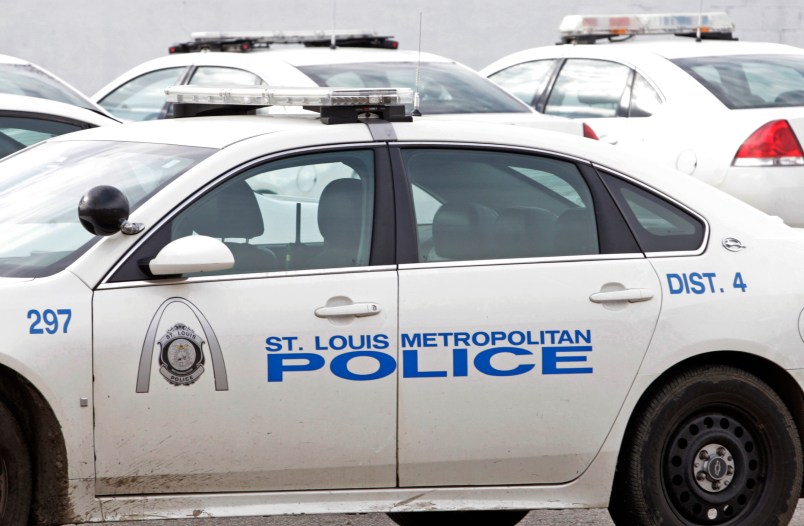
KANSAS CITY, Mo. (AP) — St. Louis’ prosecutor said Thursday she won’t be charging two officers in the fatal shooting of a black 18-year-old last year, concluding that no evidence disproves police claims of self-defense in what she called “a tragedy in every aspect of the word.”
Circuit Attorney Jennifer Joyce, whose office investigated Mansur Ball-Bey’s August 2015 death separately from an internal police probe, said officers and a witness reported that an armed Ball-Bey ran from a home during a raid and was shot after pointing his gun toward one of two officers. Both officers, who are white, fired simultaneously at Ball-Bey, though one missed, Joyce said.
She said Ball-Bey’s loaded gun was found at the scene, with his palm print on the ammunition clip.
A local medical examiner concluded that Ball-Bey sustained a severed spinal cord, and that a bullet pierced his heart.
“One of the biggest challenges we face in this case is that there is no independent, credible witness we can put in front of a grand jury or regular jury who contradicts police statements,” Joyce said in a statement. “None of the other witnesses had a clear view at the moment when Ball-Bey was shot.”
An attorney for Ball-Bey’s family, Jermaine Wooten, has questioned the police account that Ball-Bey was armed.
Ball-Bey’s death came a little more than a year after a white police officer, Darren Wilson, shot and killed Michael Brown, a black, unarmed 18-year-old, in nearby Ferguson, Missouri. Brown’s August 2014 shooting sparked waves of protests, including some that turned violent, and was a catalyst for the national Black Lives Matter movement and debate over police treatment of minorities.
A St. Louis grand jury and the U.S. Department of Justice ultimately cleared Wilson, who resigned in November 2014.
Ball-Bey’s death led to a similar outcry, resulting in at least nine people being arrested and property damaged during demonstrations in which glass bottles and bricks were thrown at police.
The law gives police officers latitude to use deadly force when they feel physically endangered. The Supreme Court held in a 1989 case that the appropriateness of use of force by officers “must be judged from the perspective of a reasonable officer on the scene,” rather than evaluated through 20/20 hindsight.
That standard is designed to take into account that police officers frequently must make split-second decisions during fast-evolving confrontations, and should not be subject to overly harsh second-guessing. The Justice Department cited that legal threshold last year when clearing Wilson in Brown’s shooting.
Last November, Joyce cleared two St. Louis police officers in the fatal shooting of 25-year-old Kajieme Powell, who in August 2014 was armed with a steak knife as he approached the officers and urged them to shoot him. The white officers fired 12 times, killing Powell, who was black, at the scene while the region already was on edge over Brown’s death 10 days earlier.
But last month, Joyce charged former St. Louis police officer Jason Stockley with first-degree murder in a 2011 shooting of a 24-year-old black man. Joyce said Stockley, who is white, was on duty when police say he witnessed a drug deal involving Anthony Lamar Smith. She said after a chase with speeds exceeding 80 mph, Stockley approached the car that was being pursued and fired five times into its driver’s side, striking Smith with each round.
Attorneys for Stockley, who this week was freed on $1 million bond, have argued he fired in self-defense.
Copyright 2016 The Associated Press. All rights reserved. This material may not be published, broadcast, rewritten or redistributed.