

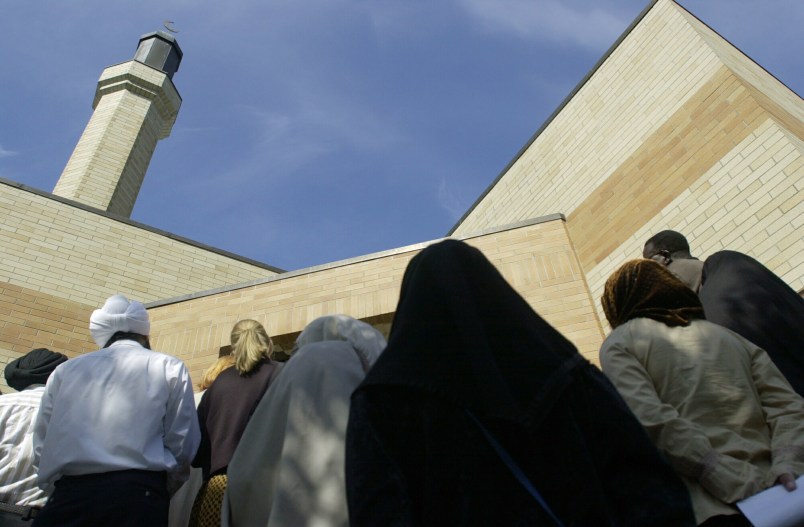
McLEAN, Va. (AP) — The rejection of a sewage permit in rural Virginia has made unlikely allies of the Trump administration and the American Civil Liberties Union, which both allege that a county board discriminated against Muslims trying to build a new mosque.
A federal judge in Charlottesville is scheduled to hear pretrial arguments Wednesday in the lawsuit, which was launched in December by the Obama administration against Culpeper County, about 70 miles southwest of the nation’s capital.
The Trump administration is moving forward with the lawsuit, to the surprise of some who have been critical of Trump for anti-Muslim rhetoric and his proposed travel ban directed at half a dozen Muslim-majority countries. Indeed, the ACLU has accused Trump of anti-Muslim bias in legal briefs opposing the travel ban.
“We were curious as to what would happen” to the case, acknowledged Leslie Mehta, legal director for the ACLU’s Virginia chapter, which has filed a brief in support of the federal lawsuit.
But she said she’s happy the Trump administration is continuing to enforce the Religious Land Use and Institutionalized Persons Act, or RLUIPA, which enables private parties or the federal government to sue if they believe a local government is manipulating land-use policy to discriminate based on religion.
Justice Department spokeswoman Nicole Navas said the agency “continues to enforce RLUIPA vigorously as they have since its enactment in September 2000.”
The Culpeper dispute began in April, when the county board of supervisors voted 4-3 to deny a “pump-and-haul” sewage permit to the Islamic Center of Culpeper, which needs the permit to construct a mosque.
The supervisors who opposed the permit say it was strictly a land-use decision. Bill Chase, the supervisor who made the motion to deny the mosque its permit, said the notion that he and other supervisors were swayed by anti-Muslim sentiment is “bull—-.”
“Nobody even talked to me” about the mosque, Chase said.
The Justice Department lawsuit cites emails that supervisors wrote stating they were receiving comments opposed to the mosque based on religion. It also notes that the board has granted permits like the one sought by the mosque dozens of times in the past.
“Many Culpeper County residents expressed religious animus in opposing the ICC’s request for the permit,” the Justice Department wrote in a memo last month. “The public’s religious animus may be imputed to the Board.”
Earlier this month, the Islamic center filed its own lawsuit against the county, using the same law but advancing slightly different legal arguments, so that the mosque can move forward if the Trump administration reverses course.
But Johnathan Smith with Oakland, California-based Muslim advocates, which is representing the mosque, said he expects the DOJ to move ahead with its case.
“There is a very long, bipartisan tradition in the Civil Rights Division of addressing cases of religious discrimination,” said Smith, who used to work in that division.
The last 10 lawsuits filed by the feds, going back to 2011, have all been filed on behalf of Muslim worshippers. As recently as last month, the government reached a settlement with the city of Sterling Heights, Michigan, allowing for construction of a mosque on city property.
Nationally, the law has been a powerful tool for vindicating the rights of religious minorities, said Daniel Mach, director of the ACLU’s Program on Freedom of Religion and Belief.
Often, the very fact that the feds investigate a case will prompt a settlement, Mach said, though statistics show that settlements are less likely in cases involving mosques.
Copyright 2017 The Associated Press. All rights reserved. This material may not be published, broadcast, rewritten or redistributed.



To quote Bill Chase…“BULLSHIT!” Mosque? You mean this was about a mosque?