

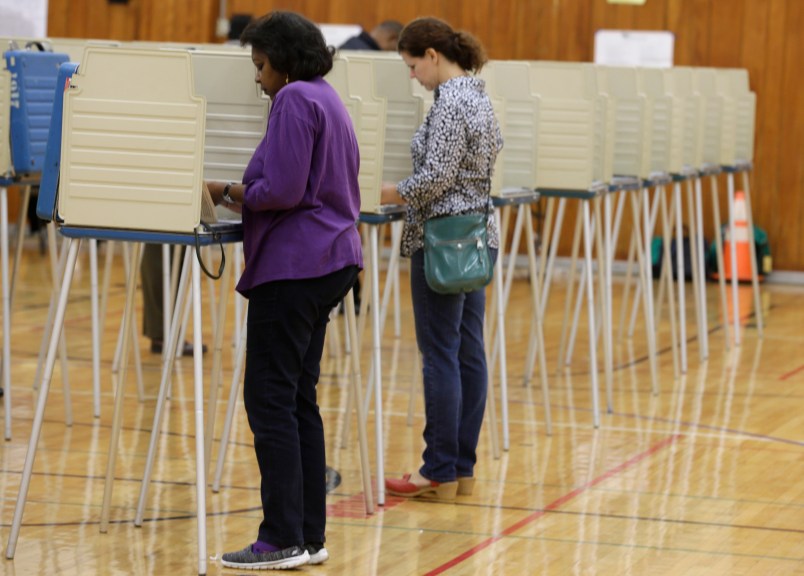
WASHINGTON (AP) — Republicans and Democrats feel a massive disconnect with their political parties and helpless about the presidential election.
That’s according to a new poll by the Associated Press-NORC Center for Public Affairs Research, which helps explain the rise of outsider candidates Donald Trump and Bernie Sanders and suggests challenges ahead for fractured parties that must come together to win this fall.
“It feels like the state of politics is generally broken,” said Joe Denother, a 37-year-old Oregon voter who typically favors Republicans.
The divisive primary season has fueled an overall sense of pessimism about the political process that underscores a widening chasm between political parties and the voters they claim to represent. Just 12 percent of Republicans think the GOP is very responsive to ordinary voters, while 25 percent of Democrats say the same of their party.
Among all Americans, the AP-NORC poll found that just 8 percent consider the Republican Party to be very or extremely responsive to what ordinary voters think. An additional 29 percent consider the GOP moderately responsive and 62 percent say it’s only slightly or not at all responsive.
The Democratic Party fares only slightly better, with 14 percent saying the party is very or extremely responsive, 38 percent calling it moderately responsive, and 46 percent saying it’s only slightly or not at all responsive.
Denother, who works in health insurance, says he feels the disconnect with the party he usually supports.
“The Republicans have gotten away from their core message of fiscal responsibility,” said Denother, who voted for Mitt Romney in 2012 and is undecided this year. “I feel there’s an identity crisis. And with a lack of identity, it’s hard to have confidence in the party.”
The survey exposes an extraordinary crisis of confidence in most major political institutions just as both parties intensify efforts to connect with voters heading into the general election.
In general, only 15 percent of Americans report a great deal of confidence in the Democratic Party compared with just 8 percent who say the same of the GOP. That’s as only 4 percent say they have a great deal of confidence in Congress, 15 percent in the executive branch and 24 percent in the Supreme Court.
The findings come as Trump assumes the mantle of GOP leader, having won the number of delegates necessary to clinch the Republican presidential nomination. Trump got there with an aggressive anti-establishment message, railing against his party leaders for months.
Now the New York billionaire appears to be changing course. He recently entered into a high-dollar fundraising agreement with the Republican National Committee and plans to rely heavily on the RNC’s staffing and data programs to connect with voters.
On the Democratic side, Hillary Clinton remains locked in a divisive primary battle with Sanders, a self-identified democratic socialist who has inspired a large and loyal following. The Vermont senator has echoed Trump’s charges of an unfair political system that’s stacked against him and ordinary Americans, a criticism that resonates with many voters.
“It seems that everything was made straight for Hillary Clinton,” said Ron Cserbak, a 63-year-old retired teacher who lives in Cincinnati and usually votes for Democrats.
The new poll finds that 6 in 10 Americans think the Republican Party is only slightly or not at all open to new ideas or candidates outside the political establishment, and about half say the same of the Democratic Party. About 3 in 10 think each party is only moderately open either to new ideas or outsider candidates.
The survey also found evidence of overwhelming interest in the presidential contest, although less than a quarter of Americans say they’re excited about it.
Worse, 55 percent of Americans, including 60 percent of Republicans and 53 percent of Democrats, say they feel helpless about the 2016 election. And two-thirds of Americans under 30 report feeling helpless.
“I am despondent,” said Cserbak. “I wouldn’t say I feel totally helpless. I do have a vote.”
In contrast, only 13 percent of respondents said they felt proud about the election; 37 percent said they were hopeful.
The AP-NORC poll of 1,060 adults was conducted May 12-15 using a sample drawn from NORC’s probability-based AmeriSpeak panel, which is designed to be representative of the U.S. population. The margin of sampling error for all respondents is plus or minus 4.1 percentage points.
Respondents were first selected randomly using address-based sampling methods, and later interviewed online or by phone.
___
Online:
AP-NORC Center: http://www.apnorc.org/
Copyright 2016 The Associated Press. All rights reserved. This material may not be published, broadcast, rewritten or redistributed.




“It feels like the state of politics is generally broken.”
Well, whose fault is that, Joe who typically favors Republicans?
As always, “It’s the economy, stupid!” is the message that resonates best for voters “feeling” disconnected and helpless. Which general election candidate (three and counting) will best deploy an economic argument to cure the malaise?
Anomie is being shoved down our throats!!!
Thought this was apropos here.
Here’s the thing about “outsider candidates” - being President of the United States requires (or should) years of public service (local, state, federal, community organizer even) and a demonstrated ability to grasp political nuance, to understand complex national and international issues, and to balance pragmatism with idealism.
The GOP has an outsider candidate now. The most “outsider” major party candidate in the last 50 years. And how’s that working out for them?
It’s like complaining that the CEO is always taken from senior executive ranks; it’s never the junior manager down in Sales who gets promoted! It’s NOT FAIR! SYSTEM IS RIGGED FOR HILLARY!