

UPDATE: Nov. 2, 2015, 2:16 PM ET
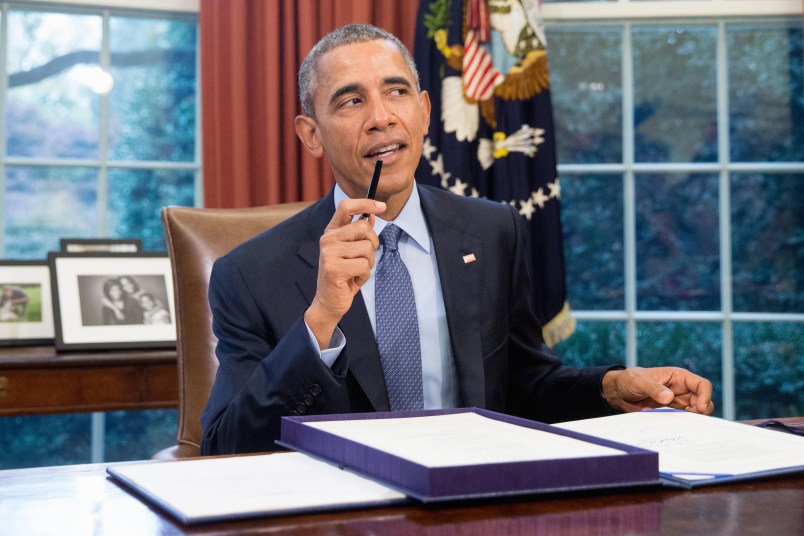
WASHINGTON (AP) — President Barack Obama on Monday signed into law a bipartisan budget bill that avoids a catastrophic U.S. default and puts off the next round of fighting over federal spending and debt until after next year’s presidential and congressional elections.
Obama praised the rare bipartisan cooperation behind the deal, saying that 2-year agreement that funds the government through the 2017 fiscal year puts the government on a responsible path.
“It should finally free us from the cycle of shutdown threats and last-minute fixes and allows us to, therefore, plan for the future,” Obama said in brief remarks as he signed the bill.
Tuesday was the deadline for averting a default on U.S. financial obligations by raising the debt limit.
The Senate gave final approval to the House-passed bill late last week and sent it to Obama. He signed it in the Oval Office, shortly before departing on a day trip to New Jersey and New York to focus on the criminal justice system, as well as raise money for his fellow Democrats.
The legislation raises the limit on the government’s debt through March 2017, pushing reconsideration of what in recent years has become a contentious issue until after the elections for the White House and Congress in November 2016.
The measure also sets federal spending through the 2016 and 2017 fiscal years, and eases strict caps on spending by providing an additional $80 billion, split evenly between military and domestic programs. The Appropriations committees must write legislation to reflect the spending and they face a Dec. 11 deadline to finish the work.
Negotiations over the budget, which began weeks ago, wrapped up quickly last week as Republican Rep. Paul Ryan of Wisconsin prepared to become the new House speaker.
Obama negotiated the agreement with Republican and Democratic congressional leaders who were intent on steering the institution away from the brinkmanship and government shutdown threats that have haunted lawmakers for years. Republican Rep. John Boehner of Ohio, who stepped down both as speaker and from his seat in Congress at the end of last week, said he felt a sense of urgency to reach a deal before turning the gavel over to Ryan. Other lawmakers wanted the issue taken off the table as they look ahead to next fall’s elections.
Obama called the deal “a signal of how Washington should work” and urged lawmakers to keep up the collaboration.
“My hope is now that they build on this agreement with spending bills that also invest in America’s priorities — without getting sidetracked by a whole bunch of ideological issues that have nothing to do with the budget,” he said.
The $80 billion in additional spending is paid for with a mix of spending cuts and revenue increases touching areas from tax compliance to spectrum auctions.
The deal would also avert a looming shortfall in the Social Security disability trust fund that threatened to slash benefits, and head off an unprecedented increase in Medicare premiums for outpatient care for about 15 million beneficiaries.
The plan will lift caps on the appropriated spending passed by Congress each year by $50 billion in 2016 and $30 billion in 2017, evenly divided between defense and domestic programs. Another approximately $16 billion would come each year in the form of inflated war spending, evenly split between the Defense and State departments.
The cuts include curbs on Medicare payments for outpatient services provided by certain hospitals and an extension of a 2-percentage-point cut in Medicare payments to doctors through the end of a 10-year budget. There’s also a drawdown from the Strategic Petroleum Reserve, and savings reaped from a Justice Department fund for crime victims that involves assets seized from criminals.
___
Associated Press writer Darlene Superville contributed to this report.
Copyright 2015 The Associated Press. All rights reserved. This material may not be published, broadcast, rewritten or redistributed.




Well, there goes about half the GOP’s source of drama-queen soundbites and political brinksmanship.
And for two whole cycles!
Consider what this agreement means.
President Obama and the Democratic Congressional minority have just gotten nearly everything they wanted from the Republican majority, and have protected their funding and policy priorities from what was expected to be a Tea Party/Freedom Caucus gut job.
No more arbitrary spending caps from the sequester. No more hostages or shutdowns until at least 2017.
It continues a trend of President Obama and Democratic victories.
Last month President Obama publicly vetoed the Republicans’ NDAA bill and sent it back to Congress to better address military preparedness and to remove accounting tricks to hide wasteful and unneeded military spending.
Several weeks ago, President Obama and the Democratic Congressional minority were able to uphold the Iran nuclear deal despite majority opposition, because earlier this year they insisted that they would only agree to a Congressional “review” that led to a vote on disapproval – and not on an approval, which would have been unlikely or impossible to achieve.
Also, early this year, a bipartisan bill which ended the Medicare “Doc Fix” passed with comfortable majorities – after being kicked down the road for more than 15 years.
And in advance of the Paris climate talks scheduled for December, despite promises by Republican leadership to kill proactive efforts by the Obama administration, emissions-cutting pledges submitted by 146 countries – that cover nearly 90% of global emissions – could cut average global emissions per capita of greenhouse gases by up to 8 percent by 2025 and 9 percent by 2030 compared with 1990 levels, a U.N. assessment found, and are a good step toward achieving an international global warming goal, the U.N. climate chief said.
And despite Republican obstruction on increasing the federal minimum wage, dozens of local and state governments have done just that in response to President Obama’s urging.
And in spite of intense opposition from labor leaders and Democrats, a draft for the Trans Pacific Partnership multilateral trade agreement was recently signed by 12 Asian and Pacific nations and is awaiting review by Congress.
It’s still early, but we finally may be turning a corner on government by crisis and hostage taking.
Too often we get disappointed seeing the short-term political gains the Republicans have reaped in recent years by demonizing the scary black man President Obama: winning both branches of Congress and a majority of state governments, and successfully blocking much of the Democrats’ agenda.
But here’s the good news: the Republicans are losing – and deep down they know it – and President Obama is winning.
Obama, in his upbeat, even-tempered, professional way, is prodding moderates and independents to rethink their political ideologies, encouraging Democrats to sharpen their focus and rethink their priorities and strategies, and inviting independents and moderate Republicans – and even conservatives --to join him in crafting sensible compromises and solutions to the problems that face us all.
In doing so he is exposing and isolating the extremists as those unwilling to do the hard work of coalition-building and self-government, and making a mockery of the “lame duck” meme.
It has been a long game, yes, and maybe not as immediately satisfying to some Democrats and liberals who would have preferred him to play the part of the stereotypical angry young black rabble rouser.
But with his economic policies that laid the groundwork for recovery, in his domestic policies that protected – and expanded – the social safety net, and in his foreign policies that ended the threat of an Iranian nuclear weapon and the neocon policy of preemptive wars, and which pivoted our focus from the Middle East quagmire to the increasingly important Pacific Rim, he is reviving the dream of the American Century and confronting the illusory neocon dream of American Empire.
And when the history of this era is written, President Obama, Speaker Pelosi, and Majority Leader Reid will be lionized as the most productive and progressive force in a generation.
What they achieved in just a brief period of time with a small Democratic majority, and with razor-thin votes in Congress, hasn’t been matched since the early years of LBJ’s term. And what they’ve done to protect their priorities since the Republicans won majorities in Congress has been remarkable.
Moreover, since the Republicans succeeded in taking over both chambers of Congress in 2014, Obama has racked up an impressive string of successes:
This was not supposed to happen. Obama was supposed to be a lame duck, demoralized and irrelevant going into 2015. But Obama refuses to play the game by the Republicans’ rules, and in so doing he highlights their inaction and fecklessness.
Worse for them, President Obama is setting the agenda going into the election season.
Much remains to be done. This work will take years and future administrations, but the groundwork is being laid. And Obama is preparing and inspiring a new generation of leadership with his management style, which the Republicans deride as “leading from behind” but which is actually a progressive form of leadership that involves a sharing of power that comes from mutual respect and not domination over others.
It is not apparent now, but it will become apparent in retrospect a generation from now, that we are living in the Age of Obama.
EDITED AND UPDATED
Recherche des temps perdu, indeed! Governing like it used to be before Newt Gingrich and his American Contractors badly remodeled Congressional politics and bi-partisan comity.
This is an agreement on the top-line numbers. The Republicans can still screw things up by not passing the appropriations bills on time (or even the continuing resolutions), or they can simply go back on the agreement and put in a whole different set of numbers.