

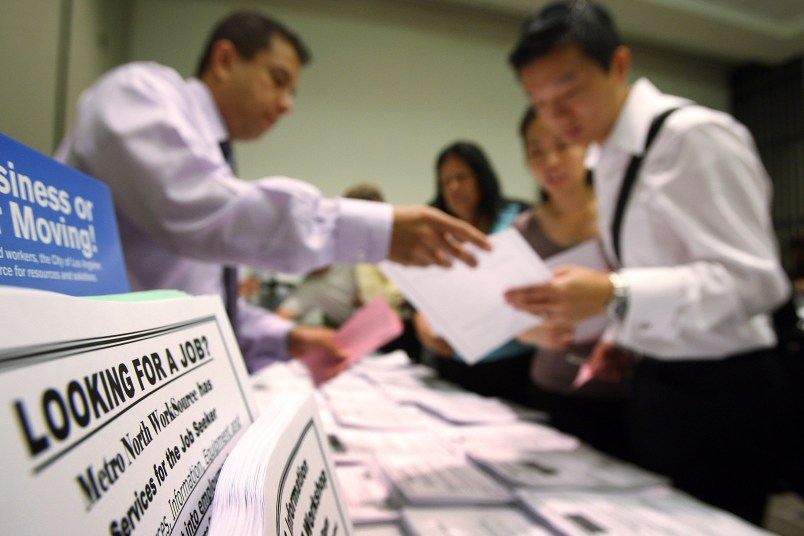
WASHINGTON (AP) — U.S. employers went on a hiring binge in February, adding 313,000 jobs, the most in any month since July 2016, and drawing hundreds of thousands of people into the job market.
The Labor Department said wage gains, meanwhile, fell from January to 2.6 percent year-over-year. Strong hourly wage growth had spooked markets last month because it raised the specter of inflation. But January’s figure was revised one-tenth of a point lower to 2.8 percent.
The influx of new workers kept the unemployment rate unchanged at 4.1 percent.
The surge of job gains may reflect, in part, confidence among some businesses that the Trump administration’s tax cuts will accelerate growth. Consumers are also benefiting from higher after-tax income, which grew last month at the fastest pace in a year, aided by the tax cuts.
In the meantime, economists are calculating how the Trump administration’s decision Friday to impose a 25 percent tariff on steel imports and a 10 percent tariff on aluminum might affect the job market. The Trade Partnership, a consulting firm, estimates that the tariffs will eliminate roughly 145,000 jobs.
Steel and aluminum producers would hire more people. But the gains would be more than offset, the firm calculates, by sharp losses among companies that use the metals, such as automakers, packaged food companies and those that make industrial machinery.
During 2017, the stock market, as measured by the S&P 500 index, surged 19 percent, partly on anticipation of corporate and individual tax cuts. Yet barely a month after the tax cuts became law, investors shifted their focus to the potential consequences: Faster growth that might intensify inflation and lead the Fed to accelerate its rate hikes.
There have been some signs that price pressures are picking up. But overall, inflation remains in check. The inflation gauge that the Fed tends to monitor most closely shows an increase of just 1.7 percent from a year earlier, below the central bank’s 2 percent target level.
Most economists expect growth to pick up in the coming months and to accelerate inflation slightly by year’s end. They have forecast that the economy will expand at just a 2 percent annual rate in the January-March quarter before topping 3 percent in the next two quarters.
For now, consumers have pulled back somewhat on spending despite income gains, thereby setting the stage for potentially stronger spending gains in coming months. After-tax incomes in January — which include benefit payments from the government and business income as well as wages — climbed by the most in a year. They were boosted, in part, by the Trump administration’s tax cuts and company bonuses that were paid out in response to corporate tax cuts.
And manufacturers expanded at the fastest pace in nearly 14 years in February, according to a survey of purchasing managers.
The housing market, too, remains generally solid, with demand for homes strong in much of the country, though rising mortgage rates may begin to slow sales.
Correction: The headline on this article originally said unemployment had fallen to 2.6 percent.






The reality of the situation is that business owners always feel more comfortable when the Republicans are in power. It is totally irrational because the GOP inevitably drives the economic car into the ditch of recession, but it is true.
Uhhhh, you might want to check your headline regarding that reference to 2.6%.
I had that same reaction. Headline says 2.6 percent, then “The influx of new workers kept the unemployment rate unchanged at 4.1 percent.” Which is it?
Exactly. The fact that TPM hasn’t fixed the headline means that perhaps no one at TPM is minding the store.
It’s a good report. Better than expected.
Wages growth was not as high as expected which eases inflation fears.
The Trump economy officially began in February when he lined up both a budget and tax rates. In Jan, he had the tax rates but the budget was still an Obama one.
My view/observation is that it always takes about a year for bad GOP economic/budget policies to demonstrate a negative impact. I think a key marking point will be when we see Q1 and Q2 government receipts vs. outlays. If the debt explosion is as bad as some project, then you could see an acceleration of the impact in the economy.