

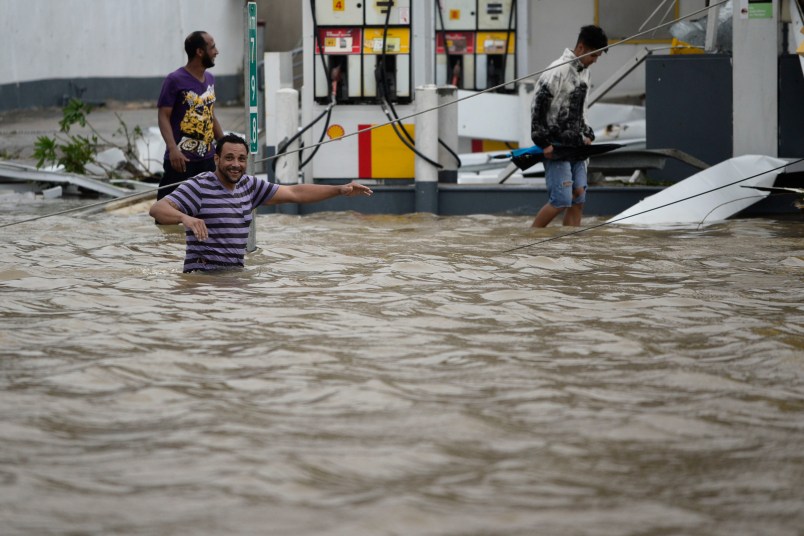
SAN JUAN, Puerto Rico (AP) — Tens of thousands of Puerto Ricans stunned by a hurricane that crushed concrete balconies, twisted metal gates and paralyzed the island with landslides, flooding and downed trees vowed to slowly rebuild amid an economic crisis as rescue crews fanned out across the U.S. territory Thursday.
The extent of the damage is unknown given that dozens of municipalities remained isolated and without communication after Maria hit the island Wednesday morning as a Category 4 storm with 155 mph winds, the strongest hurricane to hit Puerto Rico in over 80 years.
Uprooted trees and widespread flooding blocked many highways and streets across the island, creating a maze that forced drivers to go against traffic and past police cars that used loudspeakers to warn people they must respect a 6 p.m. to 6 a.m. curfew imposed by the governor to ensure everyone’s safety.
“This is going to be a historic event for Puerto Rico,” said Abner Gomez, the island’s emergency management director.
Previously a Category 5 with 175 mph (281 kph) winds, Maria hit Puerto Rico as the third-strongest storm to make landfall in the U.S., based on its central pressure. It was even stronger than Hurricane Irma that storm roared into the Florida Keys earlier this month.
In the capital of San Juan, towering eucalyptus trees fell nearly every other block over a main road dotted with popular bars, restaurants, and coffee shops, some of which were damaged. Outside a nearby apartment building, 40-year-old tourism company operator Adrian Pacheco recounted how he spent eight hours in a stairwell huddled with 100 other residents when the hurricane ripped the storm shutters off his building and decimated three balconies.
“I think people didn’t expect the storm to reach the point that it did,” he said. “Since Irma never really happened, they thought Maria would be the same.”
Hurricane Irma sideswiped Puerto Rico on Sept. 6, leaving more than 1 million people without power but causing no deaths or widespread damage like it did on nearby islands. Maria, however, blew out windows at some hospitals and police stations, turned some streets into roaring rivers and destroyed hundreds of homes across Puerto Rico, including 80 percent of houses in a small fishing community near the San Juan Bay, which unleashed a storm surge of more than 4 feet.
“Months and months and months and months are going to pass before we can recover from this,” Felix Delgado, mayor of the northern coastal city of Catano, told The Associated Press.
The sound of chain saws began to fill the silence that spread across San Juan late Wednesday afternoon as firefighters began to remove trees and used small bulldozers to lift toppled concrete light posts. Some neighbors pitched in to help clear the smaller branches, including Shawn Zimmerman, a 27-year-old student from Lewistown, Pennsylvania who moved to Puerto Rico nearly two years ago.
“The storm didn’t bother me,” he said. “It’s the devastation. I get goosebumps. It’s going to take us a long time.”
Maria has caused at least 10 deaths across the Caribbean, including seven in the hard-hit island of Dominica and two in the French Caribbean territory of Guadeloupe. Puerto Rico’s governor told CNN one man died after being hit by flying debris. No further details were available, and officials could not be immediately reached for comment.
Maria weakened to a Category 2 storm later in the day but re-strengthened to Category 3 status early Thursday with winds of 115 mph (185 kph). It was centered about 70 miles (110 kilometers) north of Punta Cana, Dominican Republic, and moving northwest near 9 mph (15 kph).
The hurricane was still dumping rain overnight Wednesday in Puerto Rico, where crumbled red roof tiles lay scattered across many roads, and curious residents sidestepped and ducked under dozens of black power lines still swaying in heavy winds. But they posed no danger: Maria caused an island-wide power outage, with officials unable to say when electricity would return.
Puerto Rico’s electric grid was crumbling amid lack of maintenance and a dwindling staff even before the hurricanes knocked out power. Many now believe it will take weeks, if not months, to restore power.
Edwin Rosario, a 79-year-old retired government worker, said an economic crisis that has sparked an exodus of nearly half a million Puerto Ricans to the U.S. mainland will only make the island’s recovery harder.
“Only us old people are left,” he said as he scraped a street gutter in front of his house free of debris. “A lot of young people have already gone…If we don’t unite, we’re not going to bounce back.”






Tough times ahead for Puerto Rico, sadly.
I have no knowledge of architectural history, but thinking back on my youth in Puerto Rico, it strikes me that a high percentage of the “Pre-War” (WW2) housing and buildings might well have been built after the destruction of the 1928 (San Felipe II- 312 fatalities) and 1932 (San Ciprian-225 deaths) hurricanes. I think in the Spanish speaking Caribbean, they named each season’s storms alphabetically, after a Catholic saint name.
Anyway, I listened to the Mayor of San Juan in some of her local interviews and in her MSNBC and CNN interviews last night. She is saying that San Juan is going to have to perform a major reconstruction and reinvention of itself.
In saner times, this would be an opportunity for piles of federal reconstruction dollars that would upgrade Puerto Rico’s infrastructure, make it greener and more resilient, even an example for other vulnerable areas to follow.
Yeah, I know I’m dreaming.
We need the Texas congressional delegation, who voted against FEMA aid for NJ because it was not kosher (included minor perceptible levels of pork, as interpreted by the Texas delegation) but couldn’t vote for hurricane aid for Texas fast enough two weeks ago. Unfortunately, Puerto Rico has one non voting member of Congress (the Resident Commissioner).
The best outcome here would be to establish something akin to the Marshall plan for Puerto Rico. it needs to be a thoroughly coordinated effort to re-build this island with someone in an oversight position to make sure the money goes to re-building and upgrading in a timely fashion.
Unfortunately, there is no interest in DC to doing anything like that.