

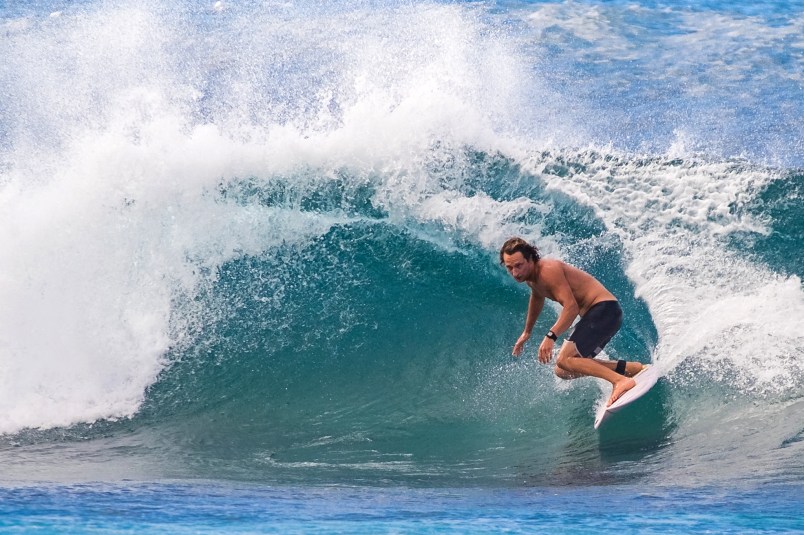
HONOLULU (AP) — As a record number of visitors stream into Hawaii, state officials want residents to know: Tourism is your friend.
The agency that promotes travel to Hawaii is starting an online video campaign to remind locals about the benefits of the state’s biggest employer.
The first installment features Honolulu chef Mark Noguchi talking about his brother-in-law’s job at a Waikiki restaurant and his uncle’s work building resorts. He closes the 30-second video saying: “Take care of tourism. It’s a family business.”
The campaign is aimed at showing tourism helps a broad cross-section of the state, not just those who work in hotels or at other jobs directly in the industry, said Leslie Dance, the Hawaii Tourism Authority’s vice president for marketing and product development. People sometimes forget how important tourism is and start lamenting there are too many people around, particularly when business is good, she said.
“It’s just a tendency for people to start complaining,” Dance said. “And so the thing is, let’s remind everybody again.”
But not everyone in Hawaii is on board.
Critics say the industry offers poorly paid jobs and exploits Hawaiian culture. But many complaints are about increased traffic and congestion.
The campaign comes as the state tries to maintain the momentum that brought a record 8.6 million travelers to Hawaii last year, the fourth-straight year of record-breaking visitor arrivals. Industry officials attribute the growth to an increase in flights and Hawaii’s enduring popularity with global travelers.
Online review sites like Yelp are directing tourists to restaurants, hikes and beaches in residential areas where travelers rarely ventured decades ago. Websites like Airbnb also allow more visitors to spend the night in neighborhoods instead of Waikiki hotels, even when most Oahu vacation rentals are illegal under county law.
Rena Risso, a 30-year-old who was born and raised in Kailua, understands the positive aspects of tourism, but she believes they’re outweighed by the negatives.
“I think, as far as the local’s point of view, it’s humbug,” she said after an early morning walk. “I can’t even take my kids to the beach on a weekend because it’s so crazy.”
The tourism agency should do more than promote “uncritical support for the growth of tourism,” said Jonathan Osorio, a professor of Hawaiian studies at the University of Hawaii at Manoa. It should be required to consider the long-range effects of continued growth on Hawaii’s resources and society, he said.
“The admonishment that we should take care of tourism because it’s a family business is a slick seduction that wants to avert the public’s attention from the industry’s abuses,” Osorio said in an email.
Dance called the campaign an inexpensive, grass-roots way to have a conversation. The videos cost $18,000 each and are posted on the tourism authority’s YouTube channel.
The second clip shows Renee Kimura of Kimura Lauhala Shop discussing how tourists support the Big Island store her great-grandfather founded over a century ago. The next video will be filmed on Kauai.
People should be reminded of tourism’s benefits so they’ll treat visitors well and encourage them to come back, said Henry Maumalanga, a hotel security guard who lives in Honolulu.
“A lot of tourists come here just because of the aloha spirit and all of that. They hear about all that kind of stuff,” he said. “And we got to show it.”
For Amanda Corby Noguchi, an event planner who appears in the first video alongside her husband, tourism is a way to teach people about Hawaii. Her husband, for example, has taken visiting friends and other travelers to fishponds and taro patches in Heeia to show them how organizations are reviving traditional forms of Hawaiian agriculture.
“It’s an opportunity to educate people about what real Hawaii is, and what matters,” she said.
Noguchi, the chef in the first video, said he means it when he says tourism is a family business. His uncle who designs resorts is a structural engineer. His father and the family company insure a number of resorts on the Gold Coast of Hawaii Island.
“That wasn’t made-up lines,” said Noguchi, who runs the Mission Social Hall and Cafe. “We know we might not be a concierge or bellboy or valet, but we are still connected.”
Copyright 2016 The Associated Press. All rights reserved. This material may not be published, broadcast, rewritten or redistributed.




Like any peak season tourist town, it gets over crowded during typical vacation times.
I’ve never been to the main island but Oahu and the smaller islands haven’t been bad when I went.
I live in a tourist town in Colorado and we’d be struggling without the never ending influx plus the college.
Tourism done right is a good thing. Aloha!
Went to the Big Island last year, and it was gorgeous, but my husband was abused, for hours, by an unhappy airport security guard and an unhinged car rental counter person after getting in the “wrong” line (labeled as being correct, btw). My husband, an avowed pacifist and all-around good guy, and was told “I can tell what kind of person you are just by looking at your eyes…” and was told he would spend the night in jail if he didn’t modify it somehow.
Welcome to Hawaii!
I’ve lived in tourist areas, and sometimes it does get crazy, but Hawaii does seem to have a bit of a chip on its shoulder, justified or not, that makes me skeptical about going back.
Oahu is the main island. It’s the population center. The state has two Congresscritters and one of the Districts is part of Oahu. (It’s basically Honolulu.) Hawai’i (Island, as it’s referred to in the piece) is the largest island in the archipelago. Last time I looked it had the second largest population.
I suspect that most of the problem is on Oahu: in fact, I tell my friends who are going to Hawaii to get off Oahu. If you aren’t going to get off Oahu, save your money and go to San Diego. The beaches are nearly as nice and the weather is nearly as nice. It’s also much cheaper.
A lot of this is about expectations on both sides being unrealistic, but much of that can be solved by picking different islands. I experienced nothing but welcome and aloha from the people on Kauai–particularly when I was in a hotel or restaurant near the beach, as those are obviously tourist-dependent, but even in the little moco loco food truck down on the south end of the island. Oahu is crowded and cosmopolitan, which does tend to come at the expense of losing some of Hawaii’s Hawaiian-ness.
Research the islands before planning a trip, because every island has a unique brand of culture and era. Find the best fit for your personality and the aloha will find you there.
It’s beautiful by all accounts, but it’s expensive and difficult to get to. it’s expensive to stay too.
Memo to local yokels:
Keep your hate to yourselves. Smile, even if it kills you.