

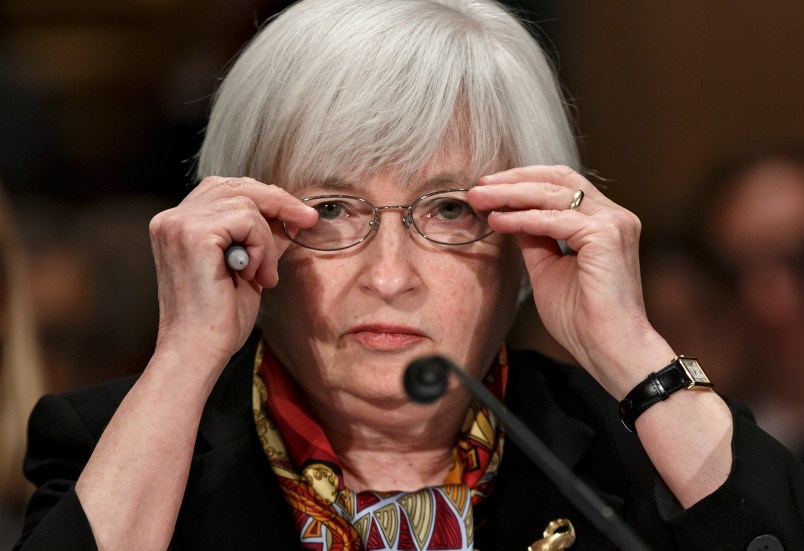
WASHINGTON (AP) — Federal Reserve Chairwoman Janet Yellen will have some good news to tell Congress this week about the health of the labor market. But lawmakers will likely press her to provide more information on just how the central bank intends to react to the good news.
Yellen is scheduled to deliver the Fed’s twice-a-year report to Congress on interest-rate policy and the economy. She testifies before the Senate Banking Committee on Tuesday and will follow that with testimony Wednesday before the House Financial Services Committee.
She delivered her first monetary report to Congress in February, just a week after being sworn in to succeed Ben Bernanke as the first woman to head the central bank.
While unemployment stood at 6.7 percent in February, it has now fallen to 6.1 percent, the lowest point since September 2008, reflecting strong job growth in recent months. The economy has created an average of more than 200,000 jobs a month over the past five months, the strongest stretch since the late 1990s.
That will be the good news that Yellen will relate. But lawmakers are certain to quiz her about what the performance of the labor market will mean for the Fed’s handling of interest rates in coming months.
In recent comments, Yellen has stressed that while jobs are now being produced at a faster clip, the economy still needs the Fed’s help in the form of low interest rates because a variety of indicators, from measures of long-term unemployed to wage growth, still remain weak.
Yellen’s comments will be followed closely to see whether there are any shifts in her view that inflation, while rising at a slightly faster pace than back in February, remains low with no danger that it is about to get out of hand.
The Fed’s twin goals are to promote maximum employment while keeping inflation under control.
Lawmakers will want to hear Yellen’s views on both goals and on related subjects such as whether she has any concerns that the Fed’s prolonged period of low interest rates could be setting the stage for financial instability once the central bank starts raising rates.
And lawmakers will also be looking for insights on how the Fed plans to unwind its massive holdings of Treasury bonds and mortgage-backed securities, which are approaching $4.5 trillion, more than four times the amount on the balance sheet when the financial crisis struck in the fall of 2008. The Fed’s bond purchases were aimed at keeping long-term interest rates low to give the economy a boost.
Minutes of the Fed’s June discussions released last week show that Fed officials are now in broad agreement that they will likely announce an end to their monthly bond-buying program in October with a final $15 billion reduction in the bond purchases.
The minutes showed that the Fed had a lengthy discussion on just how it planned to accomplish that reduction in its balance sheet. No final decisions were made, although officials expect to produce a plan before the end of this year.
The Fed has kept a key short-term interest rate at a record low near zero since December 2008. At its June meeting it kept language signaling that it plans to keep short-term rates low for a “considerable time” after the bond purchases end.
But the minutes showed there is a split between Fed officials who are still worried about low inflation and economic weakness and those concerned that the Fed may need to start raising interest rates more quickly than investors now expect.
Most private economists believe the Fed’s first rate hike will not occur until next summer, although some believe the move could occur a few months sooner if the labor market continues to show healthy gains in employment.







They can use their balance sheet unwind instead of cutting rates for quite some time.
Investors are the least of the economy’s concerns. They make money either way and the big boys love it when the economy tanks and help to cause that.
Keep putting the masses to work and the rest will fall in place. Under a Democratic administration that is.
Congress is just out to give a heads up to the donor class anyway. Inflation is just another red herring that they like to complain about and think that it makes them sound smart.
A few days ago TPM had a chart displaying the numbers of those lacking health insurance, going dramatically down. The number of uninsured dropped to the lowest levels since 2008. Today we are seeing that the jobless numbers have dropped to the level of 2008.
Obviously Obamacare has nothing or very little to do with the decrease of uninsured people, while job creation by the private sector, with it’s healthcare benefits, is the real game changer in the uninsured numbers drop.
So, now you’re crediting the Obama Recovery?
Will you clowns ever get your stories straight?
What Obama has anything to do with the private sector? Isn’t he the one complaining that in Washington nothing gets done? How could he then claim he has anything to do with the recovery?