

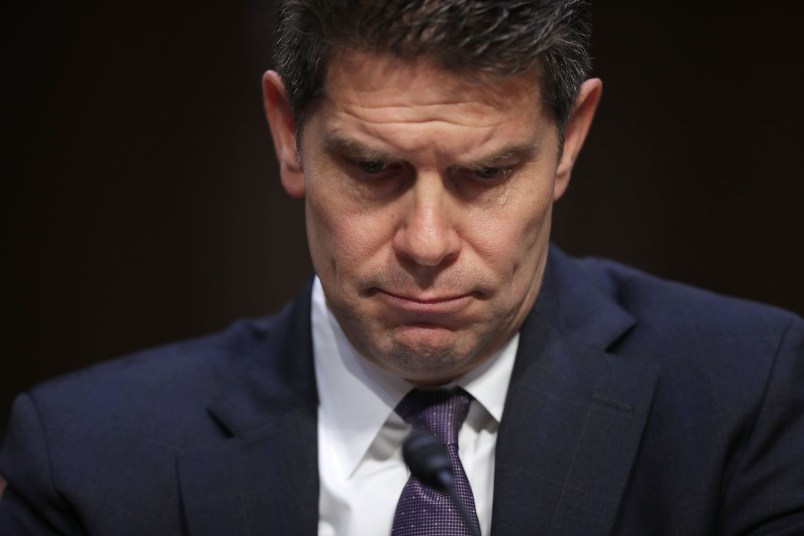
WASHINGTON (AP) — The FBI could have and should have done more to investigate information it received prior to last month’s massacre at Florida’s Marjory Stoneman Douglas High School, the agency’s deputy director told a Senate panel on Wednesday.
David Bowdich told the Senate Judiciary Committee that authorities will never know if any investigative work would have prevented the shooting, “but we clearly should have done more.”
The panel is examining legislative proposals to improve school safety, but much of the early focus was on law enforcement failures. Sen. Charles Grassley, the Republican chairman of the committee, expanded the blame to include local and state officials. He noted that Broward County Sheriff Scott Israel declined an invitation to testify Wednesday, as did Michael Carroll, secretary of Florida’s Department of Children and Families.
“By thumbing their noses at Congress, Sheriff Israel and Secretary Carroll have let the American people down and also the citizens of Florida they serve,” Grassley said.
The FBI has acknowledged it receive separate tips related to the accused shooter, Nikolas Cruz. Bowdich said the tips occurred on September 25, 2017 and on Jan. 5.
The first tip came via email from someone in Mississippi who warned that someone had posted on a YouTube page under the username Nikolas Cruz: “I’m going to be a professional school shooter.”
Bowdich said it was determined that the true identity of the poster could not be determined and work on the tip was closed about two weeks later.
In January, the FBI received a call from a woman who identified herself as a close friend of the Cruz family and shared information from Cruz’s social media accounts that concerned her. She also warned that Cruz wanted to kill people, was mutilating small animals and he was going to explode.
Bowdich said that upon finishing the call, the FBI operator conducted a search of databases and found the closed lead out of Mississippi. The operator then consulted with her supervisor and the matter was closed. He said he didn’t know why the information was not forwarded to local law enforcement.
“When we make mistakes, we will not hide them, and we are committed, with your help, to doing whatever is necessary to correct our mistakes and prevent tragedies like this one from being repeated,” Bowdich said.
Sen. Dick Durbin, D-Ill., said that the FBI is getting about 4,100 tips a day, while it has about 160 people on staff. He expressed concern that more people should be dedicated to that task.
Sen. Ted Cruz, R-Texas, said the shooting stemmed from a catastrophic and systemic failure of law enforcement at every level.
Ryan B. Petty’s daughter, Alaina, was killed in the Parkland shooting. In his written testimony, he tells the committee: “Nikolas Cruz and the deadly danger he posed were the worst-kept secrets in Parkland.”
He said every relevant authority knew that Cruz was deeply troubled, but “he was a secret kept from many of the parents” of the Parkland students.
Separately, The House is set to vote on a measure Wednesday that authorizes $500 million over 10 years for grants to improve training and coordination between schools and local law enforcement.
The White House said President Donald Trump strongly supports the measure, which if approved, would be the first gun-related action by Congress since the Feb. 14 attack in Parkland that left 17 dead.




This is a recurring theme I hear from our NSA, FBI and CIA, in regards to this, the 9/11 attack and the ongoing attack on our election systems. There are structural and cultural issues with these agencies that need to change pronto.
Missing one tip or even two I can understand, but when there is a consistent pattern from multiple sources there shouldn’t be this much of a problem.
If law enforcement can prevent some school shootings, that would be great, but I think that it is a mistake to rely much on law enforcement agencies for prevention.
The deterrent effect of law enforcement will be negligible on school shooters (who already know that they will end up either dead or facing certain conviction for multiple counts of first-degree murder).
School shootings also don’t appear vulnerable to law enforcement actions that can have a substantial preventative effect. These actions include such items as: increased presence in known target areas; dismantling criminal networks and infrastructure; and detention/prosecution of individuals with specialized knowledge or relationships. School shooters tend to be relatively asocial, they can obtain firearms in the US with relative ease, and they are fairly indistinguishable from a relatively large pool of troubled young people who attribute much of their pain to their experiences with peers and others at their schools.
If there are some promising measures that focus on law enforcement, go for them. Just don’t expect a large improvement, and don’t stop looking for other ways to address the problem.
Guess that whole “arm the teachers” idea might not be a good one…
“How dare you take one or two incidents and try to make policy by it. Now, if you’ll excuse me, I have a Voter ID panel meeting to attend.”
Really?
What could the FBI have done exactly?
The killer in the FL school shooting hadn’t broken any Federal or Florida state laws until he owned fire.
That’s the problem (and point).