

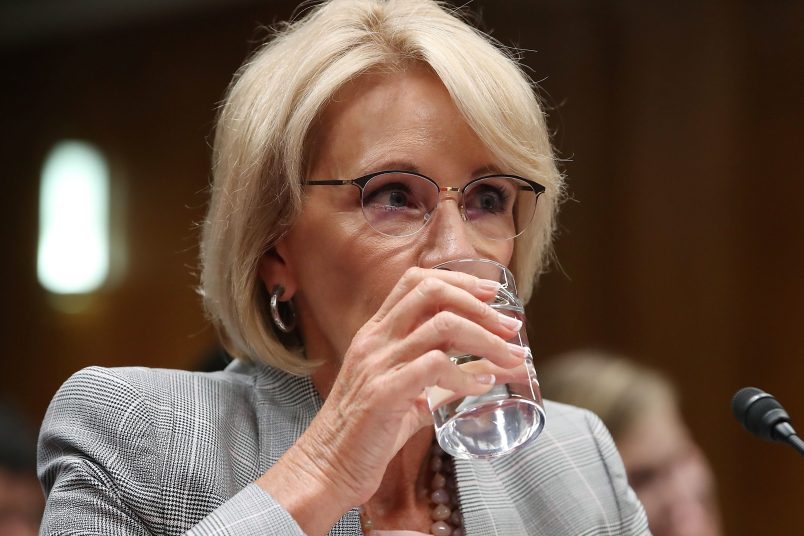
Students who are defrauded by their schools would have a harder time getting their federal loans erased under new rules proposed by the Trump administration Wednesday.
The proposal, which aims to replace a set of Obama-era rules that were never implemented, drew applause from the for-profit industry but sharp criticism from advocacy groups that represent student borrowers.
Education Secretary Betsy DeVos said the proposal lays out clear rules schools must follow to avoid trouble, while also protecting students harmed by deception.
“Our commitment and our focus has been and remains on protecting students from fraud,” DeVos said.
Under the proposal, students would be eligible for loan relief if they can prove their schools knowingly misled them with statements or actions that directly led them to take out loans or enroll at the school.
That would be a higher bar than the borrower defense rules finalized under Obama in 2016 after the collapse of two for-profit schools, Corinthian Colleges and ITT Technical Institute. Those rules allowed relief in a wider range of cases dealing with breach of contract.
Education Department documents supporting DeVos’ proposal argue that, while students should be protected from fraud, they also have an obligation to do their research before picking schools.
“Postsecondary students are adults who can be reasonably expected to make informed decisions if they have access to relevant and reliable data about program outcomes,” the department said.
The new proposal is estimated to save nearly $13 billion over the next decade compared with spending estimates under the Obama rules, primarily by reducing the amount of loan relief awarded to students.
Department officials say they have received more than 100,000 fraud claims since 2015, and most are still under review. But the new rules would apply only to loans taken out after July 1, 2019, officials said.
Schools would gain an opportunity to respond to claims of fraud under the new proposal, which says schools deserve to defend themselves against accusations that could damage their reputations and revenue.
It also would allow schools to force students into arbitration agreements barring them from suing the school, a practice used by some for-profit colleges that would have been banned under Obama’s rules.
Opponents blasted the proposal, saying it places schools ahead of students and discourages victims from pursuing financial relief.
“It encourages abusive and predatory institutions to continue to rip off students with impunity, while slamming the door on the debt relief that Congress has instructed the department to provide to cheated students,” said Toby Merrill, director of the Project on Predatory Student Lending at Harvard University.
Bob Shireman, a senior fellow at the Century Foundation and a former education official under Obama, said the proposal “is perhaps the most damaging action Betsy DeVos has taken since assuming office.”
“These changes would effectively strip students of their right to recourse if they believe that a college or university has misled them, making it next to impossible for defrauded students to get the relief they are entitled to,” he said.
But the changes were hailed as an improvement by the for-profit college industry and some Republicans.
Steve Gunderson, president and CEO of the trade group Career Education Colleges and Universities, said previous versions of the rules allowed for “carte blanche approval” of fraud claims, to the detriment of schools and their students.
“The department has undertaken a thoughtful and deliberate approach to this rule, and we applaud their hard work on this important matter,” Gunderson said.
Sen. Lamar Alexander, a Republican from Tennessee and chairman of the Senate education committee, said DeVos’ proposal will prevent taxpayers from footing the bill for “unreasonable or unsubstantiated claims of fraud.”
“The Obama administration went too far in rewriting this provision by setting overly broad and vague standards and as a result, put taxpayers on the hook for too many loans,” he said.
Obama’s education officials created new rules to clarify the debt relief process after thousands of students said they were defrauded by for-profit colleges. Before that, the process was rarely used and relied on a patchwork of state laws to determine if students deserved loan forgiveness.
The updated rules were scheduled to take effect in July 2017, but DeVos delayed them after a California group representing for-profit schools sued to block the regulations. DeVos began the process to replace them soon after.
Meanwhile, the department has only recently begun to process a backlog of fraud claims, announcing in December that it will provide only partial relief to borrowers based on their incomes. Under the Obama administration, students were granted full relief for their loans.
On Wednesday, the department said it will be gathering public input on the proposal for the next 30 days. Along with opinions on the rules, officials are also asking if borrowers still making payments on their loans should be able to apply for forgiveness at all, or if it should be reserved for those who default.



“they also have an obligation to do their research before picking schools”
What research? Do the schools post their scams for all to see? That’s never how it worked in America before. No kid should be subject to institutional fraud and then sidelined because they “should have known better”. Fraud of any kind involving anybody is not dealt with that way.
"“Postsecondary students are adults who can be reasonably expected to make informed decisions if they have access to relevant and reliable data about program outcomes,” "
Yeah, data generally under the total control of the for-profit schools (because it is generally collected and reported via self-reporting of the school to data aggregators like US News), who have every incentive under the sun to fluff it in order to hook more disinformed fishies to increase their profit margins.
The governing philosophy of “conservatives” and this maladministration: If there’s dick move to be made, do it.
“After all, the purpose of higher education is to make money for their investors isn’t it? These little buggers should be working in salt mines to pay their debts.” oh wait, she didn’t finish her thought out loud…
Student loan debt overtook credit card debt in America a few years ago. Making student’s more susceptible to fraudulent debt is just more icing on the shitcake.