


ANCHORAGE, Alaska (AP) — Lake Iliamna in Alaska is North America’s eighth-largest lake, but nobody would mistake it for the Pacific Ocean. Not even a seabird.
So when thousands of common murres were found dead at the southwest Alaska lake, as part of a massive die-off of a species whose preferred winter habitat is at sea, seabird experts were puzzled.
“We’ve talked about unprecedented things about this die off. That’s another one,” said John Piatt, research wildlife biologist for the U.S. Geological Survey.
Murres occasionally land in fresh water, Piatt said.
“You figure it’s a misguided individual. To have 6,000, 8,000 birds in the lake is pretty mind-blowing, really,” he said. “I’ve never heard of any such a thing anywhere in the world.”
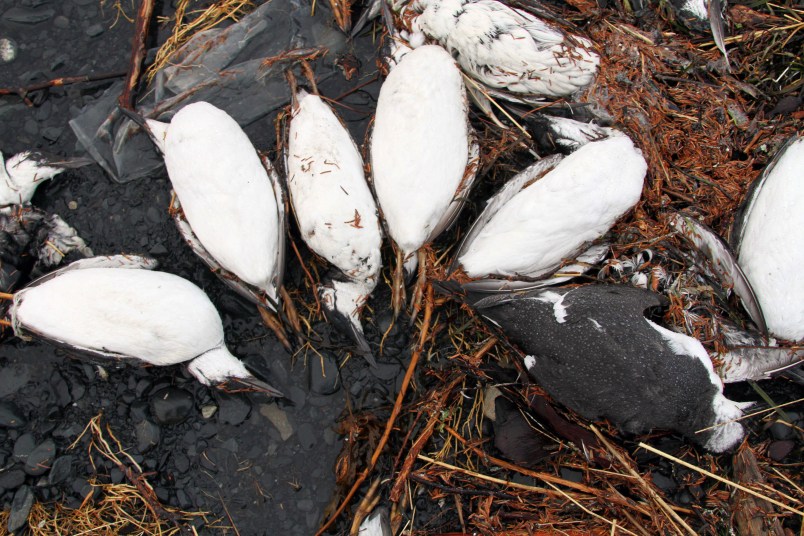
Abnormal numbers of dead common murres, all apparently starved, began washing ashore on Alaska beaches in March 2015. After late-December storms, 8,000 were found at the Prince William Sound community of Whittier. The confirmed carcass count is now up to 36,000, but most don’t wash ashore. Also, Alaska has more coastline than the rest of the United States put together and relatively few beaches have been surveyed.
Common murres catch finger-length fish to feed their young in summer and can forage on krill. Less is known about what they eat in winter. Because of a high metabolism rate, they can use up fat reserves and drop to a critical threshold for starvation in three days of not eating.
Researchers trying to find out the cause of the deaths would not have thought to look on a freshwater lake but were alerted to the Iliamna carcasses by Randy Alvarez, a member of the Lake and Peninsula borough assembly.
A commercial fisherman, Alvarez has lived in Igiugig on the west end of 77-mile long Lake Iliamna since 1983.
He had seen a few dead murres on the beach, but on a mid-February flight with the borough mayor and manager, they saw thousands.
“We came up with a guess of 6,000 to 8000 birds in about 12 miles,” Alvarez said.
Nobody he knows remembers common murres at the lake. Alvarez speculates the birds could not find food in the Pacific and flew to the lake to eat salmon smolt. Lake Iliamna has not frozen the last two winters, which itself is strange.
His friends and relatives in Naknek, a Bristol Bay port, in normal winters catch smelt, another small, silvery fish.
“This was the worst anybody had ever seen it for smelt,” he said, and he wonders if it’s connected to the North Pacific’s third-straight year of above-normal temperatures. If seabirds can’t find enough to eat, he worries that salmon won’t either.
“I think something is not right,” he said.
Scientists in multiple federal agencies are trying to determine if the murre deaths are connected to lack of food, parasites, disease, weather or something else, but they keep being pitched curves, like birds showing up in surprising places.
“This is the thing about this die-off,” Piatt said. “We don’t even know what we don’t know.”
Copyright 2016 The Associated Press. All rights reserved. This material may not be published, broadcast, rewritten or redistributed.







We have all the signs of global warming and the bad things that happen. Any one listening? I guess when the oceans rise as well as droughts cause mass migrations, the fish become scarce and virus’ and bacteria become daily hazards, the few humans left might have time to ponder the great poisoning.
Life will go on. Human activity? It is not so well known.
Ugh. Looks like there’s more than one “canary in the coalmine.”
"I guess that gospel song is true: God is trying to tell you something. "
The droughts are occurring, thThe usual culprit is civil wars (Iraq, Somalia, remenents of the Sudanese conflict); but as with earlier famines (that of course happened in the third world), while war is the starting point, nature is a sometime ‘helper’.
http://droughtmonitor.unl.edu
(The major reason why I struck part of this post/I was wrong.)
Unless, you know, it’s not freezing over in winter any more. In which case, if you don’t have GPS and a map, which I presume the birds did not, I expect it’s quite easy to mistake it for the Pacific Ocean which I just KNOW is around here somewhere and which isn’t frozen at this time of year.