

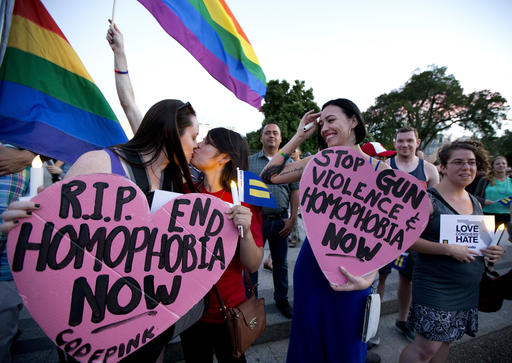
CHICAGO (AP) — A federal appeals court ruled for the first time Tuesday that the 1964 Civil Rights Act protects LGBT employees from workplace discrimination, setting up a likely battle before the Supreme Court as gay rights advocates push to broaden the scope of the 53-year-old law.
The 8-to-3 decision by the full 7th U.S. Circuit Court of Appeals in Chicago comes just three weeks after a three-judge panel in Atlanta ruled the opposite, saying employers aren’t prohibited from discriminating against employees based on sexual orientation.
The 7th Circuit is considered relatively conservative and five of the eight judges in the majority were appointed by Republican presidents, making the finding all the more notable.
The case stems from a lawsuit by Indiana teacher Kimberly Hively alleging that the Ivy Tech Community College in South Bend didn’t hire her full time because she is a lesbian.
In an opinion concurring with the majority, Judge Richard Posner wrote that changing norms call for a change in interpretation of the Civil Rights Act, which bars discrimination based on race, color, religion, national origin or sex.
“I don’t see why firing a lesbian because she is in the subset of women who are lesbian should be thought any less a form of sex discrimination than firing a woman because she’s a woman,” wrote the judge, who was appointed by Republican Ronald Reagan.
The decision comes as President Donald Trump’s administration has begun setting its own policies on LGBT rights. Late in January, the White House declared Trump would enforce an Obama administration order barring companies that do federal work from workplace discrimination on the basis of sexual identity. But in February, it revoked guidance on transgender students’ use of public school bathrooms, deferring to states.
Hively said after Tuesday’s ruling that she agreed to bring the case because she felt she was being “bullied.” She told The Associated Press in a telephone interview that the time has come “to stop punishing people for being gay, being lesbian, being transgender.”
“This decision is game changer for lesbian and gay employees facing discrimination in the workplace and sends a clear message to employers: it is against the law to discriminate on the basis of sexual orientation,” said Greg Nevins, of Lambda Legal, which brought the case on behalf of Hively.
Ivy Tech said in a statement that its policies specifically bar discrimination based on sexual orientation and that it denies discriminating against Hively, a factual question separate from the 7th Circuit’s finding regarding the law.
The Chicago ruling came on the anniversary of the assassination of civil rights icon Martin Luther King, whose marches against racism prompted Congress to pass the landmark civil law. A GOP-majority House and Senate make it unlikely the current Congress will amend the Civil Rights Act, likely leaving it for the Supreme Court to decide.
Debate in the Hively case revolved around the meaning of the word ‘sex’ in Title VII, the section of the law that deals with discrimination. Other courts have concluded that Congress meant for the word to refer only to whether a worker was male or female. They said that it would be wrong to stretch the meaning of ‘sex’ in the statute to include sexual orientation.
The majority of the 7th Circuit sided with a broader meaning.
“Any discomfort, disapproval, or job decision based on the fact that the complainant — woman or man — dresses differently, speaks differently, or dates or marries a same-sex partner, is a reaction purely and simply based on sex. That means that it falls within Title VII’s prohibition against sex discrimination …,” Judge Diane Wood, a President Bill Clinton appointee, wrote for the majority.
The dissenting opinion — written by Judge Diane Sykes, a conservative who was on Trump’s list of possible Supreme Court appointees — said the majority were stretching the meaning of the law’s text too far.
“We are not authorized to infuse the text with a new or unconventional meaning or to update it to respond to changed social, economic, or political conditions.”
The dissent alludes to the judicial philosophy of Trump’s high-court nominee, Neil Gorsuch, who advocates adhering largely to original legislative texts in deciding legal disputes.
“It’s understandable that the court is impatient to protect lesbians and gay men from workplace discrimination without waiting for Congress to act. Legislative change is arduous and can be slow to come. But we’re not authorized to amend Title VII by interpretation,” Sykes wrote.
Posner, though, said sticking to outdated meanings and cultural standards didn’t make sense.
“It is well-nigh certain that homosexuality, male or female, did not figure in the minds of the legislators who enacted Title VII,” he wrote in his concurring opinion.
“(Lawmakers in the 1960s) shouldn’t be blamed for that failure of foresight,” he wrote. “We understand the words of Title VII differently not because we’re smarter than the statute’s framers and ratifiers but because we live in a different era, a different culture.”
Copyright 2017 The Associated Press. All rights reserved. This material may not be published, broadcast, rewritten or redistributed.



An 8-3 win in a fairly conservative district is a great win-win for America. I wish Judge Posner’s careful approach to the Constitution’s words and each law’s intent would be considered by every judge.
I suspect the U.S. Supreme Court will take up the (likely?) appeal since there are varying decisions by different districts on this subject. All the more reason to fight Gorsuch and any other socially conservative judge.
Gorsuch: What Civil Rights Act?
Scalia: That’s my boy!
I think this sentence needs to be amended or struck from this article. As ThinkProgress pointed out in a March 29 piece, Trump quietly signed an executive order revoking Obama Executive Order 13673. This order required companies doing business with the federal government to provide documentation that they are compliant with other federal laws and Executive Orders. In this case, it would mean that companies don’t have to show that they are compliant with Executive Order 13672 (see how close they are in numbering?) which requires that companies doing business with the federal government not discriminate on the basis of sexual orientation/identity. If the companies don’t have to supply any documentation how is EO 13672 going to be enforced? Or Effective? Without the requirement of businesses showing they are compliant, EO 13672 is virtually toothless.
On top of that, the Trump Admin is contemplating a “religious freedom” executive order which would allow virtually all anti-LGBT discrimination just by a business saying “religious freedom.” This EO is modeled on the Heritage Foundations First Amendment Defense Act (FADA) which Trump has endorsed and promised to sign. FADA is so vague that it would enshrine discrimination against LGBT individuals into federal law. It would override any LGBT protections anywhere in the country.
So, let’s not kid ourselves, Trump is no longer promising to “enforce” EO 13672. He’s doing away with it by revoking other EOs and signing new anti-LGBT orders.
thinkprogress.org/trump-gutted-lgbt-executive-order-8dd0e3be69a
thinkprogress.org/trumps-extreme-religious-freedom-order-would-nullify-the-lgbt-protections-he-promised-to-keep-fb0055dd8e46
Well, OK SAm. Thanks.Any guesses about how the Justices, especially Kennedy, will rule if some defense of LGBT rights reaches the RichPeople’s Court, and how quickly that might happen? TIA.
Posner is an example of a conservative judge that should sit on the Supreme Court…his decisions aren’t politically based, they are based in a conservative reading of the law, which includes an understanding that times change.
Gorsuch is a political hack dressed up in judicial robes…even without the wrongness of what happened to Garland, Gorsuch doesn’t have the balance necessary to become a Supreme Court judge, because he’s not interested in being a judge for the people but instead just for his political party.
It’s too bad the Gorsuch nomination isn’t being framed this way (at least not strongly)…his hearings made it perfectly clear that he wasn’t a good choice all by himself.