

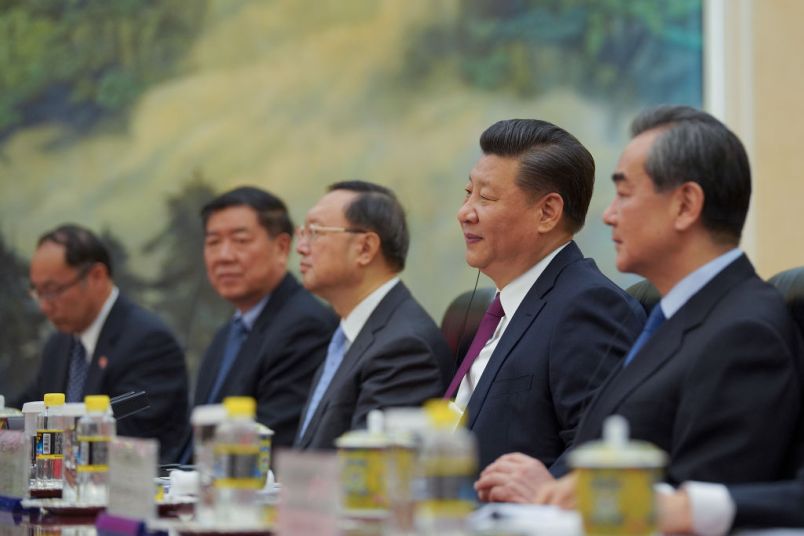
BEIJING (AP) — China said Sunday that it would not initiate a trade war with the United States, but vowed to defend its national interests in the face of growing American protectionism.
“There are no winners in a trade war, and it would bring disaster to our two countries as well as the rest of the world,” Minister of Commerce Zhong Shan said at a briefing on the sidelines of China’s annual parliamentary session.
“China does not wish to fight a trade war, nor will China initiate a trade war, but we can handle any challenge and will resolutely defend the interests of our country and our people,” he said.
It was Beijing’s latest statement on “problems in Sino-U.S. economic trade and cooperation,” alluding to President Donald Trump’s plan to impose heavy tariffs on imported steel and aluminum. Trump said Thursday that he was slapping tariffs of 25 percent on imported steel and 10 percent on aluminum, temporarily exempting big steel producers Canada and Mexico.
Chinese leaders have threatened in the past to retaliate against raised trade barriers, but have yet to take direct action following Trump’s announcement.
Citing Chinese researchers, Zhong said the U.S. has been overstating its trade deficit with China by about 20 percent every year. He gave no details on how this figure was reached, but the U.S. and Chinese governments generally report widely differing trade figures because Beijing counts only the first port to which goods go instead of their final destination.
The U.S. reported a $375 billion deficit with China last year, so a 20 percent reduction would still be among the largest trade gaps that it has with any country.
Zhong blamed the trade imbalance in part on controls over U.S. high-tech exports to China, repeating a Chinese claim that Washington could narrow its trade deficit if it allowed Beijing to buy more “dual use” technology such as supercomputers and advanced materials with military applications.
U.S. officials have said such sales would make up only a few percent of the deficit while possibly threatening American national security.
The Trump administration earlier approved higher tariffs on Chinese-made washing machines, solar modules and some other goods, prompting Beijing to accuse Washington of disrupting global trade regulation by taking action under U.S. law instead of through the World Trade Organization.
Liu He, Chinese President Xi Jinping’s top economic adviser, visited Washington earlier this month in an attempt to smooth strained ties.
Zhong said that Beijing would continue to “relax market access” to China, and that it would also attach greater importance to intellectual property rights, another point of tension with the U.S.
China absorbed $136.3 billion in foreign investment last year. The country has long been among the top global destinations for investment, but foreign enthusiasm is cooling. Surveys by business groups show companies are shifting emphasis to other Asian economies seen as more profitable or less restrictive.
“We have noticed that some foreign-funded businesses have complained about China’s investment environment,” Zhong said. “The fact that they have complaints indicates that they are still paying attention to China’s development and have confidence in China’s market.”
The commerce minister reiterated Premier Li Keqiang’s promise last week to liberalize the manufacturing industry and expand the opening up of sectors such as medical care, education and new energy vehicles. Specific details were not given, but Zhong pledged to give equal treatment to domestic and foreign businesses alike while continuing to curb “irrational overseas investment” from within China.






Does anyone else notice a difference between:
“China does not wish to fight a trade war, nor will China initiate a trade war, but we can handle any challenge and will resolutely defend the interests of our country and our people."
And:
"Trade wars are good and easy to win. Example, when we are down $100 billion with a certain country and they get cute, don’t trade anymore-we win big. It’s easy!”
Trump’s unilateral approach to trade issues will inevitably isolate us and lead to conflict.
The issues of China’s overproduction of steel – which is being curbed to combat pollution – and its dumping of steel under cost have already been noted, but I think we might be better off working through the WTO or through trade blocs.
“Speak softly and carry a big stick”
The Chinese knows “the art of not losing face”, AKA “not making a complete and utter fool of yourself”
Rather than read this as forbearance on China’s part it seems more likely that they have Trump’s number and know his tariff talk, like virtually everything else he does, mainly serve as an element of his kayfabe rather than a serious policy problem they have to solve.
That doesn’t mean they won’t respond with some blather and bluff of their own if it serves a real policy goal of their own only that they likely understand, as most of us do, that Trump has no policy goals of his own in any national sense.
NB:
I thought China didn’t really export that much steel and aluminum to the US. So how is this current Trump propaganda ploy actually getting back at China for it’s currency devaluation? Could one of the media talking heads please ask Donald that and when he’s going to get serious with China over the trade deficit instead of grandstanding?
It’s like some of Trump’s campaign assertions have just dropped off the edge of the flat world. Is China still pushing currency devaluation as Donald asserted in his election campaign? Why isn’t it a priority if he wants to start a trade war?