

NEW YORK (AP) — The crude pipe bomb that exploded beneath the streets of New York this week served as a chilling reminder of the vulnerability of the city’s subway system, a 24-hour-a-day operation with 472 stations and more than 5 million daily riders.
While police say the nation’s largest subway system has some of the tightest security possible that still allows busy New Yorkers to get where they’re going, they acknowledge they can’t be everywhere or anticipate every kind of attack, particularly in this era of lone-wolf terrorism.
“It’s very difficult, and it’s getting harder,” John Miller, the New York Police Department’s deputy commissioner of intelligence and counterterrorism, said on CBS’s “This Morning.” ”This is not the al-Qaida model, where a cell of people who are communicating with a base are an intelligence problem.”
Instead, he said, the threat is coming from people “where the conspiracy is within the confines of their own mind.”
Investigators say that appears to be what happened Monday, when a Bangladeshi immigrant indoctrinated into terrorism through internet videos strapped a bomb to his body and set it off in a busy passageway. He was the only one seriously hurt, suffering burns on his hands and torso.
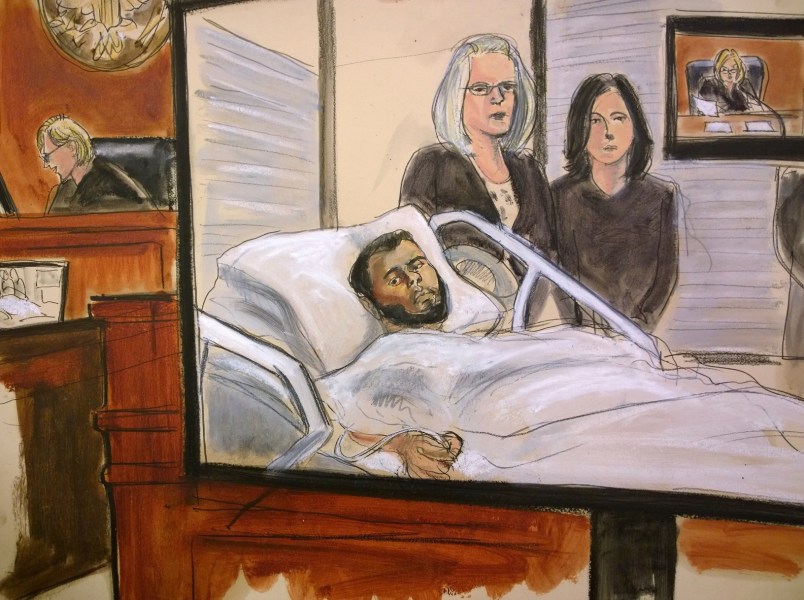
Akayed Ullah, who’s 27, was charged with federal terrorism-related offenses punishable by up to life in prison and was informed of the charges via video Wednesday as he lay in his hospital bed. He did not enter a plea and said little during the hearing, which lasted a little over 10 minutes.
It was the second lone-wolf terror attack on the city in six weeks. On Oct. 31, a man in a rented truck mowed down cyclists and pedestrians on a crowded bike path near the World Trade Center, killing eight people.
But the blast this week was the first bombing on the subway in 23 years, a streak police attribute in part to a multilayered security approach that begins with 3,000 officers underground every day, patrolling trains and platforms.
That’s bolstered by hundreds of security cameras, including one that captured detailed pictures of Monday’s explosion, and roving teams of officers with heavy weapons and dogs to sweep subway stations and trains. Officers are outfitted with pager-size radiation detectors to guard against a radioactive dirty bomb. Police also conduct tens of thousands of random bag searches in the system each year.
Yet those officers are confronted daily with thousands of people of every background, from every corner of the globe, carrying big backpacks, suitcases and large boxes, with no easy way of knowing whether any of those items contain a bomb.
Police have to rely on riders as their eyes and ears, constantly reminding them, “If you see something, say something.”
“Look up from your phones. Look up from your books now and then. Take your earphones out. You can’t say something when you see something if you don’t look at it,” Joseph Fox, chief of the NYPD’s transit bureau, urged New Yorkers after the attack.
But the see-something, say-something system didn’t work Monday. Authorities said Ullah boarded a subway train deep in Brooklyn with a bomb strapped to his torso, spent nearly an hour riding into Manhattan, changing trains along the way, and walked through one of the most heavily patrolled subway stations before triggering the device in front of a security camera.
“We’re considering spending millions (of dollars) to erect a border wall, maybe we should be thinking about using the money to better secure rail and transit lines,” said James Norton, a former homeland security official and professor at Johns Hopkins University.
He suggested more screening of bags and passengers before people get on a train.
Police and politicians have repeatedly said that measures such as adding metal detectors and bag checks to all stations could bring the system to a crawl.
“You can’t have a police person on every block at every moment — that would be impractical,” Gov. Andrew Cuomo, a Democrat, said in a TV interview this week. “But in terms of the sophistication of our security system, it’s second to none on the planet.”
Only about six crimes are reported per day in the sprawling subway system.
___
Associated Press writer Tom Hays contributed to this report.




Everywhere is vulnerable. There are hundreds of thousands of courthouses and schools and municipal and county and other government buildings with no significant security all over the country where dozens if not hundreds of people congregate. There are just as many if not more night clubs, concert venues, churches, parks, sports venues, where thousands of people congregate.
And that’s a good thing. I would not want to live in a country where we had to harden everything so much that it protected against a single person with a homemade bomb.
There really isn’t much you can do about this. If you have enough freedom to make life worthwhile you have enough to make other peoples’ lives more difficult if you’re committed to it. What can we do, bring the TSA into it, and make people take their shoes off before using the subway? I’m just happy that this time the perpetrator was such a doofus. As the meme goes:
People outside of NYC: TERRORISM!!!
New Yorkers: Dude’s a loser with a crappy bomb whose crowning life achievement is making my train 36 minutes late.
Because it’s bullshit kabuki theater. I don’t have a solution to this problem, but by continuing the wars in Afghanistan, Iraq and Africa, we sure aren’t helping. Declaring Jerusalem the capital of Israel? What could possibly go wrong??!? Please. Perhaps some day our government will get a clue, but I expect to be long gone by that time, if it ever comes.
See something, say something pretty much never works. In a place like New York, someone with brown skin bundled up in a coat with an unpleasant expression on their face is indistinguishable from a person with white skin ditto. In some other place, it’s almost always going to be someone from a warm climate who is effing cold (or a perfectly harmless immigrant who has a racist jerk somewhere in their neighborhood).
And if I see a bunch of white guys brandishing guns, well, the police are just going to learn that they’re exercising their second amendment rights and I’ll be the one in trouble.
In general, you want to reduce the noise level of random reports of suspicious activity so that authorities have time to pay attention to real signals.