

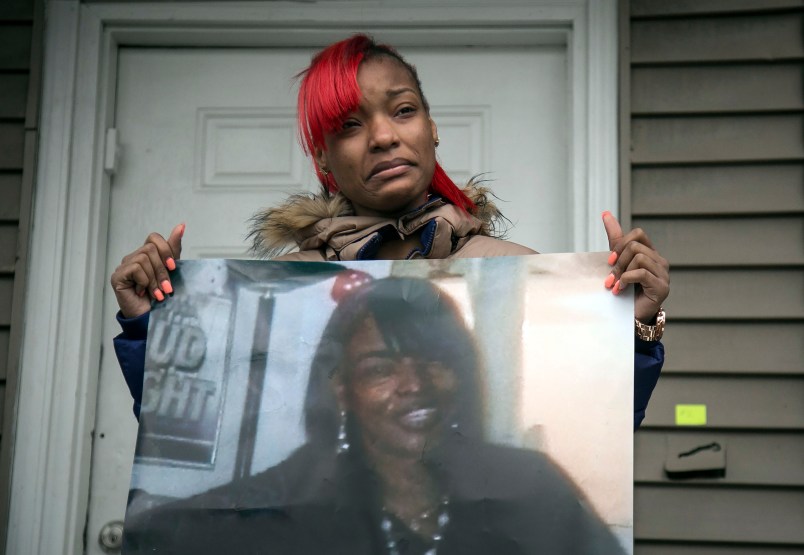
CHICAGO (AP) — Bettie Jones, known in her Chicago neighborhood for her work with anti-violence community groups, was killed by police responding to a domestic disturbance just hours after she hosted family on Christmas Day.
The fatal shooting of Jones, 55, and 19-year-old Quintonio LeGrier, a college student visiting his father for the holiday, at a West Side home has raised further questions about a police department already under intense scrutiny. Grieving relatives and friends of the two victims gathered Sunday to remember them and criticize city officials who they said had once again failed residents.
The shooting happened early Saturday morning at the small two-story home, where Jones lived in a ground-floor apartment and LeGrier’s father in an upstairs unit. Police, who were responding to a 911 call made by LeGrier’s father after an argument with his son, have released few details beyond a brief statement.
It said that officers “were confronted by a combative subject resulting in the discharging of the officer’s weapon” and added that Jones “was accidentally struck.”
Both Jones and LeGrief were black, and their deaths come amid scrutiny of police after a series of deaths of African-Americans at the hands of officers across the country gave rise to the Black Lives Matter movement. It also comes amid a federal civil rights investigation into the Chicago Police Department that was launched after last month’s release of police dashcam video showing white officer Jason Van Dyke shooting black 17-year-old Laquan McDonald 16 times in 2014.
Police did not disclose the race of the officer or officers, saying only that those involved will be placed on administrative duties.
LeGrier’s mother, Janet Cooksey, during a vigil Sunday placed candles on the porch of the home. On either side of the door, Post-It notes indicated where two bullets hit siding on the house.
“I used to watch the news daily and I would grieve for other mothers, other family members, and now today I’m grieving myself,” Cooksey said at a news conference outside the residence earlier Sunday.
Others who spoke said police should have used stun guns or other nonlethal methods if they felt they needed to subdue LeGrier.
“Why do (police) have to shoot first and ask questions later?” Jacqueline Walker, a friend of Jones, asked. “It’s ridiculous.”
Family spokesman Eric Russell said Jones’ many grandchildren had hoped to thank her for their Christmas gifts over the weekend.
Autopsy findings released Sunday by the Cook County medical examiner’s office say Jones died from a gunshot to the chest and LeGrier from multiple gunshot wounds.
Police spokesman Anthony Guglielmi on Sunday said only that the shootings are being investigated by the city’s Independent Police Review Authority, the main police oversight agency.
LeGrier’s cousin, Albert Person, said LeGrier’s father had invited his son to a holiday gathering at another home on Christmas. Person said the son’s refusal to go caused friction, but he downplayed the severity of the argument.
“What family doesn’t fight on the holidays?” he said.
LeGrier’s father, Antonio LeGrier, told the Chicago Sun-Times his son appeared to be a “little agitated” when the father returned to the apartment. Around 4:15 a.m., the elder LeGrier said he heard loud banging on his locked bedroom door and that his son said, “You’re not going to scare me.” He said his son tried to bust the door open, but he kept him from doing so and called police. He added that he called Jones on the floor below to say his son was a “little irate” and not to open the door unless police arrived.
He said Jones told him his son was outside with a baseball bat. Person said the teen was back in the house by the time police arrived.
When they did arrive, Antonio LeGrier said he heard Jones yell, “Whoa, whoa, whoa!” He said he heard gunshots as he made his way down from the second floor and then saw his son and Jones lying in the foyer.
He said his son had emotional problems after spending most of his childhood in foster care. He described him as a “whiz kid” on break from Northern Illinois University, where he majored in electrical engineering technology.
Cooksey denied that her son ever exhibited “combative behavior.” She said he “might’ve been angry with his father and they might’ve got into it,” but that he was not angry or violent.
It’s not clear whether Jones tried to intervene before being shot or if she was hit by gunfire while answering the door.
Sam Adam Jr., a lawyer for the Jones family, said Jones and LeGrier were apparently shot near the doorway of the home, but that shell casings were found some 20 feet away. He said that raised questions about whether police could have perceived LeGrier as a threat at such a distance.
It couldn’t be independently verified that the casings had any link to Saturday’s shooting.
Adam also said police took the hard drive of a home-security camera from across the street, but it was unknown if it or other cameras in the neighborhood captured the shootings.
Chicago Mayor Rahm Emanuel’s office said in a statement Saturday that IPRA would share its evidence with the county prosecutor’s office.
“Anytime an officer uses force the public deserves answers, and regardless of the circumstances, we all grieve anytime there is a loss of life in our city,” Emanuel said in the statement.
Copyright 2015 The Associated Press. All rights reserved. This material may not be published, broadcast, rewritten or redistributed.






There were at least 9 shots fired. 7 hit the young man one the grandmother and another went thru a door, a wall and lodged in an interior wall of the grandmother’s home. And the police call that “accidental”? One or two shots maybe but 9?? That officer emptied his weapon I suspect.
It’s getting bad when you have to think twice about calling the police, who are definitely not peace officers.
If this was accidental, then it could be said all the other black deaths were on purpose?
“Why do (police) have to shoot first and ask questions later?” asked a family friend.
Says it all.
Of course, this story illustrates the difference between white communities where citizens and police alike believe police to be protectors and people living in inner city black neighborhoods where police perceive citizens to be threatening. When a father has an altercation with his teenage son in a white community the police come, break up the fight and talk the two in to counselling. In the black community when a father has an altercation with his son and the police come, one or both is likely to end up in the morgue. Crime would drop off dramatically if black citizens could view police as protectors to call first and police could view themselves as protectors of the citizens they are supposed to serve. .
BTW, fathers and teenage sons of all races have been having altercations since before time. Disagreements between parents and their children are a normal part of growing up. Arguing with your father shouldn’t be a capital offense.