

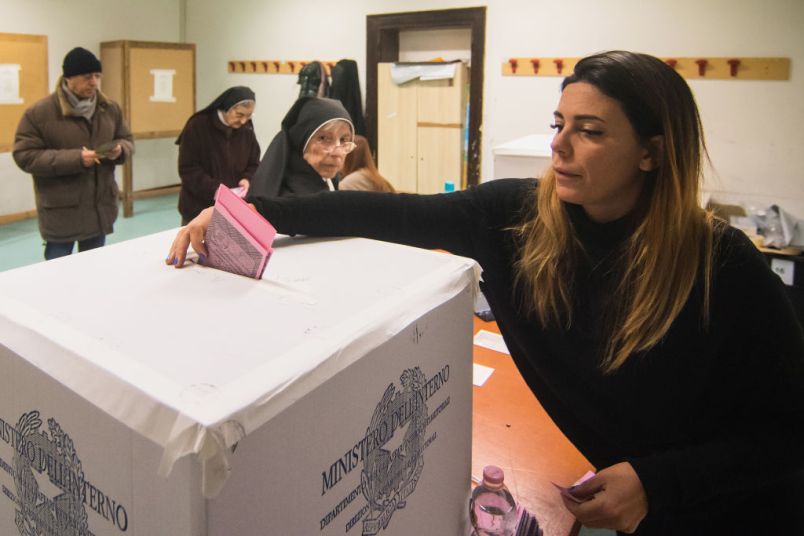
ROME (AP) — Italians braved long lines and confusing ballots to vote Sunday in one of the most uncertain elections in years — one that could determine if the country succumbs to the populist, euroskeptic and far-right sentiment that has swept through Europe.
Some Italian polling stations faced ballot delivery problems and all had new time-consuming anti-fraud measures in place that created bottlenecks at many stations. As the day wore on, authorities in Milan and Rome urged voters to give themselves plenty of time to cast their ballots and not wait until the last minute.
“You feel as if you have gone there prepared, but it’s not that clear,” Sister Vincenza complained as she cast her ballot on Rome’s Aventine hill before heading to Mass.
Some polling stations remained closed in Palermo two hours into election day because the wrong ballots were delivered and 200,000 new ones had to be reprinted overnight. Similar ballot glitches were reported elsewhere, forcing the suspension of the vote in two towns in Alessandria.
More than 46 million people were eligible to vote, including Italians abroad who already mailed in their ballots. Exit polls were expected after polls closed at 11 p.m. (2200 GMT; 5 p.m.), projections sometime thereafter and consolidated results Monday.
Italy’s political scene is dominated by three main blocs — the center-right coalition anchored by ex-Premier Silvio Berlusconi’s Forza Italia, the ruling center-left coalition anchored by the Democratic Party and the anti-establishment 5-Star Movement.
The campaign itself was marked by neo-fascist rhetoric and anti-migrant violence that culminated in a shooting spree last month against six Africans. While the center-right coalition that capitalized on Italy’s anti-migrant sentiment led the polls, analysts predicted the likeliest outcome of Sunday’s vote was a hung parliament.
With unemployment at 10.8 percent and economic growth in the eurozone’s third-largest economy lagging the average, many Italians have all but given up hope for change. Polls indicated a third hadn’t decided or weren’t even sure they would vote.
“The situation is pretty bad,” said Paolo Mercorillo from Ragusa, Sicily, who said he would not even bother casting a ballot. “There aren’t candidates who are valid enough.”
The populist 5-Star Movement hoped to capitalize on such disgust, particularly among Italy’s young. Polls indicated the grassroots movement launched in 2009 by comic Beppe Grillo would be the largest vote-getter among any single party.
But the 5-Stars weren’t expected to win enough to govern on their own, and they have sworn off forming coalitions. Still, the movement’s leader, 31-year-old Luigi Di Maio, has recently suggested he would be open to talking with potential allies.
Analysts predicted the only coalition with a shot of reaching an absolute majority is the center-right, which aside from Berlusconi’s Forza Italia includes the anti-migrant League and the nationalistic, neofascist-rooted Brothers of Italy party.
A topless Femen activist confronted Berlusconi on Sunday, jumping on a table as he was about to hand in his ballot and displaying “Berlusconi, you’ve expired” on her bare torso.
Berlusconi, 81, turned away and was escorted out. He can’t run for office because of a tax fraud conviction, but he has tapped European Parliament President Antonio Tajani, considered a pro-European moderate, as his pick if the center-right is asked to form a government.
League leader Matteo Salvini is also gunning for the top job, and some pro-European analysts envisioned a possible “nightmare scenario” of an extremist alliance among the 5-Stars, the League and the Brothers of Italy.
Steve Bannon, right-wing populist architect of Donald Trump’s White House campaign, was in Rome this weekend, cheering on the populists.
“I think if they create a coalition among all the populists it would be fantastic, it would terrify Brussels and pierce it in its heart,” Bannon was quoted as saying in Sunday’s Corriere della Sera newspaper.
Roberto D’Alimonte of Rome’s LUISS University said such an alliance would be “catastrophic” for the financial markets. But he said the 5-Stars will have to decide if they’re going to join the right or the left if they’re going to move from being in the opposition to actually helping govern the country.
“This will be the moment of truth,” he said.
With polls showing the center-left trailing, Democratic leader Matteo Renzi and the current premier, Paolo Gentiloni, spent the final days of the campaign warning that the only way to guard against a turn to populists and extremists was to vote for the Democrats. Gentiloni has been cited as a possible candidate for premier.
A new law passed last year, ostensibly to make Italy more governable, calls for a combination of direct and proportional voting for both the lower Chamber of deputies, which has 630 seats, and the Senate, which has 315 seats.
A few quirks could affect the outcome, particularly for the 5-Stars.
For starters, the names of about a dozen 5-Star candidates appeared on the ballot, but they no longer represent the party. If they actually win, other parties can woo them away to beef up their own ranks.
Analysts also warned the ballot itself is confusing and could result in a higher-than-usual percentage of invalid votes.
In addition, new anti-fraud measures involved the time-consuming logging of individual ballot serial numbers in voter registry books, and then checking the completed ballot against them to make sure they match.
While European capitals and Brussels were watching the outcome of the vote for its effects on policy and markets, some in Italy had more at stake personally. Berlusconi has vowed to deport 600,000 migrants if the center-right wins — a sentiment also endorsed by the anti-migrant Salvini.
“I fear these results, because I have arrived here with all my thoughts and dreams,” said Musab Badur, an asylum-seeker from Sudan who is living in a Milan shelter. “And I never thought that one day maybe I would have to go back.”
This post has been updated.






It’s worth noting here that the center-right and center-left coalitions are being presented as ‘everything’s normal’ politics, while the 5-Star Movement is the ‘dangerous and extreme’ group… but the center-right group is capitalizing on the anti-migrant sentiment. A brief look at M5S’s information shows they oppose career politicians, heavily support environmentalism, oppose military intervention, and are currently supportive of the EU. They also dislike immigration and have in the past opposed the EU. They’ve attempted to get into the center-left coalition within the EU parliament, but were rejected, and so remain in Farage’s coalition (for now, he’s pissed about them trying to jump ship and may kick them out).
Bottom line: M5S is not something easily reduced to right-left politics, and it’s ‘anti-establishment’ nature should not be taken as a direct analog for the Brexit or Trump fools.
Yeah, this is gonna be a serious problem.
This upsets me to the point where I haven’t been following it. We have enough to worry about here.
All I can say is that they really fucked up when they didn’t support Renzi. Now it’s going to be a fucking mess no matter which fascist-populist idiot wins and boy M5S is nothing but idiots. Idiots. The rest are fascists and Italy is already so in bed with Russia that I don’t know what hope there is.
Because they are. And stupid to boot. Look at who they run - idiots.
And you’re wrong - M5S supports withdrawal from the EU among other things. They are not the answer, @arrendis.
Never said they were. But the movement’s leadership has, both in January and February of this year, changed their position to say that the Euro, and thus the EU, are where the future lies.
Well essentially it hardly matters given the choices, although I remain utterly convinced that Populism is dangerous.
They might as well return Berlusconi to office. He’s still wildly popular in the south or was last year when I was there.