

WASHINGTON (AP) — The U.S. is bolstering its military presence in Afghanistan, more than 16 years after the war started. Is anyone paying attention?
Consider this: At a Senate hearing this past week on top U.S. security threats, the word “Afghanistan” was spoken exactly four times, each during introductory remarks. In the ensuing two hours of questions for intelligence agency witnesses, no senator asked about Afghanistan, suggesting little interest in a war with nearly 15,000 U.S. troops supporting combat against the Taliban.
It’s not as if the war’s end is in sight.
Just last month the bulk of an Army training brigade of about 800 soldiers arrived to improve the advising of Afghan forces. Since January, attack planes and other aircraft have been added to U.S. forces in Afghanistan.
But it’s not clear that the war, which began in October 2001, is going as well as the U.S. had hoped seven months after President Donald Trump announced a new, more aggressive strategy. The picture may be clearer once the traditionally most intensive fighting season begins in April or May. Over the winter, American and Afghan warplanes have focused on attacking illicit drug facilities that are a source of Taliban revenue.
One of Washington’s closest watchers of the Afghanistan conflict, Anthony Cordesman of the Center for Strategic and International Studies, wrote last month that the administration has made major improvements in military tactics and plans for developing Afghan forces but has “done nothing to deal with civil and political stability.” That challenge is expected to come into clearer focus with the approach of parliamentary elections planned for July.
The administration “not only faces a deteriorating security situation, it has no clear political, governance, or economic strategy to produce Afghan stability,” Cordesman said. In his view, the U.S. military has been assigned a “mission impossible” in Afghanistan.
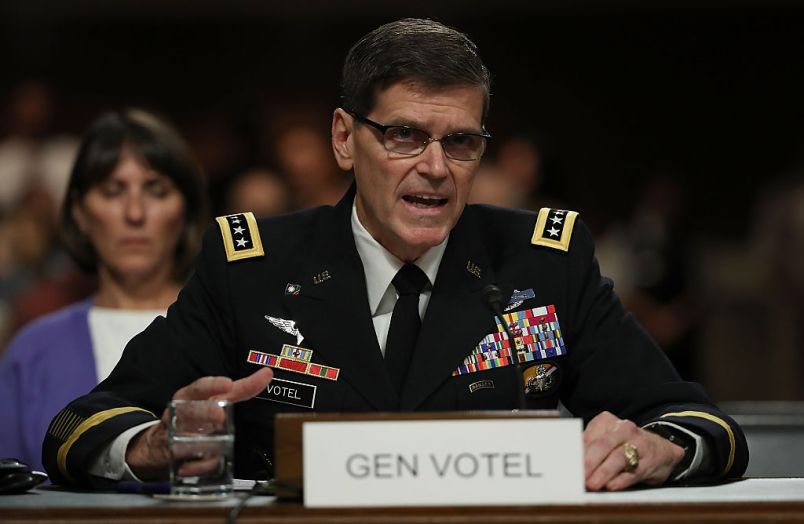
The weak central government in Kabul and the resilient Taliban insurgency are not the U.S. military’s only problems there. It also faces what Gen. Joseph Votel (pictured above), the top U.S. general overseeing the war, calls interference by Russia. He told a congressional panel last month that Moscow is seeking to undermine U.S. and NATO influence in Afghanistan by exaggerating the presence of Islamic State fighters there and portraying this as a U.S. failure.
When Trump announced in August that he was ordering a new approach to the war, he said he realized “the American people are weary of war without victory.” He said his instinct was to pull out, but that after consulting with aides, he decided to seek “an honorable and enduring outcome.” He said that meant committing more resources to the war, giving commanders in the field more authority and staying in Afghanistan for as long as it takes.
Stephen Biddle, a professor of political science and international affairs at George Washington University, said Americans’ relative lack of interest in the war gives Trump political maneuver room to conduct the war as he wishes, but that dynamic is not necessarily a good one.
“The idea that a democracy is spending billions of dollars a year, killing people and sacrificing American lives waging war, and the elected representatives of the people aren’t paying attention I think is inappropriate,” Biddle said. “But to say it is inappropriate isn’t to say it’s surprising, because this is the way Congress has been behaving toward this war for a long, long time.”
Last November, the U.S. commander in Kabul, Gen. John Nicholson, said the Afghan army, with U.S. support, had “turned the corner” and captured momentum against the Taliban. Since then, the Taliban have conducted a series of high-profile attacks in Kabul and elsewhere that have killed scores of civilians. U.S. officials have portrayed this as desperation tactics by the Taliban, arguing that they are unable to make new territorial gains.
Dan Coats, the director of U.S. national intelligence, offered a less optimistic forecast when he testified to the Senate Armed Services Committee on Tuesday.
“We assess the overall security picture will … modestly deteriorate in the coming year and Kabul will continue to bear the brunt of the Taliban-led insurgency,” Coats said. Afghan forces, while “unsteady,” probably will maintain control of most major population centers in 2018, he added.
Testifying at the same hearing, Army Lt. Gen. Robert Ashley, director of the Defense Intelligence Agency, offered a mixed outlook. He forecast that Afghan forces this year will continue to develop offensive combat power. But he also predicted the Taliban will “threaten Afghan stability, undermine public confidence by conducting intermittent high-profile attacks in urban areas,” increase its influence in rural areas and threaten district centers.
The Defense Department’s special inspector general for Afghanistan said in January that Afghan government control or influence has declined and Taliban control or influence has increase since the U.S. watchdog began reporting this type of data in January 2016.
It said in a follow-up report last month that as of October 2017, about 20.9 million Afghans, or 64 percent of the total population of 32.5 million, lived in areas where the government has control or influence. The rest of the population was in areas under Taliban control or influence, or deemed “contested” by both sides.





At this point, the US seems preoccupied by bread and circuses at home and resigned to war without end abroad, so long as these are “little wars” in forgotten corners of the world. Unfortunately real people die daily in these “little wars”. It is hard to believe that there will never be a reckoning for all those dead.
I guess Drumpf will fix Afghanistan as soon as his guaranteed ninety day plan to beat ISIS kicks in.
Forever and ever and ever…no one can say why of for who…
What a quagmire of a quagmire Afghanistan still is. With large heaping, not helping bottle of Russian dressing.
I wonder if going after the drug facilities will do anything? How did that work out in South America?
The 36 percent that is under Taliban control is it growing or shrinking?
When will Deferment Don visit our troops in Afghanistan to show how much he cares?
Maybe he could have a parade.