

DUBAI, United Arab Emirates (AP) — New security screenings for all passengers on U.S.-bound flights began on Thursday, with airlines worldwide questioning flyers about their trip and their luggage in the latest Trump administration decision affecting global travel.
However, confusion still remains about the new regulations, which come at the end of a 120-day period following the United States lifting a ban on laptops in airplane cabins affecting 10 Mideast cities. The new regulations cover all the 2,100 flights from around the world entering the U.S. on any given day.
Some airlines said they had received permission to delay implementing the new rules until January.
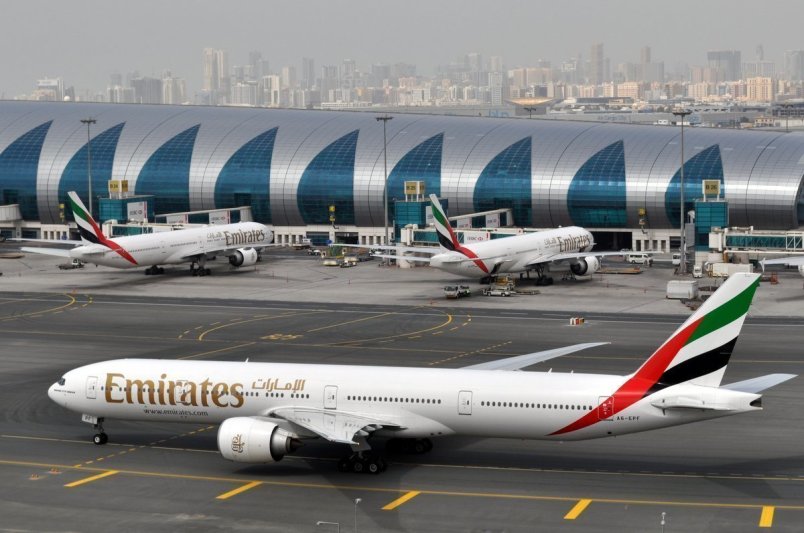
At Dubai International Airport, the world’s busiest for international travel, long-haul carrier Emirates began questioning passengers about their luggage, liquids they were carrying and where they were coming from. Passengers also had to have their carry-on bags searched, along with their electronics.
Emirates declined to discuss the new procedures in detail on Thursday. On Wednesday, it said it would conduct “passenger pre-screening interviews” for those traveling on U.S.-bound flights in concert with other checks on electronics.
Elsewhere, things did not appear to be going so smoothly. In China, an official in the Xiamen Airlines press office, who would only give his surname as Qiu, said that the airlines received a “demand” about the new U.S. regulations and planned “to take some security measures, including security safety interviews from today on.”
“We’re not going to interview all passengers, but focus on those with a certain degree of risk when checking the passengers’ documents on the ground,” he said, without elaborating.
An official with the Eastern Airlines publicity department said that she saw media reports about security safety interviews but didn’t have immediate details on what her company was doing. An official at the Beijing Airport press center would only say: “We always strictly follow relevant regulations of the Civil Aviation Administration when conducting security checks.” Both officials spoke on condition of anonymity under regulations.
At Air China, the country’s flag carrier, an official who only gave his surname, Zhang, said it would comply.
“We will meet the demands from the U.S. side, but as for the detailed measures (we will take), it is inconvenient for us to release,” he said.
South Korea’s Transport Ministry said that the United States agreed to delay implementing the new screening for the country’s two biggest carriers, Korean Air Lines Co. and Asiana Airlines Inc., until next year on condition they deploy staff at boarding gates to monitor travelers.
Royal Jordanian, based in Amman, also has said it would introduce the new procedures in mid-January.
Other airlines with U.S.-bound flights at Seoul’s Incheon International Airport brought in as many as seven extra staff Thursday to question passengers under the new rules but there were no major delays, airport spokesman Lee Jung-hoon said.
Singapore Airlines passengers may be required to “undergo enhanced security measures” including inspection of personal electronic devices “as well as security questioning during check-in and boarding,” the carrier said on its website.
Other carriers who announced the new regulations on Wednesday included Air France, Hong Kong-based Cathay Pacific Airways Ltd., the airlines of Germany’s Lufthansa Group and EgyptAir.
In Hong Kong, passengers described some of the questions they were asked.
“They asked me if I packed my own bag, where I packed it from, where I came from, they looked at my itinerary, verify where I was, who I was, from where I came from,” said Fran Young, who was travelling to Los Angeles.
Some showed displeasure.
“It’s a little inconvenient, I kind of just want to get my printed ticket and then just go inside,” passenger Gavin Lai said. “I don’t want to wait on people to interview me like that. So it’s a little annoying.”
U.S. carriers also will be affected by the new rules. Delta Air Lines said it was telling passengers traveling to the U.S. to arrive at the airport at least three hours before their flight and allow extra time to get through security. United declined to comment, while American did not immediately respond to a request for comment.
In March, U.S. officials introduced the laptop ban in the cabins of some Mideast airlines over concerns Islamic State fighters and other extremists could hide bombs inside of them. The ban was lifted after those airlines began using devices like CT scanners to examine electronics before passengers boarded planes heading to the U.S. Some also increasingly swab passengers’ hands to check for explosive residue.
The laptop ban as well as travel bans affecting predominantly Muslim countries have hurt Mideast airlines. Emirates, the region’s biggest, said it slashed 20 percent of its flights to the U.S. in the wake of the restrictions.
___
Associated Press writers Yu Bing in Beijing, Kelvin Chan and Josie Wong in Hong Kong, Anna Johnson in Phoenix and Youkyung Lee in Seoul contributed to this report.



If you want to understand just how provincial and insular Trump is look at this joke. I imagine the thinking behind this comes from the impression the USA’s in position to tell the world what to do and that things in that world work like Trump’s childish mind thinks they do. Good Lord…what is Trump worried about? Cuban cigars or a bomb? Does anyone think a traveler headed to the USA with terrorist intent is going to fess up at the departing airport? How silly can you be. Does anyone with international experience think the USA carries the clout to demand this anymore? That evaporated when we bailed out of Vietnam. It’s so damn silly in so many ways. “Sir…whats in your baggage”…ahhhh C4, some detonators and a remote device" " come with me then". Right.
You can’t stop terrorism at airports and borders. You can’t stop it with armies. The CIA, FBI and DOJ can’t stop it either. Never could.
Anyway, a terrorist doesn’t even have bring his tools in, he can buy anything he needs, guns, explosives, body armor.
More security theater. Waste of time and money, and will have no discernible impact on actual safety.
Trump is a firm believer in the Three-Question Rule widely employed by security forces and intelligence services – if you ask someone with ill intent three times, they have to tell you their plans. Trump definitely saw it work in a tense hostage situation once:
https://www.youtube.com/watch?v=z-5iCygFd9MThis is not something new. Airport security on flights heading to US have been doing thorough screening on passengers at least since the underwear bomber. Homeland security has also been checking luggage as far back as 10 year on departing flights from US. These days you do not even lock your suitcases and when I reach my destination outside US I find a Homeland security card in my suitcase and signs that someone rummaged through it What will be new is if passengers are asked to remove all their clothes and are deeply probed through all their cavities. May be Airports will soon need to employ surgeons to perform colonoscopies.