

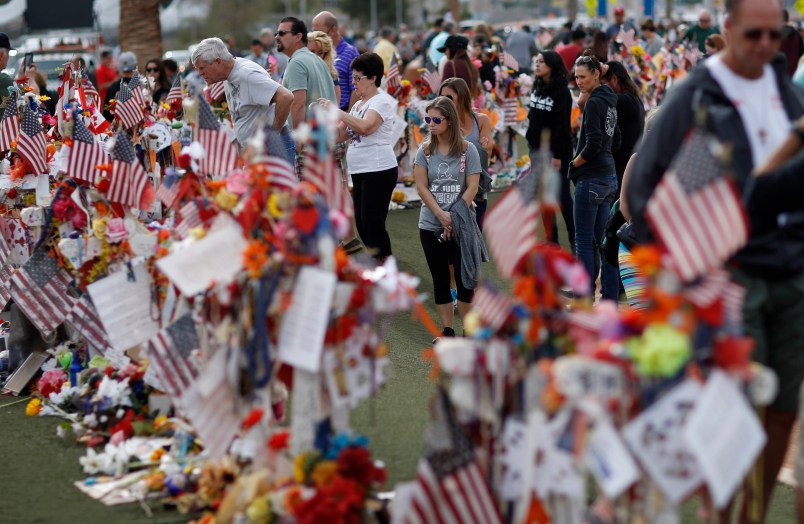
CHICAGO (AP) — Legal action following the mass shooting at a Las Vegas concert is picking up with lawsuits filed Wednesday on behalf of 14 concertgoers, including some who were shot or injured trying to escape and one woman who is so traumatized that she has since mistaken the sound of rain for gunshots.
The hotel-casino from where Stephen Paddock fired, concert organizers and the makers and sellers of a bump stock gun accessory that enabled him to fire rapidly are named as defendants. The court filings argue that they all share blame for the worst mass shooting in recent U.S. history.
The 14 civil complaints, filed together in state court in Las Vegas, follow at least three others filed since Paddock opened fire Oct. 1 from the 32nd floor of the Mandalay Bay hotel and casino, killing 58 people and injuring hundreds of others. The lawsuit seeks unspecific compensation for both “physical and mental injuries.”
The challenge for mass-shooting lawsuits is clearing a high legal bar to prove someone other than the shooter bears any responsibility. Such litigation typically drags for years and can end with victims and their families receiving little to nothing.
One of those suing, Elisha Seng, described in a phone interview haunting images she can’t dispel — of bullets thudding around her on the concert grounds and of turning to see a young woman covered in blood after being shot, clutching her throat and falling forward.
“I don’t sleep at night and, when I do, I have nightmares,” said the 46-year-old from Bartlett, Illinois, just outside Chicago. Recently, as heavy rain began to fall outside overnight, she jumped up from her bed. “I thought it was gunshots.”
Seng, who wasn’t physically injured, returned to work as a sales representative, but said she quickly tires from her lack of sleep. Going to concert or sports halls can prompt flashbacks. She recently attended a Chicago Blackhawks game and found herself nervously calculating the best escape routes should someone open fire.
A Chicago law firm helped to prepare the filings, which include several plaintiffs from the Chicago area. Victims named in the suits also include a California man, Anthony Crisci, who was rushed to a hospital with a gunshot wound in a truck crowded with other victims.
Among deficiencies at the concert venue were poorly marked exits, Wednesday’s filings say. And the hotel, it says, should have had gunfire-location devices that pinpoint where shots are coming from.
The 64-year-old Paddock, who killed himself just before his room was stormed, is also named in a bid to seize assets from his estate.
Paddock was able to use VIP status conferred on him as a high-stakes gambler to stockpile more than 20 rifles in his hotel suite, including by using exclusive access to a service elevator over days, the filings say. They argue what should have been routine checks of Paddock’s bags and his room would have revealed his growing arsenal.
The filings name a leading bump stock maker, Texas-based Slide Fire Solutions, as a defendant. A lead attorney, Chicago-based Antonio Romanucci, said it wasn’t yet clear which manufacturer, wholesaler or retailer made and sold the specific bump stock that Paddock used, but that the idea was to hold “the entire supply chain” responsible. Messages seeking comment from Slide Fire weren’t returned.
MGM Resorts International, the parent company of Mandalay Bay, called the shooting “a meticulously planned, evil … act” in a statement Wednesday and added that it would respond to any allegations only through “the appropriate legal channels.” Live Nation, a concert organizer named in the filings, said in a statement it cannot comment on pending litigation, but that the company remains “heartbroken for the victims.”
Bump stocks were originally created ostensibly to make it easier for people with disabilities to shoot. But the filings allege that Slide Fire geared its marketing to regular gun owners who wanted their semi-automatic rifles to mimic fully automatic weapons.
Civil cases in mass shootings are becoming increasingly common.
Romanucci has also filed a lawsuit on behalf of victims of the Pulse nightclub shooting that killed 49 people last year in Orlando, Florida. It alleges, among other things, that a security firm that once employed gunman Omar Mateen knew Mateen was mentally unstable and had threatened violence, and should have alerted authorities. Mateen was killed in a shootout with police.
The 2007 Virginia Tech campus shooting in which Seung-Hui Cho killed 32 people illustrated the difficulties posed by such lawsuits. In 2013, the Virginia Supreme Court overturned a jury verdict siding with parents of two victims who claimed the state was negligent. A statement from the state attorney general’s office at the time said the reversal showed what it had argued during years of litigation: “Cho was the lone person responsible for this tragedy.”
Cho killed himself after his rampage.
Seng said she joined the civil case to force better security at concerts and at hotels. She said she can’t fathom how a hotel-casino that devotes so many resources to catching gamblers that cheat didn’t notice Paddock bringing in high-powered weapons over a number of days.
“They can catch a person counting cards,” she said. “But they can’t catch someone carrying bags of guns.”





Jarndyce v. Jarndyce for the 21st century.
Question for the lawyers here: gun manufacturers are protected. Bullet makers? Gunpowder makers? The people who sell them the metal and chemicals used?
Fully automatic weapons are illegal. If it shoots like a machine gun, sounds like a machine gun, and mows down mass numbers of people, it is a machine gun. As long as the NRA’s contract with Congress exists there will be no relief from nut cases, criminals, and militias bent on mass murder. My thoughts and prayers are with the victims who have only the sketchy remedy of law suits to somehow limit mass killings to one victim per trigger pull.
That bit about being able to detect card-counters is telling.
But I really want to see discovery from the marketing departments of bump stock manufacturers. Their internal memos are likely not what they want even gun nuts to read.
Wimpy snowflakes. This is like when people sue McDonald’s for hot coffee spills. Only an idiot wouldn’t have known that a bump stock can shoot lots of bullets. Stupid snowflakes should never have been out of cover in a big, open parking lot in the first place because doing so means you’re at risk of getting in the way of someone exercising their 2nd amendment rights. Indeed, by stopping the shooter’s bullets with their bodies, they infringed on his rights. He should be the one suing. How stupid can they be? All true Americans should know this. These people were stupid enough to go to a concert and leave cover, and then they sue innocent bump stock maker?
Tort reform now! Libtard lawyers are killing us! The American bar association is a cultural Marxist globalist organization and they sold uranium to the Russsians (and I have a chart that proves it!).
These would be ridiculous ways to respond to America’s mass-homicide problem. The courts have long found that there are situations in which there are compelling public interests in favor of some limitations on Constitutional rights. We don’t have to become a nation of constantly armed and constantly fearful people to protect a Constitutional right. The rights are for the benefit of the people, not the other way around.
I hope for a sensible America in which we can make progress in three areas initially:
Aggregate data collection and study – injuries and deaths from firearms should be treated as a public-health problem, with data collection as required to support studies of causes and solutions.
Property rights – property owners, including employers and landlords, should have the right to restrict or ban firearms on their property, and the existence of any ban or restrictions should not create a liability for them should they be sued by someone who believes they came to harm on the property because they could not access a firearm.
Liability and individual data – starting with the mass-homicide machines, ownership should be registered, transfer of ownership should be reported and recorded, and proof of liability insurance should be required to maintain ownership. Liability stays with the most recent registered owner unless that owner provides timely notification of transfer, theft, or loss of the weapon. Furthermore, insurance companies should be allowed to ask customers about firearms in a household and to offer liability coverage for firearms as a rider to the main policy.