


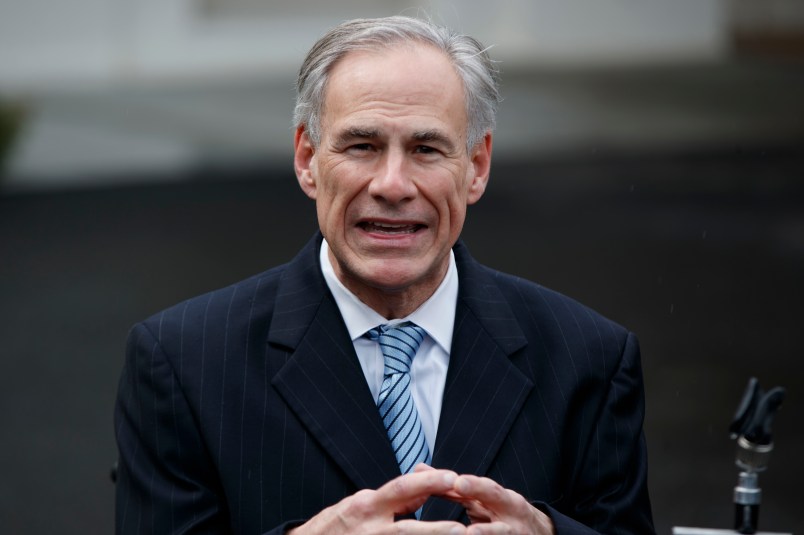
A divided 3-judge panel of federal judges ruled Thursday that the Texas legislature in 2011 drew its state house districts with the intention of diluting minority voters.
“With regard to the intentional vote dilution claims under § 2 and the Fourteenth Amendment, the Court finds that Plaintiffs proved their claims in El Paso County (HD78), Bexar County (HD117), Nueces County (the elimination of HD33 and the configuration of HD32 and HD34), HD41 in the Valley, Harris County, western Dallas County (HD103, HD104, and HD105), Tarrant County (HD90, HD93), Bell County (HD54), and with regard to Plan H283 as a whole,” the two-to-one decision, issued from the U.S. District Court for the Western District of Texas, said.
The finding is part of a pattern for the Texas legislature. A voter ID law it passed in 2011 has twice been found to have been enacted with intention of discrimination against minorities by a federal judge—the second time after using a higher legal standard laid out by an appeals court. The same panel of judges who decided Thursday’s ruling also found that the Texas legislature drew a handful of U.S. House districts in way that amounted to illegal racial gerrymandering.
A finding of intentional racial discrimination in violation of the Voting Rights Act risks putting Texas back under what is known as pre-clearance, the VRA process requiring certain states and localities to get federal approval for changes to their election laws. Texas was previously under the pre-clearance regime until the Supreme Court in 2013’s Shelby County v. Holder gutted the formula determining the pre-clearance states under section 5 of the VRA.
Time will tell if the judges in those cases will seek to put Texas back under pre-clearance via section 3, which still stands. It is likely Texas will appeal those cases, given its history of fighting voting rights decision against it tooth-and-nail, meaning that the Supreme Court may get to weigh in on the state’s relationship with the Voting Right Act.




It took 6 years for this? That’s too long.
Gosh. Fancy that.
I’m guessing getting that approval to discriminate will be no big whup with the DOJ under Jefferson Beauregard Sessions.
They’ll appeal, but it will be difficult for even a gerrymandered supreme court to do much. Unless they decide to go nuclear and declare “intent to discriminate” a purely political question.
Hopefully, we’ll have a non-felon AG in place by the time the Supremes weigh in on this… and hopefully a Democratic one, to boot.