

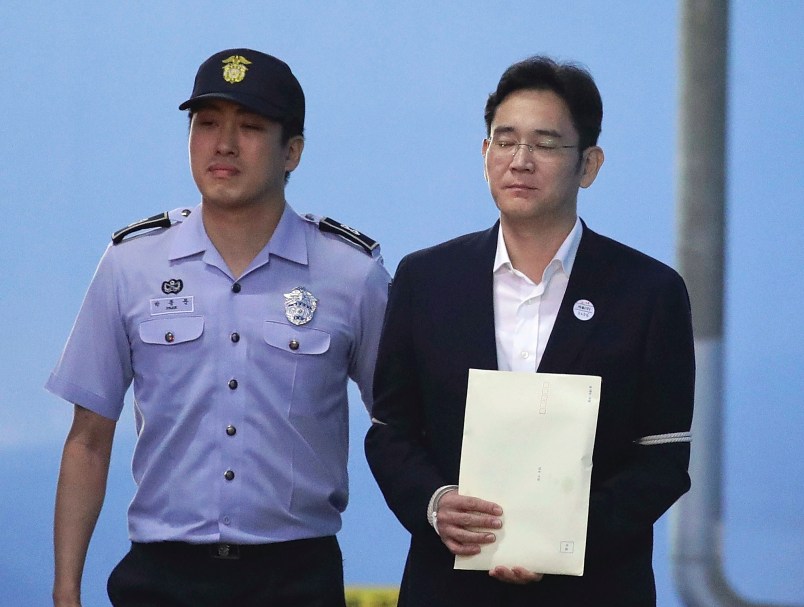
SEOUL, South Korea (AP) — A South Korean court sentenced the billionaire chief of Samsung to five years in prison for crimes that helped topple the country’s president, a stunning downfall that could freeze up decision making at a global electronics powerhouse long run like a monarchy.
The Seoul Central District Court said Friday that Lee Jae-yong, 49, was guilty of offering bribes to Park Geun-hye when she was South Korea’s president, and to Park’s close friend, to get government support for efforts to cement his control over the Samsung empire. The revelations that led to Lee’s arrest in February fed public outrage which contributed to Park’s removal.
A panel of three judges also found Lee guilty of embezzling Samsung funds, hiding assets overseas, concealing profit from criminal acts and perjury. Prosecutors had sought a 12-year prison term.
The court said Lee and Samsung executives who advised him caused “a big negative effect” to South Korean society and its economy.
“The essence of the case is unethical collusion between political power and capital,” the court said in a statement. It led the public to fundamentally question the public nature of the president’s work and to have “mistrust in the morality of the Samsung group,” it said.
The families who control South Korea’s big conglomerates, known as chaebol, were lionized a generation ago for helping to turn South Korea into a manufacturing powerhouse put public tolerance for double standards that put them above the law has been rapidly diminishing.
Analysts said the verdict will not immediately have an impact on Samsung’s business operations, which are overseen by three chief executives. The company has successfully weathered past crises that include two recalls of Galaxy Note 7 smartphones prone to catch fire and Lee’s arrest. It is set to report its highest-ever earnings this year.
But long-term business decisions, such as finding future growth areas and identifying companies for acquisitions, may have to be put on hold.
“South Korea’s chaebol system is similar to monarchy,” said Park Sang-in, a professor at Seoul National University. “In the monarchy system, you need a king.”
There is also potential for a destabilizing family feud over inheritance when the elder Lee dies.
“Samsung was in the middle of change and that has stopped,” said Park Ju-gun, chief executive at CEO Score, a private corporate watchdog. “That is a big risk.”
Business lobby groups, while refraining from openly criticizing the verdict, expressed concerns that Lee’s absence from the helm of Samsung would take a toll on the South Korean economy. Samsung accounts for about one fifth of the nation’s exports.
“Samsung Electronics represents South Korea as a global company so we are deeply worried about the fallout from his long absence,” said a Korea Employers Federation spokesman. “It will be a disaster not just to an individual company but to the nation’s economy.”
The verdict, however, could be good news for shareholders at South Korean companies who have complained about weak corporate governance that let founding families wield outsized influence and enjoy emperor-like authority even with minority ownership.
South Korean President Moon Jae-in’s office, in a rare commentary on a court ruling, welcomed the ruling as a step toward rooting out corruption.
“We hope that it would pave the way to end persistent government-business collusion, which has hampered society from moving forward,” its spokesman Yoon Young Chan said.
Lee was accused of offering $38 million in bribes to four entities controlled by Choi Soon-sil, a long-time friend of Park, in exchange for government help with a merger that strengthened Lee’s control over Samsung after his father suffered a heart attack in 2014.
Samsung has not denied transferring corporate funds. But Lee, vice chairman at Samsung Electronics and the Samsung founder’s grandson, claimed innocence during the court hearing. He said he was unaware of the foundations or the donations, which were overseen by other executives.
The closely-watched verdict is the latest convulsion in a political scandal that prompted millions of South Koreans to protest last fall, culminating in the ouster and arrest of Park as well as the arrests of Choi and Lee. Park, who was embroiled in a tumultuous series of scandals, was removed from office in March. She and Choi are both currently on trial.
Judges pointed to an unusual arrangement in which Samsung bankrolled equestrian training for Choi’s daughter as proof of Lee’s knowledge of what was transpiring.
They said Lee was aware that Park wanted Samsung to sponsor the equestrian training.
Samsung secretively provided a huge amount of money to Choi’s Germany-based company that paid for the training and the exorbitantly priced foreign horses worth 3.6 billion won ($3.2 million) were part of the bribes, the verdict said. The attempts to hide Samsung’s involvement also constituted crimes, it said.
In total, Samsung paid $7.9 million in bribes to the German company and a winter sports center, the judges said.
The verdict also dealt a blow to Samsung’s publicly stated position that recent business dealings or restructuring efforts have nothing to do with the succession of corporate leadership to Lee from his father. Instead, Samsung has insisted that a merger of two Samsung companies at the center of the scandal was about creating business benefits. Judges rejected Samsung’s argument.
“He was set to benefit most from the succession work, which was part of the favors sought from the president,” Kim Jin-dong, the head judge, said.
Other former Samsung executives charged with Lee were also found guilty.
Choi Gee-sung, a mentor of Lee, and Chang Choong-ki were sentenced to four years in prison. Two other former executives received suspended prison terms.
The ruling in Lee’s case can be appealed twice. Samsung will appeal the ruling immediately, Song Woo-cheol, a Samsung attorney, told reporters.






Must be nice to live in a country where this is a concern.
Um, does this mean the warranty on my flat-screen is now invalid?
If so, I’m pissed. If not, who gives a shit.
This is what happens when you allow corruption to become your economic growth model to move your country into the global market. Add the importance of royal family image and standing and you have an open invitation for chaos down the line. They have been plagued with this since they became a semi-democratic country after the junta. Now if they can do something about legalized extortion to solve altercations, they might be able to really clean up the way they do things in what passes as a judicial system. And relying on arbitration to come to agreement on financial settlements should be next on their list. Too many things in SK lead to corruption. They have a taste and a hunger for it.
“They have a taste and a hunger for it.” Yeah, not like us, eh?
The U.S. is not perfect by any stretch of the imagination. But it is a proven fact that corruption was allowed to go unabated so that SK could move onto the global stage. They have turned a deaf ear and a blind eye to so many blatantly corrupt actions. There is no jury system. One must rely on the old boy legal network. No checks and balances. Public comment about officials can land you in jail. The Shawol ferry tragedy, that cost over 300 lives, is a prime example of being allowed to overlook regulations. It didn’t have to happen.