

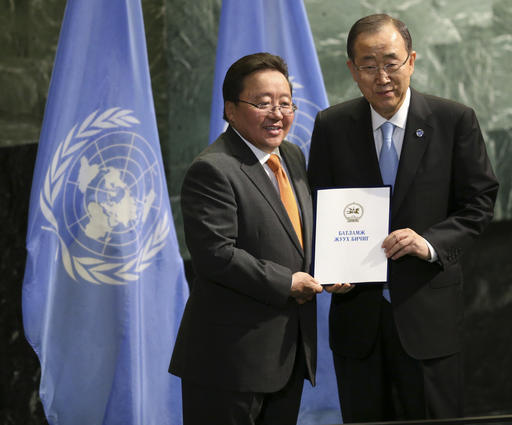
UNITED NATIONS (AP) — Thirty-one countries formally joined the Paris climate change pact Wednesday, bringing the total number of countries ratifying the treaty to 60 and raising hopes that it will enter into effect by the end of the year.
The number is higher than the 55-country threshold needed for the treaty to enter into force. But because together those countries account for 48 percent of total global emissions — short of the 55 percent threshold — the agreement must wait for more nations to join.
“Today we also heard commitments from many other countries to join the agreement this year. Their combined emissions will take us well past the required amount for the agreement to enter into force,” Secretary-General Ban Ki-moon said at an event on the sidelines of the high-level U.N. General Assembly gathering. “I am convinced that the Paris Agreement will enter into force before the end of 2016.”
U.S. Secretary of State John Kerry said he is confident of reaching the magic number before the next U.N. climate conference, which starts Nov. 7 in Marrakech, Morocco. He urged people everywhere “to become warriors for the planet.”
The world’s two biggest emitters, the United States and China, have already ratified the deal, providing momentum for other countries to quickly ratify the accord.
Brazil, Mexico and Argentina were the largest emitters to join the treaty Wednesday, but many of the countries that joined were small island nations, whose very existence is threatened by rising sea levels provoked by global warming, but whose individual emissions account for a mere fraction of a percent of total global emissions.
The treaty’s ratification has taken place at what is considered a blistering pace for international diplomacy, reflecting a sense of urgency in the fight against global warming and a desire to seal the deal before Ban and U.S. President Barack Obama leave office.
The European Union, which accounts for 12 percent of global emissions, is lagging behind other countries in joining the deal but is trying to speed things up.
“We are trying to accelerate the ratification process,” EU Climate Commissioner Miguel Arias Canete told The Associated Press.
He said EU environment ministers will meet Friday to discuss a plan to ratify the agreement as a bloc, even though only a handful of the 28 member states have approved it domestically.
If all agree and the plan is endorsed by the European Parliament, which is likely, the EU could ratify the deal by early October.
David Waskow, International Climate Director at World Resources Institute, called Wednesday’s announcement “a major step forward.”
“We’re seeing broad political support around the world for this agreement, other countries said they’re going to join in the coming several months so we really see the momentum from Paris not only continuing but actually growing,” Waskow said.
After years of negotiations, governments agreed in Paris last December to curb the emissions of carbon dioxide and other greenhouse gases that scientists say are warming the planet.
So far, 185 nations have signed the agreement which takes effect 30 days after 55 countries, representing 55 percent of global emissions, deposit their ratifications with the secretary-general.
___
Associated Press Writer Karl Ritter contributed to this report from Stockholm.
Copyright 2016 The Associated Press. All rights reserved. This material may not be published, broadcast, rewritten or redistributed.





But of course no one around the world respects President Obama or would follow him on any initiative.
The global warming initiative is warming up. Apropos no?
Of all the shit that we have to worry about, this one is the biggest because it renders all the rest of our worries moot.
The world, the biggest players are compelled and have to come together. This isn’t negotiable like fair pay or working conditions. This issue has the exact same affect on all of us. It is unbigoted, racially blind and an equal opportunity killer.
The importance of this is shown by the fact that it is the one and only thing that can bring all the nations together. We can argue about bullshit forever and battle each other because peace scares people I think but we/humanity can not ignore this.
Polluting for huge profits is meaningless if every penny of those profits and then some must be spent to survive the global calamity caused by seeking those profits.
We may all have to become vegans and commute via not so cool alternative vehicles but we’d be alive as a species and have a planet to call home.
It’s do or die.
The time has come.
It’s time for a change.