


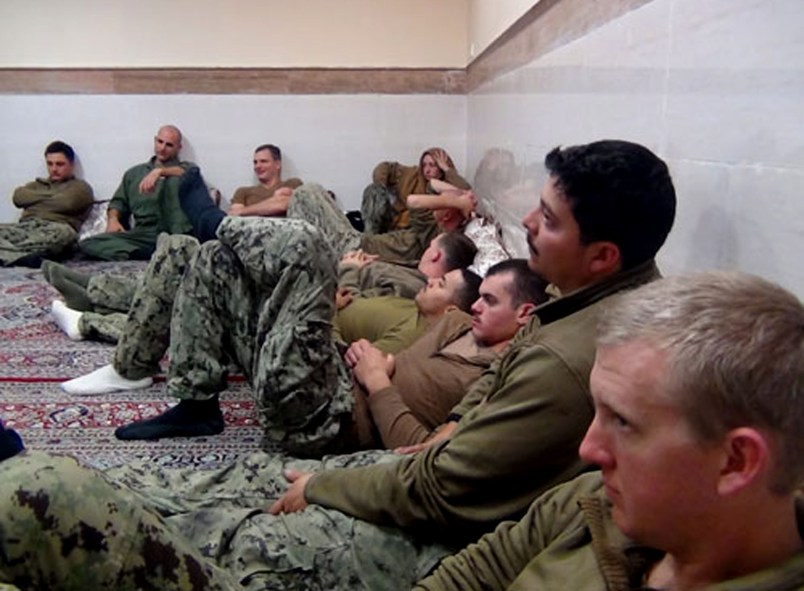
WASHINGTON (AP) — In its first official account of Iran’s seizure and subsequent release of 10 U.S. sailors in the Persian Gulf, the U.S. military said Monday the only items found missing from their two recovered boats were SIM cards for two satellite phones.
But key questions, such as why the sailors had deviated from their planned route to enter Iranian territorial waters, remain unanswered in the account released by U.S. Central Command. It’s calling the description a preliminary timeline of the events of Jan. 12-13.
“A Navy command investigation initiated Jan. 14 will provide a more complete accounting of events,” Central Command said.
The investigation will focus on the U.S. sailors’ treatment while in custody, including any interrogation by Iranian personnel, the command said.
Defense Secretary Ash Carter said last week while visiting Central Command headquarters in Florida that the boat crews had “misnavigated.” He did not say how that mistake happened or provide other substantial details about an episode that posed a potential complication to efforts by Washington and Tehran to establish better relations.
The boat seizure happened just hours before President Barack Obama delivered his State of the Union address and just days before implementation of the Iran nuclear deal with the West. The implementation triggered the end of crippling international sanctions on Iran and a U.S.-Iran prisoner exchange.
The timeline released Monday said the U.S. sailors were not mistreated during approximately 15 hours in Iranian hands. It said a post-recovery inventory of the boats found that all weapons, ammunition and communications gear was accounted for, minus two SIM cards apparently removed from two hand-held satellite phones.
The sailors were traveling in small armed vessels known as riverine command boats, headed from Kuwait to Bahrain, which is the location of the Navy’s 5th Fleet.
“The planned transit path for the mission was down the middle of the Gulf and not through the territorial waters of any country other than Kuwait and Bahrain,” the account said. The boats were seized by Iran and escorted at gunpoint to Farsi Island, which is in the middle of the Gulf and home to an Iranian military facility.
Along the approximately 300-mile journey they were to have refueled by linking up with a U.S. Coast Guard vessel, the Monomoy, in international waters. The timeline said that approximately 10 minutes after the scheduled refueling, Central Command’s naval headquarters at Bahrain received a report that the boats’ crew members were being questioned by Iranians.
About 19 minutes later, the naval headquarters “was advised of degraded communications with” the two boats, the account added. After an additional 26 minutes, the naval headquarters was notified of a total loss of communications with the boats.
A large-scale search-and-rescue mission was undertaken at that point, but it is not clear whether the Americans had by this time already been taken ashore on Farsi Island.
Central Command’s naval headquarters at Bahrain attempted to contact Iranian military units operating near Farsi Island by using marine radio to broadcast information about the search-and-rescue operation. Separately, the U.S. notified Iranian coast guard units via telephone. Some hours later, about four hours after the U.S. first heard that the sailors were being questioned by Iranians, the U.S. Navy cruiser USS Anzio received word from the Iranians that the sailors were in Iranian custody. The Iranians described the 10 as “safe and healthy,” according to the U.S. account.
In the hours after the seizure of the Americans became public on Jan. 12, there were conflicting reports about what caused the sailors to stray off their intended course. Monday’s official account did not explain the reason. It said only that the crews “deviated” from their planned course. It made no reference to the navigation error cited by Carter last week.
“At some point one (of the two boats) had indications of a mechanical issue in a diesel engine which caused the crews to stop . and begin troubleshooting,” the account said. Because the boats were traveling together, the other boat also stopped. At this point they were in Iranian territorial waters, “although it’s not clear the crew was aware of their exact location,” it added.
While the boats were stopped and the crew was trying to assess the mechanical problem, Iranian boats approached. First to arrive were two small Iranian craft with armed personnel aboard. Soon after, they were joined by two more Iranian military vessels. A verbal exchange ensued between the Iranians and Americans, but there was no gunfire.
Armed Iranian military personnel then boarded the U.S. boats while other Iranian personnel aboard other armed vessels monitored the situation. At gunpoint the U.S. boats and their crews were escorted to a small port facility on Farsi Island, where the Americans went ashore and were detained, the account said.
The sailors were released the following morning aboard their boats.
___
This story’s 10th paragraph has been corrected to reflect that the trip was 300 miles, not 50
Copyright 2016 The Associated Press. All rights reserved. This material may not be published, broadcast, rewritten or redistributed.






Clearly, the Navy is not releasing the entire story. You don’t transport navy personal 300 miles between bases in small limited range riverine command boats.
It’s possible they were repositioning the boats themselves, but these boats are designed to be moved long distances on larger ships.
Sounds like the Navy got caught snooping around inside Iranian waters.
Actually…those small vessels are routinely used that way. They are 50 feet long and almost never moved via large vessel. There is nothing odd here.
First: so happy they are safe and diplomacy worked.
Second: from a woman’s standpoint, did anyone else notice the rugs they were sitting on. The Repubs were probably upset they were sitting on the floor, but we wouldn’t sit our captives on seats worth thousands of dollars. Lol
If Iran really wanted to get in our good graces, they would have given each serviceman a Gabbeh as a parting gift.
Yeah, having the Coast Guard cutter there for refueling makes it pretty evident this isn’t an unusual move for transporting these boats. Basically unless you’ve got something with a well deck in the area and available to make the trip, then these things are fine to move through open waters if the weather’s not expected to give them an intolerable amount of chop.
So unless you’re gonna move an entire LPD / LSD whenever you realize you need two more shallow-draft patrol boats… you send them out on their own. Avoiding Saudi waters would be necessary unless you want to go through the lengthy procedure of requesting permission for these boats to operate in those waters - which isn’t done unless there’s no other option, because it opens the door to all sorts of questions being asked about why, about what’s on them, etc etc, and that means losing time. So instead of taking a couple of days to get permission to drive closer to shore, you drive down the middle of the Gulf. At the point between Nakhiloo and Ras Tanura, that’s not a lot of margin for screwing up the navigation.
Note that there’s a few interesting bits of language in the article, too: “they were to have refueled”, “10 minutes after the scheduled refueling”. These aren’t “they refueled” and “10 minutes after completing their refueling”. Either the USN didn’t include confirmation of a successful refueling for some reason, or they never made that rendezvous. Which makes sense, if you think about it, because at 30kts (comfortable speed for a CB90), even if there’d been no mechanical trouble, they’re less than 5 miles from a US Coast Guard cutter - the same cutter that fired a warning shot over an Iranian dhow in August of 2014, and can herself make 30kts to be on-site in 10m (and inside effective range of Monomoy’s 25mm chain guns in under 5).
So there’s no way they made that fueling stop - not if they were inside Iranian waters (as everyone involved acknowledges they were), and Monomoy was waiting in international waters (because you don’t take chances and put the cutter near Iranian waters). But at the same time, C&C didn’t lose contact with them until well after the Iranians showed up.
The other thing that’s interesting to me here is: one of the CB90s had mechanical trouble, but the next morning, they went on their merry way. The Iranians clearly went over the boats. Frankly, it’d be irresponsible of them not to at least make sure they weren’t exposing their own sailors to something hazardous. I know Rachel Maddow raised the possibility as snark, but… these are Swedish-built craft designed 25 years ago, with commercially-available diesel engines. (Scania DSI14s. You can get the manual online and buy parts on ebay.)
Maybe the Iranians did repair the damned engine while they had it?
Guess you will cover the Iran Deal & prisoner release next week!
