

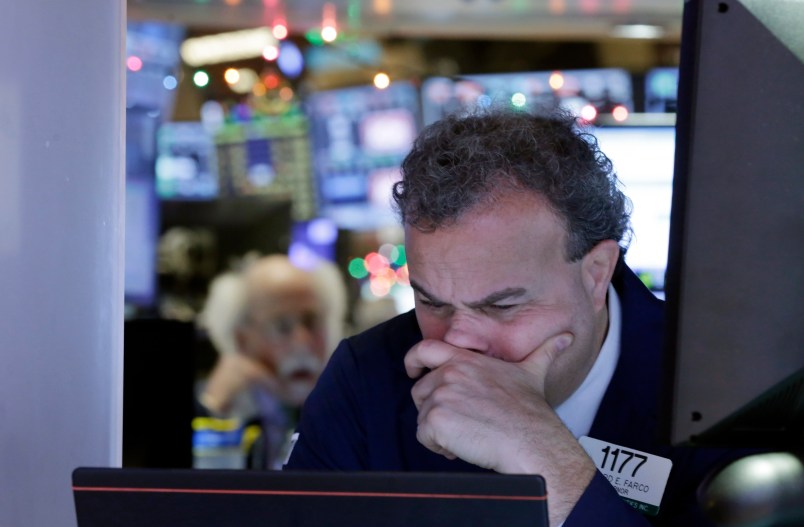
NEW YORK (AP) — U.S. stocks dropped sharply in early trading Monday morning after a plunge in China triggered by weak Chinese manufacturing data and escalating tensions in the Middle East. The Dow Jones industrial average sank 2 percent. China’s main index plunged lost 7 percent, forcing an emergency trading suspension. European indexes fell between 2 and 4 percent.
KEEPING SCORE: The Dow Jones industrial average sank 384 points, or 2.2 percent, to 17,044 as of 10:09 a.m. Eastern time. The Standard & Poor’s 500 index lost 41 points, or 2 percent, to 2,002. The Nasdaq composite gave up 133 points, or 2.7 percent, to 4,874.
CHINA PLUNGE: The Shanghai Composite Index dived 6.9 percent to its lowest level in nearly three months. The drop led the Shanghai and Shenzhen stock markets to halt trading for the remainder of Monday to avert steeper falls, the official Xinhua News Agency said.
Chinese authorities have been trying for months to restore confidence in the country’s stocks after a plunge in June rattled global markets and prompted a panicked, multibillion-dollar government intervention. Concerns about China’s economic slowdown were revived by weak manufacturing data released Monday, along with Middle East tensions, which pushed up oil prices.
THE QUOTE: Huang Cengdong, an analyst for Sinolink Securities in Shanghai, said selling accelerated as investors tried to lock in trades before trading was halted. He expects further turmoil ahead of corporate earnings reports.
EUROPE DROPS: The DAX index in Germany, whose export-led economy is sensitive to the fortunes of China, tumbled 4.2 percent. Britain’s FTSE 100 fell 2.1 percent while France’s CAC 40 dropped 2.4 percent.
CHINESE DATA: The Caixin/Markit index of Chinese manufacturing, which is based on a survey of factory purchasing managers, fell to 48.2 points in December from 48.6 the previous month, marking contraction for the 10th straight month. On Friday, an official manufacturing index also showed a persistent contraction in factory activity despite Beijing’s stimulus measures.
MIDDLE EAST JITTERS: Saudi Arabia said Sunday it is severing diplomatic relations with Iran, a development that could potentially threaten oil supply. The world’s largest oil supplier executed a prominent Shiite cleric that prompted protesters to set fire to the Saudi Embassy in Tehran and Iran’s top leader to criticize Saudi Arabia.
“Oil markets will be concerned that this could be an incremental step in a deteriorating political situation that might ultimately threaten world oil supply,” Ric Spooner, chief analyst at CMC Markets, said in a commentary.
OIL RISE: Benchmark U.S. crude added $1, or 2.8 percent, to $38.04 per barrel in New York Mercantile Exchange. Brent crude, used to price international oils, rose $1.60, or 4 percent, to $38.86 a barrel in London.
ASIA SELL-OFF: Japan’s Nikkei 225 tumbled 3.1 percent and Hong Kong’s Hang Seng retreated 2.7 percent. South Korea’s Kospi closed 2.2 percent lower. Stocks in Australia, Taiwan and Southeast Asia were also lower.
CURRENCIES: The dollar weakened to 119.19 yen from 120.23 yen. The euro fell to $1.0822 from $1.0858.
BONDS: Bond prices rose. The yield on the 10-year Treasury note fell to 2.21 percent from 2.27 percent.
__
AP researcher Fu Ting in Shanghai contributed to this report.
Copyright 2016 The Associated Press. All rights reserved. This material may not be published, broadcast, rewritten or redistributed.




“Oil markets will be concerned that this could be an incremental step in a deteriorating political situation that might ultimately threaten world oil supply,” Ric Spooner, chief analyst at CMC Markets, said in a commentary."
Bullshit.
It’s a shame that Congress is so opposed to a fiscal stimulus program – what with a scary black Democratic President in the White House who might take credit for it – but this underscores the need for a massive national economic recovery program.
A massive jobs program focused on rebuilding our infrastructure could provide needed work for Americans and an economic boost to our nation, and help to offset the exposure our financial networks and many of our large multinational corporations face in the event of further turmoil in the Chinese markets.
Even though our interest rates rose slightly in recent weeks, we can still borrow money at incredibly low rates, and the beneficial spin-off effects of a massive infrastructure initiative would be widespread.
But if the current world oversupply of oil is curtailed, doesn’t that mean energy-company stocks will go up, which would be good for the market? he asks innocently.
“Shhhh,” say the oil company executives.
Saudi Arabia gets a free Two-Fer.
It gets to piss in the face of the Shiites, and they get a FREE boost in Oil Prices (what they actually wanted all along.)
They have SERIOUS problems domestically with the ISIL threatening the Monarchy externally and a largely Young, Male, Unemployed, Uneducated, restless population that is getting fed up with the constant cuts in domestic stipends that the Monarchy uses to BUY their acquiescence to their despotic rule.
The best thing they can do (in their minds) is to gin up a Holy War against the apostates (Shiites) to distract their population from how badly they are being screwed over by the corrupt Monarchy, and to drive up global oil prices at the same time. If they play their cards right (with the help of Netenyahu and his slavish minions in the US Congress) they might even be able to prevent the Iranians from getting back into the international Oil markets entirely by reinstating an embargo (after they manufacture a Iranian-led “Atrocity” somewhere.)
This is a dangerous game they are playing, but the House of Saud knows that the Reich-Wingers have it’s back and they can do whatever they want because Money (Oil) talks, innocents be damned. They are just “collateral damage”.