

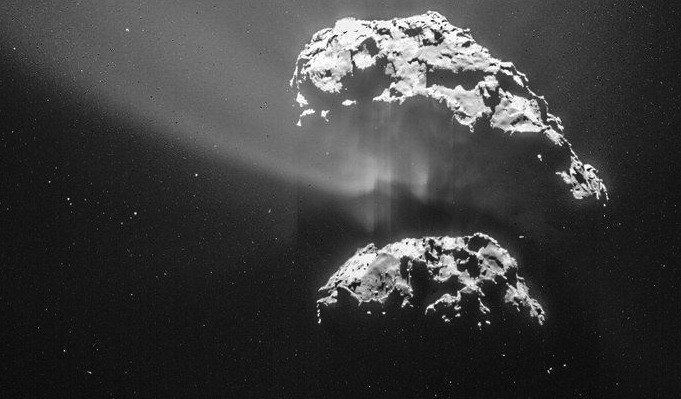
BERLIN (AP) — Whatever caused small space rocks to lump together billions of years ago, magnetism is unlikely to be the reason.
Scientists said Tuesday that measurements made by the European space probe Philae, which landed on comet 67P in November, show the comet’s core isn’t magnetized.
Some astrophysicists have suggested that magnetism might have been responsible for aligning and then binding together rocks into larger boulders during the early stages of planet formation.
But in a paper published online by the journal Science, the team led by Hans-Ulrich Auster at the Technical University of Braunschweig, Germany, said their data — which benefited from three unexpected bounces that allowed Philae to collect more results than planned — don’t support this theory.
“If the surface was magnetized, we would have expected to see a clear increase in the magnetic field readings as we got closer and closer to the surface,” said Auster. “If comet 67P/Churyumov-Gerasimenko is representative of all cometary nuclei, then we suggest that magnetic forces are unlikely to have played a role in the accumulation of planetary building blocks greater than one meter (3 feet) in size.”
Allan H. Treiman, a senior scientist at the Lunar and Planetary Institute in Houston, Texas, who wasn’t involved in the study, said the results credibly suggest other forces were responsible.
“Auster did not find any magnetic field, with a very sensitive instrument, so it seems unlikely that magnetism in the solar nebula was significant for the collection of meter-sized objects,” Treiman said in an email. “At that scale, it seems likely that electrostatic or gravitational attraction would be stronger.”
The findings are part of a series of scientific results obtained by scientists analyzing data collected by the Philae lander and its mother ship Rosetta, which is flying alongside the comet on its elliptical orbit around the sun.
Copyright 2015 The Associated Press. All rights reserved. This material may not be published, broadcast, rewritten or redistributed.





Gravity. Duh.
I have NEVER heard of anyone claiming that Magnetism is involved in mutual gravitation of masses in space.
I have always heard is is a combination of solar wind pressure and gravitation that causes particles in space to clump together.
But then again: “I am not a scientist” so it must have been a stone-age Sky God who did it.
My theory is that it’s held together with Post-Its, but those rocket scientist geniuses didn’t even think to test for that.
Apparently, when all the solids are down at the dusty particulate level, gravity isn’t enough to form those first tiny clumps that are bigger than the other bits that eventually get the gravity ball rolling within the time between the formation and ignition of the sun and the end of the period when the planets were formed. Which leads to either magnetism or electrostatic charge as possible candidates.
Based on the ongoing experiment in dustbunny formation that is my kitchen baseboards, I’ve always assumed it was electrostatic charge.
Good point.