

LONDON (AP) — Voters in Britain are deciding Thursday whether the country should remain in the European Union — a historic referendum that will determine the nation’s future for generations to come.
More than 46 million people are registered to vote in the referendum, which asks: “Should the United Kingdom remain a member of the European Union or leave the European Union?” The heated campaign saw the nation take stock of its place in the modern world, even as it questioned the direction it wanted to take in the future.
“This is, I’d say, the most important day in the past 20 years, at least for the U.K., and the economic consequences of a vote out are huge,” said investment banker Hasan Naqvi outside a London polling station.
“Leave” campaigners claim that only a British exit can restore power to Parliament and control immigration. The “remain” campaign led by Prime Minister David Cameron argues that Britain is safer and richer inside the 28-nation EU.
Financial markets have been volatile ahead of the vote, with opinion polls suggesting a tight race, but the pound has surged this week amid market optimism that uncertainty over the vote would end with a vote to stay.
On Thursday The pound was up 1.1 percent on the day, at $1.4874, the highest level so far this year. Britain’s benchmark stock index, the FTSE 100, was up 1.6 percent at 6,362. Germany’s DAX was up 2.2 percent at 10,297.
Turnout is considered critical in the vote, as polling suggested there were a number of undecided voters. A large turnout will favor the “remain” campaign as those who waver at the end tend to go for the status quo. Those favoring “leave” also tend to be more committed.
“It’s all about turnout and those soft ‘remainers’ staying at home,” U.K. Independence Party leader Nigel Farage said outside his home after collecting the newspapers.
“I do think we are in with a very strong chance, I do genuinely,” he said.
It was raining heavily in some parts of the country, which could reduce turnout and there were anecdotal reports of voters being unable to get to the polls.
Downpours and flooding swamped parts of London and southeastern Britain. London’s Fire Brigade received hundreds of calls of weather-related incidents early Thursday, including some reports of flooding and lightning strikes.
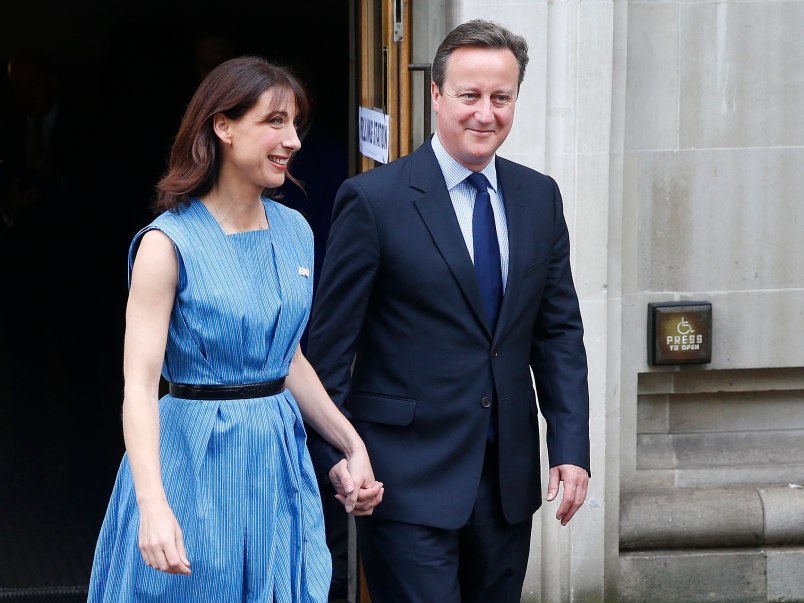
Weather forecasters quipped that voters in the southeast would need umbrellas and possibly rubber boots in order to cast ballots. Prime Minister David Cameron ignored questions about the weather as he and his wife, Samantha, cast their votes in London.
“I think it’s very important to vote in such a big decision,” said voter Belinda Byrne in Teddington, southwest London. “It’s going to have a huge impact on the country.”
The race is widely seen as being too close to call, though bookmakers have stood solidly for “remain” — a fact opposition Labour leader Jeremy Corbyn noted as he cheerfully cast his ballot at a school in his London constituency.
“You could either check the wind or check the bookies,” said Corbyn, who backs “remain.” ”The bookies usually get it right.”
The slaying of pro-Europe lawmaker Jo Cox in the final week before the vote may also prove a factor in the outcome. While the motive for the killing is unclear, the rare killing of a politician cast a shadow over a divisive campaign unusually heated even by Britain’s boisterous standards.
Her husband, Brendan Cox, told a crowd of some 9,000 people gathered in Trafalgar Square on the eve of the vote that his wife had died because of her beliefs
“Jo’s killing was political,” he said. “It was an act of terror designed to advance an agenda of hatred toward others. What a beautiful irony it is that an act designed to advance hatred has instead generated such an outpouring of love.”
The reach of the EU into every aspect of life has made the issues at stake far more complex than in a general election — and far more heated. And while the vote is final — unlike in an election where the results can be reversed in the next term — it is not legally binding and Parliament would have to vote to repeal the law that brought Britain into the EU in the first place.
__
Associated Press Writer Frank Jordans contributed to this story.
Copyright 2016 The Associated Press. All rights reserved. This material may not be published, broadcast, rewritten or redistributed.




I have not been following this topic closely. Thoughts from others here? What do you see as the pros and the cons of Britain staying or leaving the EU? What are the practical consequences if they leave?
After the assassination of Jo Cox, I think ‘Remain’ wins narrowly.
This decision is really tough. I see good vaalid resaons for either direction:
Leave:
Stay:
When I was discussing the issue yesterday with two British friends yesterday, (one who happens to be of Chinese decent) one mentions “Is Britain even part of Europe?”, which reminded me this question has always loomed large. Of course technically they are, but they are separated physically and by identity. For example, the Brits are the only nation coming out of WW2 with a feeling of pride for their behavior… There’s also the feeling that they never should have become involved in the EU in the first place, and getting out sooner rather than later would result in less pain.
I’m living in London, and work in financial services, so my views need to be seen in that light.
The main argument for leaving is that Britain will regain autonomy from Europe, and thus be able to better control immigration and have more control over its laws.
The main argument for staying in is that it will be better for Britain’s economy.
Clearly, I think that the remain argument makes a lot more sense. London’s role as the financial capital of Europe would almost certainly be jeopardised if we leave the EU, and once London stops being the goose laying golden eggs, well, teh country would have a really hard time.
Another thing to consider is the price that the Eu would force Britain to pay if it leaves. Look at Norway, for example. In order to gain access to the european market they need to both allow for the free movement of people and comply with large swaths of European law anyway.
Alas, no reporting on exit polls is allowed in Britain while the polls are open, so we will all have to wait until 10 tonight to get some predictions…
They went with the lesser of two evil per Krugman.
http://krugman.blogs.nytimes.com/2016/06/12/notes-on-brexit/?smid=tw-nytimeskrugman&smtyp=cur&_r=0
Edit: Oops. I was thinking they’d all ready voted to stay in. Guess they went with the worse of 2 evils. Value of pound sure shows it too.