

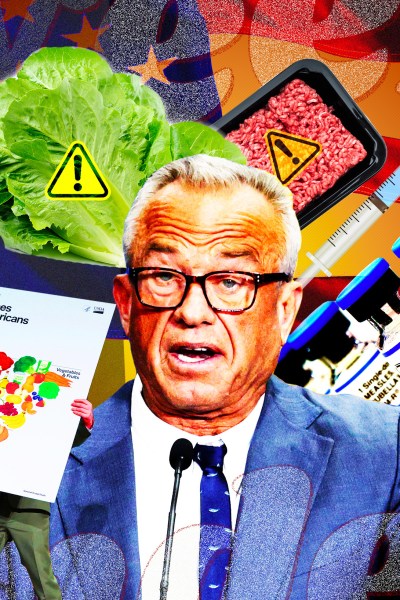



Making America Sick Again
We’re coming to the end of a summer of food safety crises. As an Aug. 20 New Republic piece flagged, in just one week, “the FDA has discovered salmonella in granola, salad dressing, jalapenos, and animal food; glass in fruit popsicles; and metal in sourdough,” recalling 12 products — “a rate four times higher than the same week a year ago.” Of course, there were also the bouts of diarrhea lettuce and E. Coli blueberries. All the jarring headlines about foodborne illnesses are perhaps the most visible indicator of how our public health has been endangered by the Trump administration. Turns out imposing sweeping staff and budget cuts on the FDA, CDC and HHS may not have been the best idea.
But the broader damage RFK Jr. has done during his tenure as HHS secretary is extraordinary. Below, we take a quick look at some of the massive failures of public health under his watch. (We’re keeping it as light and brief as possible because it’s The Weekender, even though some of these examples are truly horrifying. An initial moment of levity: we recently learned at a press conference that the man’s cell ringtone is literally the sound of a quacking duck!?)
5) Making Americans’ Teeth Bad Again
Community water fluoridation “was long considered one of the greatest public health achievements of the last century,” as the Associated Press put it, noting that the American Dental Association “credits it with reducing tooth decay by more than 25% in children and adults.” Sounds pretty good, right?
Not if you’re RFK Jr. The HHS secretary has called fluoride “industrial waste” and spread misinformation about its health risks, prompting states including Utah and Florida to ban communities from adding it to public drinking water. ProPublica reported last year that lawmakers in at least 21 states have proposed measures to prohibit or roll back the addition of fluoride to public water systems. The Trump admin entirely dismantled the CDC’s Division of Oral Health, nixing its research for and assistance with fluoridation programs. And TPM fellow Farrell Brenner reported that these RFK-fueled conspiracy theories are also prompting patients to turn down fluoride treatments at the dentist’s office and throw out their kids’ fluoridated toothpaste.
4) We’ve All Had to Learn What Cyclospora Is
“Parasite monitoring” is probably not the place to cut back on government funding. Yet RFK Jr.’s CDC did just that in 2025, and then 2026 saw a catastrophic outbreak of cyclosporiasis, with more than 17,000 cases documented as of Aug. 2026, including 922 hospitalizations and two deaths. The main culprit: iceberg lettuce.
The rash of headlines around cyclospora and other severe foodborne illnesses this summer has people joking that the only safe item to consume in the U.S. is Pop-Tarts’ collab with the rotund to-go cocktail brand BuzzBallz. (It’s also put some $280 million of monthly consumer spending on vegetables, which Americans definitely consume enough of, at risk, per consumer data from Numerator.)
3) Threatening the Best Option for Safe Abortion Care
Women in the United States are dying preventable deaths and losing out on essential, basic reproductive healthcare services thanks to state abortion bans and cuts to Medicaid and the VA. Post-Dobbs, the abortion pill mifepristone, which is used in some two-thirds of abortions in the U.S., has been a godsend for women looking to end unwanted or unsafe pregnancies, particularly in states that have restricted access to the procedure.
But RFK Jr. launched a review of the drug’s “safety profile,” even though the FDA itself has said it’s safe and effective when used as indicated (in combination with misoprostol).
2) Waging an All-Out Assault on Vaccines
In a classic addition to the “Do Not Trust What People Say During Confirmation Hearings” genre, RFK Jr. promised not to dismantle U.S. vaccine policy during his 2025 Senate confirmation hearings, helping him win the crucial vote of physician and Republican Louisiana Sen. Bill Cassidy. You’ll never guess what happened next.
Indeed, Kennedy has slashed the number of vaccines children are scheduled to receive; cancelled some $500 million in funding for 22 mRNA vaccine research projects; replaced the CDC’s expert vaccine advisory panel with cranks; and continued to promote discredited links between vaccination and autism. As the American Public Health Association details, vaccination rates among U.S. kindergartners have fallen and vaccine exemptions “have reached a record high.”
1) Bringing Back All the 20th Century Diseases
In extremely related news, preventable diseases, particularly measles, are on the rise. Two unvaccinated people died from measles in Pennsylvania just this week, some of the over 2,700 cases reported nationally this year — a 38-year high, per the New Republic. (RFK baselessly claimed that “hopeful staffers” in Pennsylvania Gov. Josh Shapiro’s office “altogether fabricated” the two deaths, which is pretty repugnant.)
Declining vaccination rates are also expected to bring about a rise in diseases like mumps, whooping cough and meningitis.

Ahead by a Century: Some Observations From Canada
Me debunk an American myth?
And take my life in my hands?
— At the Hundredth Meridian, The Tragically Hip
As TPM’s sole Canadian resident, I feel reluctantly obligated to provide some observations on the current trade war with America. I say reluctantly because I am not a Canadian; I’m an American, and, as an American, I don’t want to give the impression that I’m speaking on behalf of Canadians or that my thoughts represent how Canadians are thinking or feeling at this moment. To the extent that I have Canadian bona fides, they come from being married to a Canadian and from having grown up in Vermont, 45 minutes from the Canadian border. For as long as I can remember, I’ve gone back and forth across that border and Canada, at least east of Toronto, has always felt more familiar to me than, say, anywhere I’ve been south of the Mason Dixon. Canadians were, and are, my family, friends and neighbors. It was probably something of a fait accompli that I am now raising two Canadian-American children. And so, while I’ve only been an official Canadian resident for just over a month, I do have a certain vantage point from which to comment on the unfortunate rupture in relations between the two countries.
That responsibility for hostility between the countries rests on Trump and his administration should be, at this point, obvious to any reasonable observer. Before even taking office for the second time, Trump was floating steep tariffs, attacking Canada’s sovereignty with taunts of making it the 51st state, and referring to then-prime minister Justin Trudeau as “governor.” While this played in American media mostly as a joke in bad taste, something akin to giving a friend a noogie, in Canada it was taken deadly seriously. This wasn’t because Canadians can’t take a joke, but because they are so enmeshed in American culture that many understand U.S. politics in ways even some Americans do not. They knew insecurity or ambition lurked behind Trump’s taunts, and that either could be dangerous to Canada. Trump’s admiration of Vladimir Putin is well known, and while U.S. military invasion was never a primary concern of any Canadian I’ve talked with, Russia’s invasion of Ukraine isn’t exactly out of mind either. But more crushing to the Canadians than any threat of aggression was the psychic toll of being blindsided by a friend with whom you share so much in common. And despite the image of Canadians as exceedingly polite and overly apologetic, they are anything but pushovers. Hockey is, after all, the national sport, and it’s the only game I’m aware of where it’s within the rules to drop your gloves and challenge an opposing player to a fight when you feel aggrieved or just need a change in momentum.
That Trump intended to do more than just taunt the Canadians became clear when less than two weeks into his presidency he announced a sweeping 25% tariff on goods from Canada and Mexico — seeming to violate the USCMA trade deal he had negotiated with the two countries during his first term. To justify the tariffs, Trump claimed it was a national emergency to stop fentanyl trafficking across borders into the U.S. This indicated to Canadians — whose borders are responsible for less than 0.1% of the Fentanyl that makes it into the U.S. and, thus, could hardly do more to prevent it — that they had been targeted in bad faith. Trump put a pause on the tariffs a few days later, part of his now famous pattern of aggression followed by retreat (or TACO, if you prefer). But in Canada, trust had been severed and the relationship with the U.S. was on ice, if not in peril.
Soon after, the Canadian and U.S. men’s hockey teams went head to head in the 4 Nations Face-Off at the Bell Centre in Montreal. Intended as something of an amuse bouche in anticipation of the return of professional players to the Olympics a year later, the tournament (which also included Sweden and Finland) supplanted the traditional NHL all-star game. National pride was on full display, and the riotous crowd at the Bell Centre booed the U.S. national anthem before the puck dropped. My heart was already beating up near my throat when a fight broke out within the first seconds of the game. Two more fights happened within the first nine seconds, mostly instigated by the U.S. The game went on to be an all-time classic. The Americans won, but the Canadians beat them a week later in Boston to claim the trophy. After the tournament, players on both sides, who mostly play for professional teams in the U.S., waved away political tension as a reason for the increased intensity.
When I visited Canada that month in preparation for our eventual move, Canadians had begun boycotting American products and embraced a ”Buy Canadian” mentality. American liquor was being removed from the shelves in all but two provinces, and the province I visited encouraged people to pay for things with cash to avoid American credit card processing fees. When I had to identify myself as an American, which you have to do often when going through the steps necessary to buy a house, I was treated cordially; but I also found myself developing a routine of saying something along the lines of “don’t hold it against me,” in a way that I hoped indicated I was on their side without having to “get into it.” Family and friends expressed regret about what was happening and while no one I knew held any animosity toward American people, or feared that the inverse might be true, most thought it was best to steer clear of the country for a while. They knew the boycotts weren’t going to be financially significant enough to change anything, but it was one way they could signal to their old friend that they were unhappy with the way they were being treated.
In mid March, Mark Carney replaced Trudeau as Prime Minister in an election Trump single-handedly swung in the liberals favor. Before the tariffs and 51st state taunts, Canada was in line to follow the post-COVID trend of democracies throwing out the incumbent party; but Pierre Poilievre’s Trump adjacency, if not outright alignment, ultimately sunk him. Electing Carney, the former banker, to manage the economic threat posed by tariffs seemed like a smart play. Plus, there was hope that Trump’s treatment of Canada might stem from a personal dislike of Trudeau, and that Carney, as a member of the financial elite, might be someone Trump would respect. Hostilities did appear to ease somewhat after the election, but the on-again, off-again nature of Trump’s tariff policy made tariff-watching a near-constant activity in our household. Each new announcement directed at Canada was a fresh psychic wound, like discovering that not only is your partner a cheater, but a serial offender. Eventually, Trump moved on to harassing Greenland, invading his own cities, and starting another war in the Middle East. But this didn’t mean that the relationship between the two countries had stabilized and Canada would just move on.
One of the hardest things Canadians seem to find about this whole situation is that, until recently, an issue so important and existential to them hardly seemed to get any, let alone commensurate, consideration in the U.S. Since Trump’s reelection, he has been the gravitational center of Canadian politics; in American politics, there seems to be little urgency or political momentum in mending the relationship. When Carney made his speech at Davos about middle powers banding together to counter U.S. hegemony, he got the world’s attention for a while, but Trump and the U.S. didn’t appear particularly concerned. That is until Trump reached back in history to find a century-old law he could use to skirt the Supreme Court and justify punishing Canada with 50% tariffs for “discriminating against the commerce of the United States.” While Canada didn’t ask for this, it would at least be another chance to come back to the negotiating table and present their case to an American audience.
That the Canadians appear to have been given an unworkable deal and walked away — and that Canada and the U.S. are now in an all-out trade war with grave economic stakes for both countries, but particularly for Canada — has been covered extensively by all the major news outlets in both countries and I have no special insight to add either about what happened or what comes next. What I can tell you is that the day after the talks fell apart, a Saturday, my friends and neighbors in Canada weren’t talking about the impending trade war, they were talking about going to a tribute to celebrate the 10-year anniversary of the final show of the legendary Canadian band The Tragically Hip.
If you are unfamiliar with The Hip, they are a rock group from Kingston, Ontario that started in the ‘80s and became something like the national band of Canada — known for their popular music and activism related to Indigenous rights. When asked by the CBC what he liked about the band, Mark Carney said, “The fabric of the country is woven into a lot of the lyrics and some of the lessons, and some of the strengths and weaknesses are there for all to see.” The Hip played their final show in 2016, the culmination of a farewell tour initiated after lead singer Gord Downie learned he had terminal brain cancer. The CBC broadcast the show live and more than 12 million Canadians watched (more than a third of the population). To honor the 10-year anniversary of that final show, towns and municipalities across Canada would replay the broadcast and host various Hip-related events.
Unfortunately, I didn’t go to the event in my town. Instead, I went to see The Odyssey, which left me contemplating the scarily relevant theme of what winning by dirty tricks does to a person’s, or country’s, psyche. But when I got home, I played the final 30 minutes of The Tragically Hip show. The last song the band plays is called Ahead By A Century. It’s a sad but sweet song about the end of childhood relationships and the anxieties that follow. On the day the trade war started, it’s likely a healthy portion of Canadians were singing along. Make of that what you will.

GOP’s Message to Voters: Things Should Never Get Better For You
Sen. Darline Graham (R-SC) — the late Sen. Lindsey Graham’s sister who was recently appointed by the South Carolina governor to finish out her brother’s term — declared victory Tuesday after beating Rep. Ralph Norman (R-SC) in the GOP primary runoff for South Carolina’s Senate seat.
Graham’s victory speech took a bizarre turn that night when she tried to create a contrast between herself and Annie Andrews, the Democrat she will face in the general election.
“Gun control, government-run health care, abortion until the moment of birth — bad idea after bad idea. Annie Andrews backs them all,” Graham said. “I have a different background and vision for our state … I grew up in the back of a bar and liquor store in one room in central South Carolina. My parents worked long, hard hours to make ends meet. We didn’t take vacations. If they were sick, they had to get up and go to work cause if the doors weren’t open we weren’t making money. My mother passed away when I was 11 and my father just over a year later.”
Here me out. Maybe, just maybe, Graham’s parents wouldn’t have had to work those grueling hours or be forced to go to work when they were sick if — I don’t know — they had government-run health care.
The newly-minted, Trump-backed senator is certainly not the first Republican who sounds committed to making sure living conditions don’t get better for the next generations. The GOP loves trying to gaslight the American people into believing that just ‘cause their parents or grandparents suffered or worked their butts off — or literally died — to try to get one step closer to the so-called American dream, so should the rest of us.
Republicans’ despise of universal healthcare coverage is just one example of this. President Joe Biden’s push around student loan forgiveness had gotten similar hate from Republicans who have claimed that forgiving student loans would be unfair to working-class Americans who did not go to college or who already paid off their student loan debt.
”It’s monumentally unfair,” former Sen. Roy Blunt (R-MO) said during an August 2022 ABC News interview. “Unfair to people who did not go to college because they didn’t think they could afford it, unfair to people who paid their loans back.”
These are also the same people who last year enacted the biggest cuts in history to Medicaid and the Supplemental Nutrition Assistance Program (SNAP) just to give their rich friends tax breaks. I guess unfair does not apply if it’s helping the guys who will fund their next political campaign.
God Bless the USA

How Much of This Week’s News Do You Remember?
- The Washington Post was ordered to rehire this Washington Post columnist fired for her posts about Charlie Kirk.
- What’s the name of the potential spoiler candidate who is joining Dan S. Sullivan and Mary Peltola on Alaska’s general-election ballot in November?
- Name a type of product that’s expected to get more expensive due to Trump’s ill-advised trade war with Canada.
Answers below
Midterm Madness and Meltdowns Over the WNBA
WNBA Star Reacts to Kate’s Reporting
Las Vegas Aces star Brianna Turner is unsurprised that the America First Policy Institute — an organization with close ties to the Trump admin — seems to be backing the right-wing anti-trans crusade against the WNBA, as Kate Riga reported this week.
Hunter on the 2026 Primaries
Investigative reporter Hunter Walker joined the Michelangelo Signorile Sirius radio show to talk about his piece on the extremely normal Republican nominee for governor in Colorado, who claims to have battled “demons” with “reptilian eyes.” He also went on MS Now’s 11th Hour With Ali Velshi to discuss the 2026 midterms and why institutional Democrats should get out of their party’s own way.
As Hunter put it, “There’s been a lot of histrionics about these progressives that are winning in some cases, but some of them are fairly moderate, and also the polls show there’s broad-based support for a lot of elements of their agenda. This includes universal healthcare, this includes addressing climate change. This is an election where the numbers show people want structural change, and I think the Democrats that are resisting that are only hurting themselves.”

Private Jet Populism
North Carolina’s GOP Senate nominee Michael Whatley is just a regular guy like the rest of us. He wears flannel shirts, and is campaigning by driving around the state in a truck, meeting voters where they’re at.
Except, according to an investigation by Popular Information, he’s actually doing a bunch of his travel by private jet. And not just any private jet, but one owned by Drew Boggs, a man convicted of defrauding the federal government. Popular Information dug through campaign finance filings and found that Whatley’s campaign committees have spent over $100,000 to travel on Boggs’ private jet travel since last September.
Goodbye to the Queen of Country

Trivia answers: 1) Karen Attiah 2) Dan J. Sullivan 3) Paper products (and specifically toilet paper), honey, whiskey, bedsheets, dishes, motorcycles, clothing, cosmetics




Public health failures? It’s seems like it’s going as planned. Poisoned food? Who can afford to eat anyway?
My Canadian bona fides? I grew up in Ann Arbor, about 60 minutes from the border. We also got CBC, so I saw a lot of Benny Hill and curling.
Wayne and Shuster must have been a comedy favourite.
Mark and his cat.