

If you’re not a regular listener to our podcast, I hope you’ll listen to the episode that will come out later this afternoon. It was, I think, a particularly good episode, in large part because we had such critical issues to discuss: Callais, the wave of emergency redistrictings across the southern tier of the old Confederacy and what seems to be a sea-change moment on Supreme Court reform among establishment Democrats. I want to expand today on some points about Supreme Court reform, offering some of the historical background for this present moment.
Every current member of the Supreme Court comes out of what we might call the elite academic-judicial nexus, which is to say they’ve been law professors at elite universities and judges in the federal judiciary. I believe this applies to all the current justices. It didn’t used to be this way. It used to be relatively common to have justices who had never served as judges before and had never been law professors. Frequently they were ex-politicians. Famously, William Howard Taft was an ex-president when he became chief justice. Earl Warren was a popular Republican governor of California who had never served as a judge until president Eisenhower nominated him as chief justice. If you go further back, many justices never even went to law school, though this was more a matter of the evolution of legal education. The last non-law school justice was James F. Byrnes. (In earlier history, you generally learned the law as a kind of apprentice and then passed the bar to practice.) There was a brief boomlet of chatter when Bill Clinton was elected that he should or would try to re-inject this “politician on the Court” tradition back into the system. Of course that didn’t happen. The idea has scarcely been entertained since.
Read More
Some of the most consequential and trust-shattering Supreme Court decisions of late have been ones that could have been predicted decades ago. Certainly that’s the case with the Dobbs decision. Callais doesn’t have quite as long a history, in terms of attempts to overturn the precedent. But certainly it’s been in the cards for at least a decade. Still, it’s some of the smaller decisions that tell us just who and what this corrupt court is. Kate Riga notes one of them here: Conservatives on the Supreme Court have previously invoked the “Purcell principle” to rule that a change couldn’t be made to districts on the “eve” of an election. Now it’s fine to do so in states like Louisiana and Alabama where primary elections are actually already underway and tens of thousands of cast ballots must be invalidated.
The message is simple: there are no rules. Only power. It reminds me of my hand tool woodworking shop. There are a big selection of tools. And it’s just a matter of what helps the GOP and the Court in that particular moment. In a way it’s clarifying. Even helpful.
Read More


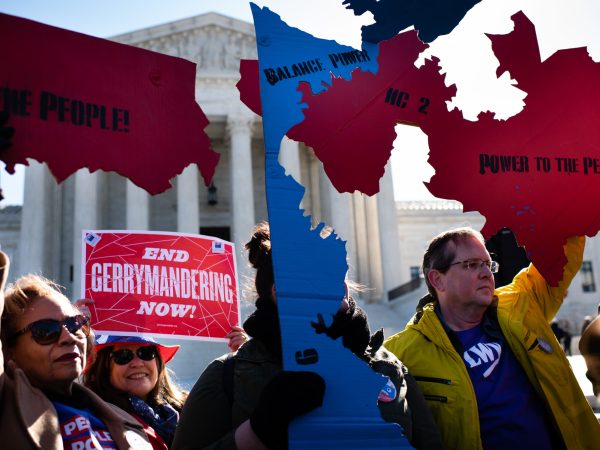

Callais, combined with today’s court ruling in Virginia, has jolted Democrats and sent commentators into bemoaning an accelerating “race to the bottom” and, to paraphrase Jeff Zeleny on CNN this afternoon, the end to norms that have organized American politics and redistricting for generations.
I’d like to offer a significantly different view of the situation. What we have seen over recent months is that Democrats have largely abandoned the mode of the last decade plus in which with one hand they fought the partisan battles of the day and with the other assume the mantle of defending the political norms Republicans have already destroyed. In other words, it was the responsibility of Democrats both to be contestants and referees. Republicans violated norms; Democrats tried to uphold them. That of course meant no partisan battle was ever on equal terms and Republicans almost always won them.
Read More
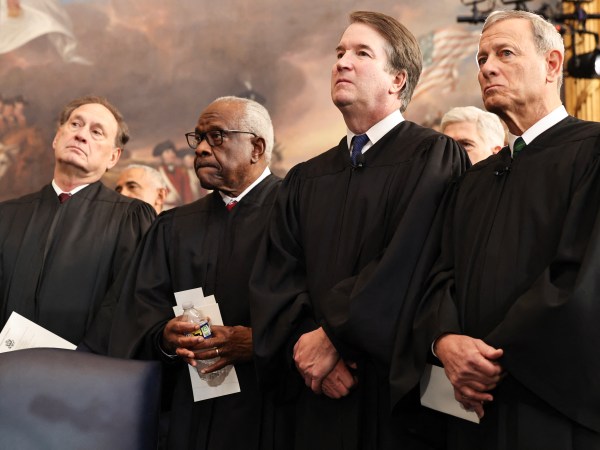
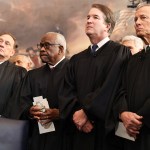
Yesterday, Lauren Egan — who authors The Bulwark’s newsletter about Democrats — sent out a newsletter edition entitled “Get Ready for the Dem Court-Expansion Litmus Test.” (Egan tends to be fairly dismissive of Democrats’ intentions, with a kind of mainstream media vibe.) Today Chief Justice John Roberts is complaining that the public is misinformed thinking that the Supreme Court is made up of corrupt political actors. As I’ve written repeatedly, there are deep inertia pools of opposition to Supreme Court reform. It’s a much heavier, though just as critical, lift than contesting the gerrymandering wars or abolishing the filibuster. But these and other hints show that a movement and a coherent push are beginning to take shape.
Read More

I’m hoping to bring you some news on the DOJ-in-Exile front in the not-too-distant future. It was probably simply too early in the spring and summer of 2025. It’s not too early now. But the DOJ-in-Exile idea was and is part of a more general ambition and agenda — to create a baseline record, a predicate and an expectation of future accountability for the Trump administration’s criminal conduct. Some of that effort is a kind of opposition therapy, resisting the authoritarian aim of convincing the public that the law, the ecosystem of criminal accountability has disappeared. It heartens people. It provides a framework of expectation: the law hasn’t disappeared. We’re in an interregnum. It will return, as will accountability. The battle over expectations about the future is a central battle in any authoritarian takeover.
But it’s not solely a matter of heartening, strengthening the morale of the opposition. It is also very directly and literally laying the groundwork for criminal accountability for a renegade executive and all the corrupt actors and criminals who now populate the executive branch.
Read More