

 Members-Only Article
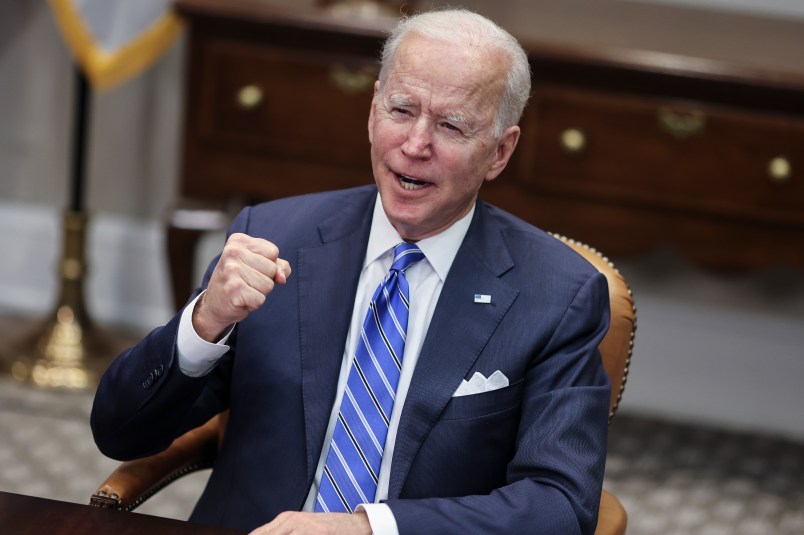
There’s a sizable batch of new polling out which shows that President Biden’s infrastructure plan is popular with a broad cross-section of the public. The popularity isn’t quite as overwhelming as it was for the American Rescue Plan. But by almost every standard in a polarized age the numbers are still overwhelming. A new poll sponsored by the Times shows 64% support. Democrats almost unanimously support it (97%). 72% of Independents support it. And even 29% of Republicans support it. The support is spread broadly across demographic groups and the individual components of the plan poll well too.
According to the Times, Republicans plan to focus their opposition on raising the corporate tax rate, a move that would reverse a central part of the 2017 Trump tax cuts. But polling from Quinnipiac and (to some extent) Morning Consult suggests an infrastructure bill becomes more popular, not less, if it is funded through corporate tax hikes as opposed to borrowing alone.
This is all good news for Biden’s bill. But it also highlights one of the central oddities of the political moment. I believe I’m on firm ground when I say that most political observers believe Democrats will lose control of Congress next year. That creates so much of the urgency of the political moment. I don’t mean a certainty but more likely than not. I’m less pessimistic than most. But at least for the House that’s my assumption too.
There’s redistricting which is expected to be a windfall for Republicans. Incumbent Presidents seldom do well in midterm elections, a big problem when the margins in both chambers are so close. And yet here we have a President who is reasonably popular. He is pushing bills which range between very popular and overwhelmingly popular. And the opposition party is 100% unified in total opposition.
Something here doesn’t fit.
Either our assumptions are wrong or there’s some part of the apparatus of government that isn’t working. A party operating significantly out of step with public opinion should pay a price at the polls. But our assumption is that that party will be rewarded at the polls. This diagnosis isn’t new and it’s central to much Democratic thinking and reform proposals: the substantial built in advantages which American electoral machinery grants to the current version of the GOP. Small states have more power. Rural areas are advantaged versus cities. ‘Excess’ Democratic votes are wasted in cities while Republicans win consistent if not overwhelming numbers in exurban regions. Each feature compounds on the others and is magnified by partisan redistricting.
But is that it entirely?
Another possibility is that voters won’t vote on the legislative political issues we see as central. Perhaps Biden can be popular and his legislation can be popular. But voters will say thank you very much for the great bill but vote on their polarized political identities regardless.
I don’t know the answers to these questions, though as I noted I’m not as sure we know what the 2022 will look like as many seem to be. But all of this does make for a persistent oddity to the politics of the moment. The fly wheels connecting public opinion to electoral outcomes seem broken. The President is pushing massive spending bills which were deemed anathema for decades and yet is garnering widespread public support. Finally, Republicans continue their lockstep support for President Trump even as he seems to drift further and further from the political scene. Together these disconnects and surprises create an uncanny and unsteady political moment. Political gravity doesn’t seem to function. The political equation on so many fronts doesn’t add up. And the reason is that some basic assumptions we have about the political moment and the coming years are simply wrong.