

 Members-Only Article
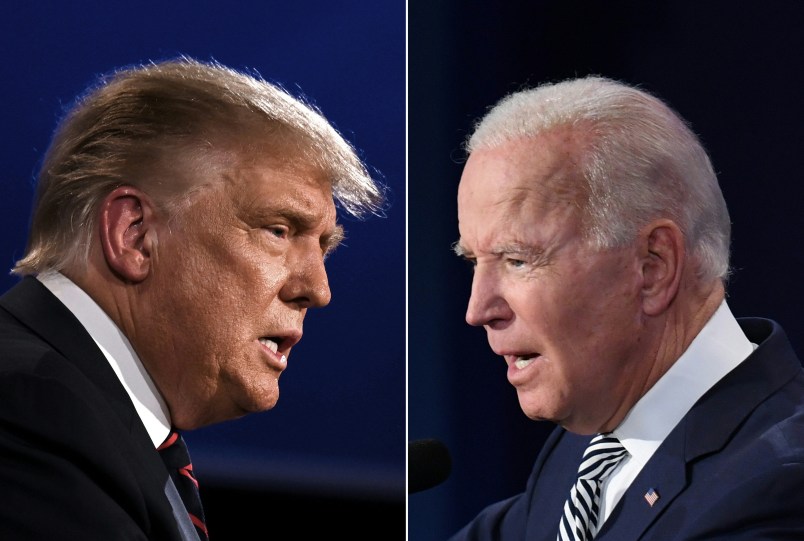
The doctor’s report is in. And after four years of President Donald Trump’s obfuscation, the information shared about President-elect Joe Biden’s foot fracture on Sunday was shockingly … thorough.
Biden’s transition team informed pool reporters on Sunday afternoon that Biden twisted his ankle while playing with his dog the day before, and would be examined by an orthopedist at Delaware Orthopedic Specialists “out of an abundance of caution.”
While Biden was still at the orthopedist’s office, the President-elect’s doctor and his transition team gave an update on Biden’s condition.
Dr. Kevin O’Connor, the president-elect’s physician who also serves as the director of executive medicine at GW Medical Faculty Associates, said in a statement that although Biden sustained a sprain in his right foot, initial x-rays showed “no obvious fracture.” However, Biden would receive an addition CT scan for more detailed imaging.
Biden’s transition team informed reporters that the President-elect would visit Delaware Imaging Network facility at the Omega Professional Center to receive a CT scan. Although a press lid was called after Biden departed the facility, O’Connor sent along a statement Sunday evening saying that a CT scan “confirmed hairline (small) fractures of President-elect Biden’s lateral and intermediate cuneiform bones, which are in the mid-foot” and that “it is anticipated that he will likely require a walking boot for several weeks.”
The frequent updates from Biden’s team marked a drastic departure from the vague and incomplete information presented around President Trump’s visits to Walter Reed Medical Center over the past year.
Last November, Trump supposedly went to the Maryland-based medical center for what the White House described as a series of “quick exam and labs” ahead of a “very busy 2020.” However, Trump’s visit did not follow the protocol of a routine presidential medical exam, which prompted speculation over why the President paid an unscheduled visit.
Fast forward to September 2020, when New York Times reporter Michael Schmidt wrote in his book that Vice President Mike Pence was privately put on “standby” to assume presidential powers “temporarily if Trump had to undergo a procedure that would have required him to be anesthetized” during his previously unscheduled trip to Walter Reed last year.
Trump appeared to react to the Times’ report by fuming in an early September tweet that he never suffered from “mini strokes.” The President requested that his doctor, White House physician Dr. Sean Conley, issue a statement confirming that the President had not experienced nor had been evaluated for stroke, mini stroke or any acute cardiovascular emergencies. Conley added that recent comments surrounding Trump’s health have been “incorrectly reported in the media.”
White House statement from Dr. Sean P. Conley, Physician to the President: pic.twitter.com/9ty3n4pM3x
— Zeke Miller (@ZekeJMiller) September 1, 2020
Exactly a month after Trump got Conley to do his bidding, history repeated itself when the President contracted COVID-19 and was hospitalized at Walter Reed for several days.
Conley delivered vague and evasive updates on Trump’s treatment for COVID-19, including contradicting earlier information about the President’s diagnosis and offering a baffling new timeline on when Trump received an initial positive diagnosis for coronavirus.
Doctors and members of the press swiftly torched Conley as they reacted to a briefing outside of Walter Reed on a Sunday morning, which left many questions unanswered after the evasive briefing that happened the day before.
Dr. Leana Wen, an emergency physician and Visiting Professor of Health Policy and Management at the George Washington University School of Public Health, was among the public health experts to rebuke the lack of information disclosed by Conley regarding Trump’s COVID-19 diagnosis and treatment in October.
In a phone interview with TPM Monday afternoon, Wen outlined the “striking” differences between Biden’s transition team providing an “exact diagnosis” versus the many lingering questions on Trump’s COVID-19 prognosis almost two months after he was discharged from Walter Reed.
“(Biden’s transition team) explained what the imaging studies showed, and he described the prognosis of what is going to come next,” Wen said. “This is in comparison to President Trump, where months after his coronavirus diagnosis, we still don’t actually know what he had.”
Wen described how Trump’s physicians never informed the public on whether he had pneumonia, what other organs were involved in this very serious illness, nor what his chest X ray and chest CT scan showed when he had a respiratory disease.
Wen stressed the importance of putting the evasive messaging of Trump’s medical team into perspective, given how Biden suffered a “minor foot injury” compared to the sitting president’s “life threatening disease.” Wen noted that Trump’s oxygen saturation dropped low enough that he had to be taken to the hospital for inpatient treatment.
“These are very two very different levels of illnesses, and still we’re getting this level of transparency that we need,” Wen said, referring to Biden transition team’s updates on the President-elect’s medical condition.
When asked about Conley’s invoking of the HIPAA as his rationale behind dodging critical questions on Trump’s COVID-19 diagnosis, Wen emphasized that this is a case where the provider is not at fault, but rather the patient (Trump) is.
“The President of the United States has an obligation to tell the American people about what is going on with with his health,” Wen said. “The American people have a right to understand the president’s fitness for office, their mental and physical state, and their ability to serve as the commander in chief.”
Wen added that doctors aren’t supposed to “cherry pick only the good results and hide the bad results, and vice versa,” and argued that the White House has that “same obligation” to tell the truth.
“They are under no obligation have to tell the public anything that the patient — the President — doesn’t want to be told, but they should not be lying to the public,” Wen said. “They should not be cherry picking information and certainly not be misleading the public.”
Wen hopes that the incoming Biden administration will “draw from the same playbook” past presidents have used regarding transparency on medical conditions, citing incidences of when former President Ronald Reagan was shot and Vice President Dick Cheney experienced heart issues.
“I mean, there is a playbook for how to communicate about the medical condition and ongoing issues of the President, Vice President,” Wen said.