After President Joe Biden’s big voting rights speech in Georgia Tuesday, Senate Democrats are mapping out a strategy to hold votes on rules changes.
The obstacles — as they were in the beginning, are now and ever shall be, Amen — are Sens. Joe Manchin (D-WV) and Kyrsten Sinema (D-AZ). Manchin has expressed openness to small technical changes to the filibuster; it’s unclear where Sinema is, aside from recently expressing support for the 60-vote threshold.
Expect a day of meetings with these two while we dig for clues to illuminate Senate Majority Leader Chuck Schumer’s (D-NY) plans. Schumer has promised a rules vote no later than Martin Luther King Jr.’s birthday, on Monday.
One area of policy where I hoped the new Biden administration would excel was in its handling of the pandemic, but it has not done so. It wasn’t prepared for either the Delta or Omicron variants; it failed initially to acknowledge waning vaccine immunity and delayed access to boosters; it still doesn’t have an accurate count nationally of infections; and its public messaging on masks, tests, and vaccines has been confusing and sometimes misleading. That was epitomized by a statement from acting Food and Drug Administration Commissioner Janet L. Woodcock in the Senate hearings yesterday.
Georgia Gov. Brian Kemp (R) on Wednesday made a lame joke to distract from the severity of his state’s restrictive voting law a day after President Biden gave a speech urging the protection of voting rights in the state.
The federal probe into Rep. Matt Gaetz (R-FL), who is reportedly being investigated to determine whether he had a sexual relationship with a 17-year-old, has reached a key development, according to two new reports.
Dr. Anthony Fauci, White House chief medical adviser, clarified his comments made Tuesday — that the Omicron variant will “ultimately find just about everybody” — during a COVID-19 response press briefing on Wednesday.
A leader of the neo-Nazi group Atomwaffen was sentenced to 84 months in prison on Tuesday over the group’s threat and intimidation campaign against reporters and Anti-Defamation League staff, according to the Justice Department.
This article is part of TPM Cafe, TPM’s home for opinion and news analysis. It first appeared at The Conversation.
The idea of community and who belongs and who does not was a common theme in the Jan. 7, 2022, sentencing hearing of three white men convicted of killing Ahmaud Arbery.
“They chose to target my son because they didn’t want him in their community,” said Arbery’s mother, Wanda Cooper-Jones, during the hearing. “When they couldn’t sufficiently scare him or intimidate him, they killed him.”
Arbery was the 25-year-old unarmed Black man who was shot to death on Feb. 23, 2020, while jogging through a predominantly white, middle-class neighborhood in Brunswick, Georgia. Race went largely unspoken throughout the trial, but the idea of belonging was clearly drawn in black and white.
This article is part of TPM Cafe, TPM’s home for opinion and news analysis. It first appeared at The Conversation.
In the summer of 1988, scientist James Hansen testifiedto Congress that carbon dioxide from burning fossil fuels was dangerously warming the planet. Scientific meetings were held, voluminous reports were written, and national pledges were made, but because fossil fuels were comparatively cheap, little concrete action was taken to reduce carbon emissions.
Then, beginning around 2009, first wind turbines and then solar photovoltaic panels decreased enough in cost to become competitive in electricity markets. More installations resulted in more “learning curve” cost reductions – the decrease in cost with every doubling of deployment. Since 2009, the prices of wind and solar power have decreased by an astonishing 72% and 90%, respectively, and they are now the cheapest electricity sources – although some challenges still exist.
With the planet facing increasingly intense heat waves, drought, wildfires and storms, a path to tackle the climate crisis became clear: Transition the electric grid to carbon-free wind and solar and convert most other fossil fuel users in transportation, buildings and industry to electricity.
The Biden administration’s goal is to have a carbon emissions-free grid by 2035. One recent study found that the U.S. will need to nearly triple its 2020 growth rate for the grid to be 80% powered by clean energy by 2030. (As difficult as that may sound, China reportedly installed 120,000 megawatts of wind and solar in 2020.)
The foundation of this transition is a dramatic change in the electric grid itself.
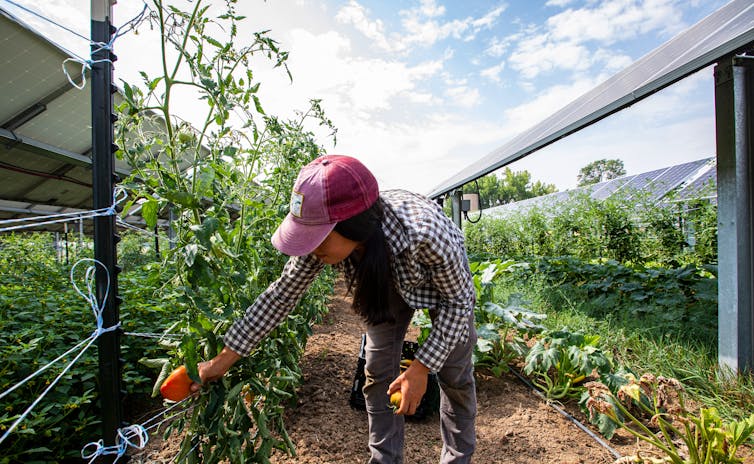
Integrating solar panels with farming can provide partial shade for plants. Werner Slocum/NREL
3 ways to bring wind and solar into the grid
Hailed as the greatest invention of the 20th century, our now-aging grid was based on fundamental concepts that made sense at the time it was developed. The original foundation was a combination of “base load” coal plants that operated 24 hours a day and large-scale hydropower.
Beginning in 1958, these were augmented by nuclear power plants, which have operated nearly continuously to pay off their large capital investments. Unlike coal and nuclear, solar and wind are variable; they provide power only when the sun and wind are available.
Converting to a 21st-century grid that is increasingly based on variable resources requires a completely new way of thinking. New sources of flexibility – the ability to keep supply and demand in balance over all time scales – are essential to enable this transition.
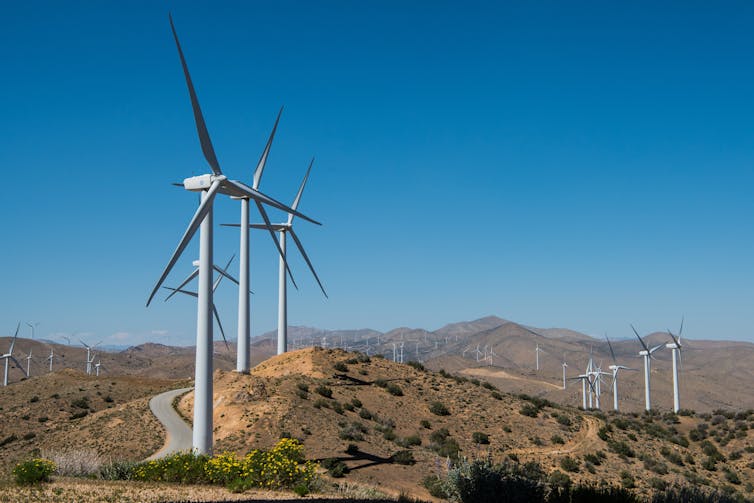
Pine Tree Wind Farm near Tehachapi, California, provides renewable power to Los Angeles. Dennis Schroeder/NREL
There are basically three ways to accommodate the variability of wind and solar energy: use storage, deploy generation in a coordinated fashion across a wide area of the country along with more transmission, and manage electricity demand to better match the supply. These are all sources of flexibility.
Expanded transmission is especially valuable. When the Northeast is experiencing peak electric demand in the early evening, there is still sun in the West. And, with more transmission, the large wind resources in the center of the country can send electricity toward both coasts. Transmission studies have shown that stronger interconnections among the country’s three power grids are highly beneficial.
Making buildings more efficient and controlling their demand can also play a big role in cleaning up the grid. Buildings use 74% of U.S. electricity. Interconnected devices and equipment with smart meters can reduce and reshape a building’s power use.
Innovations that make 100% clean power possible
Many analysts believe the U.S. can cost-effectively and reliably operate a power grid with 80% to 90% clean electricity, but decarbonizing the last 10% to 20% will be notably more challenging. While short-duration storage, lasting four hours or less, is becoming ubiquitous, we will likely need to provide power during some periods when wind and solar resources are at low levels (what the Germans call dunkelflaute, or “dark doldrums”). An expanded national transmission network will help, but some amount of long-duration storage will likely be needed.
Flow batteries are among the promising approaches that we are working on at the Renewable and Sustainable Energy Institute at the University of Colorado. In a typical design, liquid electrolyte flows between two storage tanks separated by a membrane. The tanks can be scaled up in size corresponding to the desired storage duration.
Green hydrogen is a potential storage option for very long durations. It is produced by splitting water molecules with an electrolyzer powered by renewable electricity. The hydrogen can be stored underground (or in above-ground tanks) and either burned in combustion turbines or converted back to electricity in fuel cells. Green hydrogen is currently very expensive but is expected to become more affordable as the cost of electrolyzers decreases.
In addition, new business, market design and grid operator models are emerging. Community solar gardens, for example, allow homeowners to purchase locally produced solar electricity even if their own roofs are not suitable for solar panels. Microgrids are another business model becoming common on campuses and complexes that produce electricity locally and can continue to operate if the grid goes down. Clean microgrids are powered by renewable energy and batteries.
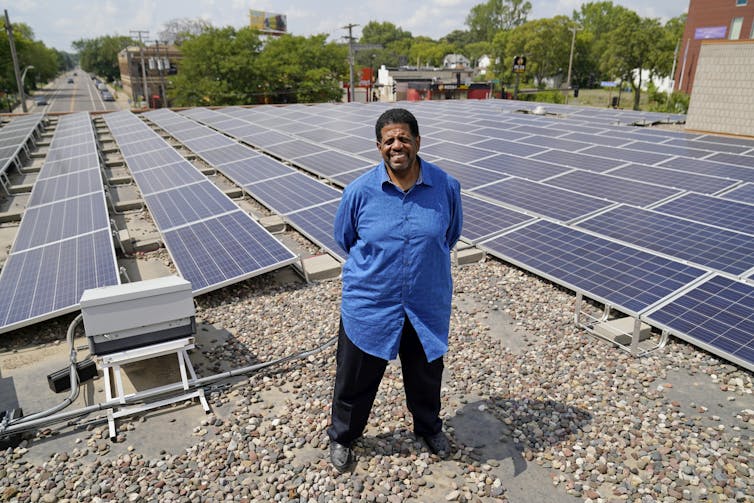
Bishop Richard Howell stands near some of the 630 solar panels on the roof of his Minneapolis church. The community solar project provides clean energy to the community. AP Photo/Jim Mone
Innovative market designs include time-of-use rates that encourage electricity use, such as for charging electric vehicles, when renewable electricity is plentiful. Expanded balancing area coordination draws on variable solar and wind resources from a wide region to provide a smoother overall supply. Improved grid operations include advanced forecasting of wind and solar to minimize wasted power and reduce the need for costly standby reserves. Dynamic line rating allows grid operators to transmit more electricity through existing lines when favorable weather conditions permit.
Across the economy, greater attention to energy efficiency can enable power sector transformation, minimizing costs and improving reliability.
Nuclear power is also essentially carbon-free, and keeping existing nuclear plants running can make the transition to renewables easier. However, new nuclear plants in the U.S. are very expensive to build, have long construction times and may prove too costly to operate in a manner that would help firm variable solar and wind.
In our view, the urgency of climate change demands an all-out effort to address it. Having a 2035 emissions goal is important, but the emissions reduction path the U.S. takes to reach that goal is critical. The No. 1 need is to minimize adding carbon dioxide and other greenhouse gases to the atmosphere. The world already has the tools to get the grid 80% to 90% carbon-free, and technical experts are exploring a wide range of promising options for achieving that last 10% to 20%.