

I want to give you another update on COVID. The outlook … well, it’s not good. Certainly not in the near-term. Here is a good summary of the emerging science of Omicron from Dr. Eric Topol. We now have at least ten lab studies that look at immune response to Omicron, specifically neutralization studies which broadly measure the body’s first line of defense against infection. The more studies we see the more they reinforce each other. Very limited protection against infection with a two dose mRNA regimen, though presumably still substantial protection against severe illness and death. A booster appears to get up towards the level of protection against infection two doses provided against Delta, though not quite as high. Two doses and prior infection also seems to produce fairly effective protection. Three doses and two doses plus infection seem to be in the same ballpark of protection.
Continue reading “Waiting for Omicron”Where Things Stand: There’s No Other Shoe Left To Drop
We keep running into a relatively new and unfamiliar dynamic where the tools of investigative journalism as they are usually deployed wind up obscuring the truth rather than illuminating it.
It’s playing out now in the coverage of the Jan. 6 attack, especially over the last few days. First with the controversial PowerPoint presentation that’s been circulating, and since last night with the Mark Meadows texts.
Continue reading “Where Things Stand: There’s No Other Shoe Left To Drop”Biden Nominee Saule Omarova Speaks Out About The Campaign To Smear Her As ‘Soviet’
Saule Omarova left her confirmation hearing feeling calm.
Continue reading “Biden Nominee Saule Omarova Speaks Out About The Campaign To Smear Her As ‘Soviet’”The Sausage Making: With Housekeeping Mostly Done, We’re Back On Manchin Time
Your intermittent briefing on negotiations over the reconciliation bill.
While Senate Majority Leader Chuck Schumer (D-NY) insists that his chamber will vote on the reconciliation bill by Christmas, Sen. Joe Manchin (D-WV) is showing no signs of urgency.
Continue reading “The Sausage Making: With Housekeeping Mostly Done, We’re Back On Manchin Time”Congress Inches One Step Closer To Getting Trump Tax Returns
After more than two years of waiting, a D.C. federal judge on Tuesday allowed a request from Congress for Trump’s tax returns to go forward.
Continue reading “Congress Inches One Step Closer To Getting Trump Tax Returns”DC Attorney General Sues Proud Boys And Oath Keepers For Jan. 6 Damages, Citing KKK Act
The city of Washington, D.C. sued the Proud Boys and Oath Keepers on Tuesday, alleging that the groups violated the Ku Klux Klan Act and seeking damages stemming from the Jan. 6 Capitol attack.
Continue reading “DC Attorney General Sues Proud Boys And Oath Keepers For Jan. 6 Damages, Citing KKK Act”Cheney Offers Details On Meadows’ Involvement With Raffensperger Call, Jeffrey Clark Plot
Rep. Liz Cheney (R-WY), who serves as vice chair of the Jan. 6 Committee, on Tuesday revealed yet more details about former White House chief of staff Mark Meadows’ communications as he worked with former President Trump to subvert the election results before and during the deadly Capitol insurrection.
Continue reading “Cheney Offers Details On Meadows’ Involvement With Raffensperger Call, Jeffrey Clark Plot”2021 Arctic Report Card Reveals A (Human) Story Of Cascading Disruptions, Extreme Events And Global Connections
This article is part of TPM Cafe, TPM’s home for opinion and news analysis. It first appeared at The Conversation.
The Arctic has long been portrayed as a distant end-of-the-Earth place, disconnected from everyday common experience. But as the planet rapidly warms, what happens in this icy region, where temperatures are rising twice as fast as the rest of the globe, increasingly affects lives around the world.
On Dec. 14, 2021, a team of 111 scientists from 12 countries released the 16th annual Arctic Report Card, a yearly update on the state of the Arctic system. We are Arctic scientists and the editors of this peer-reviewed assessment. In the report, we take a diverse look across the region’s interconnected physical, ecological and human components.
Like an annual checkup with a physician, the report assesses the Arctic’s vital signs – including surface air temperatures, sea surface temperatures, sea ice, snow cover, the Greenland ice sheet, greening of the tundra, and photosynthesis rates by ocean algae – while inquiring into other indicators of health and emerging factors that shed light on the trajectory of Arctic changes.
As the report describes, rapid and pronounced human-caused warming continues to drive most of the changes, and ultimately is paving the way for disruptions that affect ecosystems and communities far and wide.
Continued loss of ice
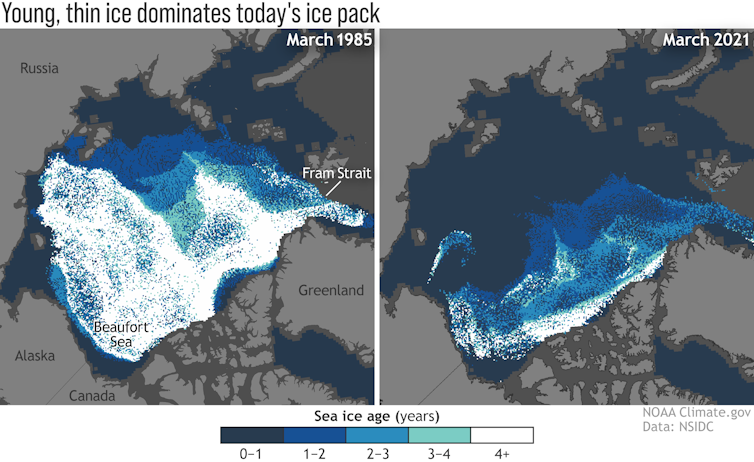
Arctic Sea ice – a central vital sign and one of the most iconic indicators of global climate change – is continuing to shrink under warming temperatures.
Including data from 2021, 15 of the lowest summer sea ice extents – the point when the ice is at its minimum reach for the year – have all occurred in the last 15 years, within a record dating back to 1979 when satellites began regularly monitoring the region.
The sea ice is also thinning at an alarming rate as the Arctic’s oldest and thickest multi-year ice disappears. This loss of sea ice diminishes the Arctic’s ability to cool the global climate. It can also alter lower latitude weather systems to an extent that makes previously rare and impactful weather events, like droughts, heat waves and extreme winter storms, more likely.
Similarly, the persistent melting of the Greenland ice sheet and other land-based ice is raising seas worldwide, exacerbating the severity and exposure to coastal flooding, disruptions to drinking and waste water systems, and coastal erosion for more communities around the planet.
A warmer, wetter Arctic
This transition from ice to water and its effects are evident across the Arctic system.
The eight major Arctic rivers are discharging more freshwater into the Arctic Ocean, reflecting an Arctic-wide increase in water coming from land as a result of precipitation, permafrost thaw and ice melt. Remarkably, the summit of the Greenland ice sheet – over 10,000 feet above sea level – experienced its first-ever observed rainfall during summer 2021.
These developments point to a changed and more variable Arctic today. They also give credence to new modeling studies that show the potential for the Arctic to transition from a snow-dominated to rain-dominated system in summer and autumn by the time global temperatures rise to only 1.5 degrees Celisus (2.7 F) above pre-industrial times. The world has already warmed by 1.2 C (2.2 F).
Such a shift to more rain and less snow would further transform landscapes, fueling faster glacier retreat and permafrost loss. The thaw of permafrost not only affects ecosystems but also further adds to climate warming by allowing previously once-frozen plant and animal remains to decompose, releasing additional greenhouse gases to the atmosphere.
This year’s report highlights how retreating glaciers and deteriorating permafrost are also posing growing threats to human life through abrupt and localized flooding and landslides. It urges coordinated international efforts to identify these hazards. More rain in the Arctic will further multiply these threats.
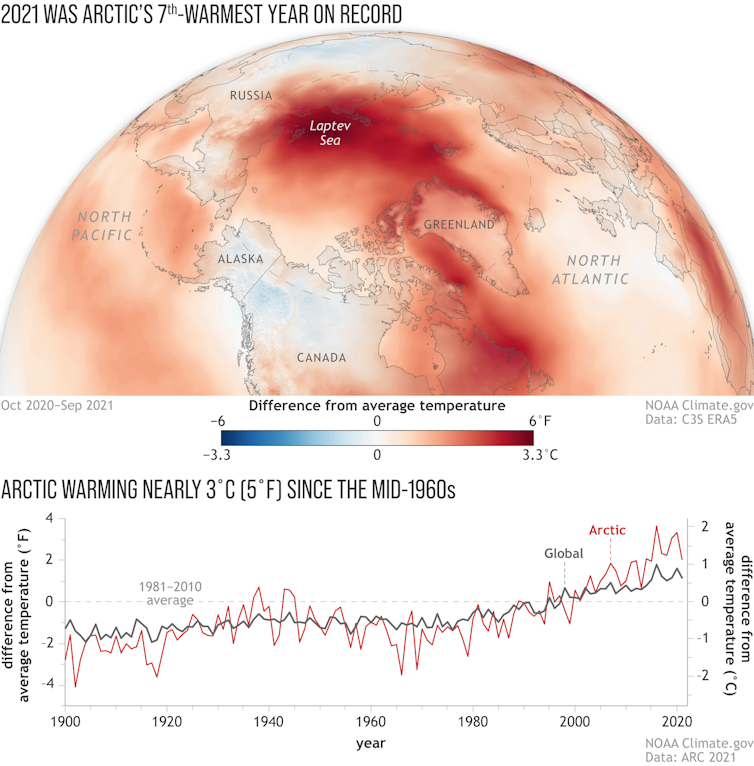
Rising human impact
Observed changes and disruptions in the Arctic have bearing on everyday lives and actions worldwide, either directly or as stark reminders of a range of human-caused harm to climate and ecosystems.
An Arctic Report Card essay on beavers expanding northward into Arctic tundra to exploit newly favorable conditions is a case study for how species around the world are on the move as habitats respond to climate shifts, and the need for new forms of collaborative monitoring to assess the scale of the resulting ecological transformations.
An essay on marine garbage from shipping washing ashore on the Bering Sea coast, posing an immediate threat to food security in the region, reminds us that the threat of both micro- and macro-plastics in our oceans is a preeminent challenge of our time.
A report on shipping noise increasingly infiltrating the Arctic’s underwater marine soundscape, to the detriment of marine mammals, is a call to conserve the integrity of natural soundscapes worldwide. For example, a recent unrelated study found that noise caused by human activities and biodiversity loss are deteriorating the spring songbird soundscapes in North America and Europe.
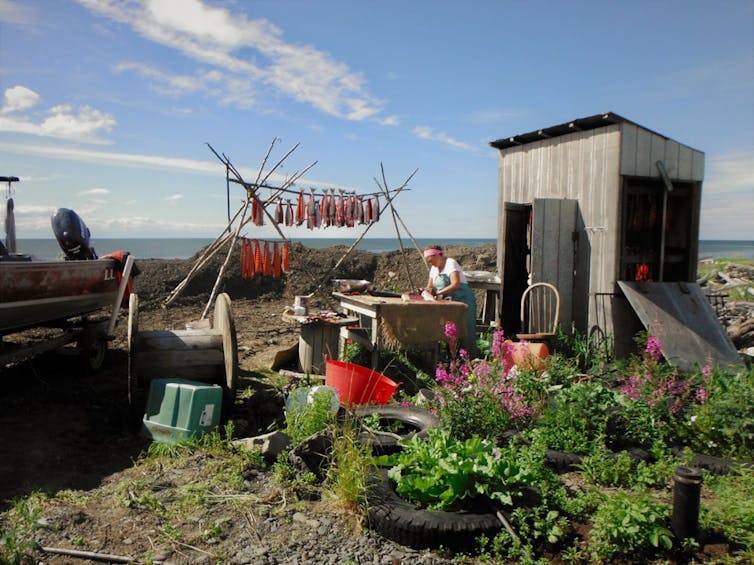
Yet, an Arctic Report Card essay from members of the Indigenous Foods Knowledges Network highlights how, despite the continued climate threats to Arctic food systems, Alaska Indigenous communities weathered early pandemic disruptions to food security through their cultural values for sharing and “community-first” approaches.
Their cooperation and ability to adapt offer an important lesson for similarly struggling communities worldwide, while reminding everyone that the Arctic itself is a homeland; a place where large-scale disruptions are not new to its over 1 million Indigenous Peoples, and where solutions have long been found in practices of reciprocity.
An Arctic connected to the rest of the world
The Arctic Report Card compiles observations from across the circumpolar North, analyzing them within a polar projection of our planet. This puts the Arctic at the center, with all meridians extending outward to the rest of the world.

In this view, the Arctic is tethered to societies worldwide through a myriad of exchanges – the natural circulation of air, ocean and contaminants, the migration of animals and invasive species, as well as human-driven transport of people, pollution, goods and natural resources. The warming of the Arctic is also allowing for greater marine access as sea ice loss permits ships to move deeper into Arctic waters and for longer periods of time.
These realities illuminate the importance for increased international cooperation in conservation, hazard mitigation and scientific research.
The Arctic has already undergone unprecedented rapid environmental and social changes. A warmer and more accessible Arctic results in a world only tethered more tightly together.
Matthew Druckenmiller is a research scientist at the National Snow and Ice Data Center’s (NSIDC) Cooperative Institute for Research in Environmental Sciences (CIRES) at the University of Colorado Boulder.
Rick Thoman is an Alaska climate specialist at the University of Alaska Fairbanks.
Twila Moon is a deputy lead scientist at the National Snow and Ice Data Center (NSIDC)’s Cooperative Institute for Research in Environmental Sciences (CIRES) at the University of Colorado Boulder.
This article is republished from The Conversation under a Creative Commons license. Read the original article.

Why Were Trump Allies Begging Him To Call Off The Capitol Attack If Antifa Did It?!
In the heat of the moment on Jan. 6, Donald Trump’s closest supporters spoke frankly: Congress was under attack by Trump’s die-hard fans, and the President alone had the power to call them off. They texted Trump’s chief of staff, Mark Meadows, in a frenzy, pleading with him to have Trump address the nation and dismiss the rioters.
Continue reading “Why Were Trump Allies Begging Him To Call Off The Capitol Attack If Antifa Did It?!”Lawmaker Texted Meadows On Jan. 7 Apologizing For Failing To Steal Election
A member of Congress texted White House chief of staff Mark Meadows the day after the violent Jan. 6 Capitol insurrection lamenting that it had been a “terrible day” … because their efforts to steal the election for Donald Trump had failed, according to new texts revealed by the House Jan. 6 select committee on Monday.
Continue reading “Lawmaker Texted Meadows On Jan. 7 Apologizing For Failing To Steal Election”