A Norfolk Southern Policy Lets Officials Order Crews to Ignore Safety Alerts

This story first appeared at ProPublica. ProPublica is a Pulitzer Prize-winning investigative newsroom. Sign up for The Big Story newsletter to receive stories like this one in your inbox.

Norfolk Southern allows a monitoring team to instruct crews to ignore alerts from train track sensors designed to flag potential mechanical problems.

ProPublica learned of the policy after reviewing the rules of the company, which is engulfed in controversy after one of its trains derailed this month, releasing toxic flammable gas over East Palestine, Ohio.

The policy applies specifically to the company’s Wayside Detector Help Desk, which monitors data from the track-side sensors. Workers on the desk can tell crews to disregard an alert when “information is available confirming it is safe to proceed” and to continue no faster than 30 miles per hour to the next track-side sensor, which is often miles away. The company’s rulebook did not specify what such information might be, and company officials did not respond to questions about the policy.

The National Transportation Safety Board will be looking into the company’s rules, including whether that specific policy played a role in the Feb. 3 derailment in East Palestine. Thirty-eight cars, some filled with chemicals, left the tracks and caught fire, triggering an evacuation and agonized questions from residents about the implications for their health. The NTSB believes a wheel bearing in a car overheated and failed immediately before the train derailed. It plans to release a preliminary report on the accident Thursday morning.

ProPublica has learned that Norfolk Southern disregarded a similar mechanical problem on another train that months earlier jumped the tracks in Ohio.

In October, that train was en route to Cleveland when dispatchers told the crew to stop it, said Clyde Whitaker, Ohio state legislative director for the Transportation Division of the International Association of Sheet Metal, Air, Rail and Transportation Workers, or SMART. He said the help desk had learned that a wheel was heating up on an engine the train was towing. The company sent a mechanic to the train to diagnose the problem.

Whitaker said that it could not be determined what was causing the wheel to overheat, and that the safest course of action would have been to set the engine aside to be repaired. That would have added about an hour to the journey, Whitaker said.

But Whitaker said the dispatcher told the crew that a supervisor determined that the train should continue on without removing the engine.

Four miles later, the train derailed while traveling about 30 miles per hour and dumped thousands of gallons of molten paraffin wax in the city of Sandusky.
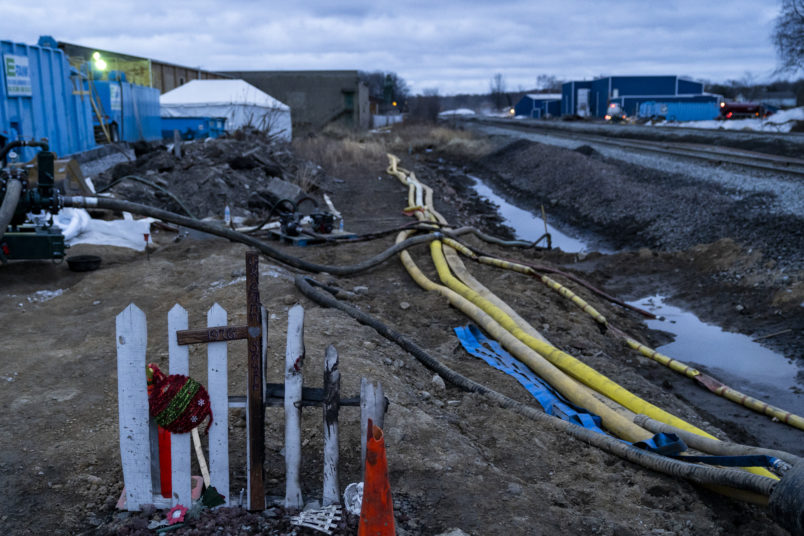
EAST PALESTINE, OH – FEBRUARY 16: A memorial for someone that was killed by a train is charred on February 16, 2023 in East Palestine, Ohio. On February 3rd, a Norfolk Southern Railways train carrying toxic chemicals derailed causing an environmental disaster. (Photo by Michael Swensen/Getty Images)

Records from the Federal Railroad Administration, the agency responsible for regulating safety in the railroad industry, show that Norfolk Southern identified the cause of the October derailment as a hot wheel bearing. Whitaker said this bearing was on the same engine that originally drew concerns.

A spokesperson for the FRA said the agency’s investigation into the derailment is ongoing. The agency did not say whether it was examining the role of any Norfolk Southern officials in deciding to keep the damaged engine on the train. It’s still unknown what role, if any, the help desk played in the final decision.

This month, 20 miles before Norfolk Southern’s train spectacularly derailed in East Palestine, the help desk should have also gotten an alert. As the train rolled through Salem, it crossed a track-side sensor. Video footage from a nearby Salem company shows the train traveling with a fiery glow underneath its carriage.

If, like the Sandusky train, this one was dangerously heating up, a key question for investigators will be whether the help desk became aware and alerted the crew, and if it did, why the crew was not instructed to stop. The NTSB told ProPublica it is reviewing data from the Salem detector and those before it on the train’s route.

Norfolk Southern declined to say whether members of the train’s crew received an alert before the derailment and, if they did, whether the help desk told them to disregard it. The company did not address questions about its policy giving its help desk leeway to ignore such alerts. A spokesperson said that the company’s detector network is a massive safety investment, and that its trains rarely require troubleshooting.

ProPublica asked officials at the six other large freight railroad companies whether they have similar policies allowing employees to disregard such alerts. CSX and Burlington Northern Santa Fe said they don’t, and Canadian National said that no one can instruct a crew to continue traveling when they receive an alert “requiring them to stop the train.” Union Pacific, Canadian Pacific and Kansas City Southern did not respond.

While some employees and outside experts say there are times in which such policies safely benefit business operations, union officials believe they are emblematic of Precision Scheduled Railroading, the most controversial — and profitable — innovation that’s come out of the country’s seven biggest railroads, the so-called Class 1s, in the last decade. It prioritizes keeping rail cars and locomotives in constant motion.

Mike Pence Has Become The Spokesman For Cutting Medicare And Social Security

Elsewhere, Republicans are running, with their hands up, shrieking, from the accusation (and for most, bare statement of fact) that they want to cut Social Security and Medicare. But not Mike Pence.

Continue reading “Mike Pence Has Become The Spokesman For Cutting Medicare And Social Security”

Where Things Stand: Ivanka And Jared Subpoenaed By Special Counsel

Donald Trump’s daughter and son-in-law have been subpoenaed by special counsel Jack Smith to appear before a federal grand jury for testimony. The New York Times’ Maggie Haberman and Michael Schmidt have the latest here.

Jared Kushner and Ivanka Trump were reportedly both compelled to share testimony on Trump’s various schemes to stay in the White House after he lost the election to President Biden in 2020 and his role in siccing a mob of his supporters attacking the U.S. Capitol on Jan. 6.

Continue reading “Where Things Stand: Ivanka And Jared Subpoenaed By Special Counsel”

Games and How AI Thinks

I’ve mentioned this many times before. But it’s one of the true privileges of this job to have the asset of this site’s readership as I explore new issues raised in the news. Readers who were only readers for years and now sometimes decades become active participants as the site’s focus shifts to their area of expertise. “20 year reader here,” said one last night, “finally you address a topic I’m an expert in!”

I’ve heard from a range of readers who are top executives and engineers at companies on the forefront of artificial intelligence, computer science academics, people who have some angle of expertise on the topic. I’ve been hearing from more people on the “pro-AI” side of things. But “pro” or “con” doesn’t really do justice to the conversation.

Continue reading “Games and How AI Thinks”

Mercenary Chief Prigozhin Goes After Top Russian Military Leadership

Wagner Group chief, U.S. election interferer, and onetime convict Yevgeny Prigozhin did something unusual, even for him, on Wednesday: he published a photo of Wagner’s losses in Ukraine.

It’s a graphic image, showing a ditch full of corpses mutilated by what appear to be military-grade weapons. But Prigozhin used it to reinforce a complaint that he’s been making over the past week: the Russian Ministry of Defense has stopped giving his mercenary army the ammo it needs to keep fighting.

Continue reading “Mercenary Chief Prigozhin Goes After Top Russian Military Leadership”

Oath Keeper Alaska Rep Asks If There Are Economic Benefits To The Deaths Of Abused Children

Alaska State Rep. David Eastman (R), an Oath Keeper who attended the Stop the Steal rally on Jan. 6, sparked outrage on Monday when he asked whether there could be economic benefits to the deaths of abused children.

Continue reading “Oath Keeper Alaska Rep Asks If There Are Economic Benefits To The Deaths Of Abused Children”

How Putin Has Shrugged Off Unprecedented Economic Sanctions Over Russia’s War In Ukraine—For Now

This article is part of TPM Cafe, TPM’s home for opinion and news analysis. It was originally published at The Conversation.

The U.S. and four dozen other countries have imposed punishing sanctions on Russia in reaction to its invasion of Ukraine on Feb. 24, 2022. The sanctions were unprecedented in their scope and severity for an economy of Russia’s size.

The initial sanctions included the freezing of Russian assets abroad and a ban on the export of key technologies to Russia. Over the course of 2022, the sanctions were ratcheted up significantly as the European Union eventually phased in a radical reduction of the purchase of Russian oil and gas. Separately, over 1,200 Western companies closed their operations in Russia.

One year into the war, are the sanctions working?

Initial setbacks but quick recovery

Before the invasion, Western nations had hoped the threat of sanctions would deter Russia from attacking Ukraine. But once the invasion began, the goal shifted to deterring President Vladimir Putin from escalating and encouraging him to withdraw – by reducing his ability to fund his war machine.

At first, Western commentators were confident that the sanctions were working.

In the first week of the war, the Russian ruble plunged in value as Russians panicked when most Russian banks were excluded from the Swift international transaction system and government assets in foreign banks were frozen. However, Russia’s central bank was able to quickly stabilize the exchange rate, bringing it back to prewar levels. Inflation peaked at 18% in April before easing to 12% by December.

Even after that, some Western observers continued to insist that the sanctions were crippling the Russian economy.

It is true that the sanctions have devastated certain sectors, notably aviation and auto manufacturing, which saw an 80% decline in output due to lack of imported components. However, overall Russia finished 2022 with a mere 3% contraction in its gross domestic product. Retail sales fell 9% during the year, with local brands – along with some Chinese and Turkish companies – replacing Western companies on the domestic market.

Despite the sanctions and setbacks on the battlefield, Putin has shown no signs of backing down. In September, he mobilized 300,000 reservists and started a campaign to cripple Ukraine’s electricity system through missile and drone attacks.

I have studied the Soviet and the Russian economy for over four decades. I believe there are four reasons the sky has yet not fallen in on the Russian economy.

1. Russia’s energy lifeline

Russia may be spending over US$300 million a day to fight the war, but for much of 2022 it was earning $800 million every day from energy exports. That revenue stream was enough to prevent living standards from collapsing and to replenish Russia’s stock of arms and ammunition.

The war, together with Russia’s cutback on gas deliveries to Europe in 2021, caused a spike in oil and gas prices. In the first month of the war, global oil prices surged 50%, reaching a peak of $139 a barrel in April, while wholesale gas prices in Europe increased 500%, peaking at 300 euros ($320) per megawatt-hour. This created windfall profits for Russia.

Even though the volume of Russian oil and gas exports to Europe fell in 2022, its energy revenues surged to $168 billion for the year, the highest level since 2011. Russia ended the year with a current account surplus of $227 billion, a record high.

2. Russia has plenty of other customers

Second, the 49 sanctioning countries account for just 60% of the world’s economy. That leaves 40% still willing to do business with Moscow.

Most non-Western countries refused to join the sanctions. Many view the Ukraine war as a result of great power rivalry and do not blame Russia. India and China are buying even more Russian oil and gas – though they persuaded Russia to give them a steep discount of $20 to $30 a barrel. Turkey is also a critical partner: Its trade with Russia increased 45% in 2022.

And despite their efforts to reduce purchases from Russia, European countries have still bought $125 billion of Russian oil and gas since the invasion began, compared with $50 billion by China, $20 billion by Turkey and $18 billion by India.

3. Russia’s economy is battle-hardened

The third factor is that the observers predicting Armageddon failed to appreciate the Russian economy’s unique features.

The Russian government has been preparing and planning for this war for many years and has learned to live with and work around the sanctions that were imposed after the annexation of Crimea in 2014.

The tumultuous 1990s taught Russian business, consumers and workers how to adapt to random shocks – such as the high inflation that wiped out many people’s savings or the corporate raiders and tax police who stole businesses. Many people came to expect the worst and prepared for it. As a whole, they are both resilient in the face of challenges and resigned to lower expectations.

The Russian labor market generally absorbs shocks not by companies firing workers but paying them less until things improve. Also, 15% of the workforce is made up of migrants, mainly from Central Asia – and they can be fired and sent home, then rehired as needed.

4. Oligarchs and policymakers remain loyal

One of the key political assumptions animating the initial sanctions strategy was flawed.

The theory was that the sanctioned oligarchs stood to lose tens of millions of dollars and access to their Western luxuries, and they would persuade Putin to change course to save their fortunes.

Well, I’d argue that Russia is a dictatorship, not a kleptocracy, and Putin values national power over personal wealth. The oligarchs lost half or more of their net worth, but few have publicly criticized the war. They knew that challenging Putin would mean losing their businesses in Russia, at the very least.

Meanwhile, the “liberal” economists running the central bank and finance ministry – who were pivotal in helping Russia withstand the sanctions – stayed loyal. As the Financial Times put it, “Putin’s technocrats saved the economy to fight a war they opposed.”

Some observers hoped that the sanctions would cause ordinary Russians to rise up in protest. That did not happen. There were protests, but they tapered in the face of police repression, with over 19,500 people arrested and some leaders sentenced to eight years in jail.

The main response of those opposing the war was to leave the country. Some 500,000 have left, including many technology workers – which will undoubtedly crimp Russia’s economic growth.

Signs of economic weakness

As the war enters its second year, there are reasons to believe that this situation may change.

It’s important to note that the Russian government stopped publishing most aggregate economic statistics, so all the data must be treated with caution – and it’s possible the reality is worse than the data suggests.

And Putin’s energy lifeline may be running out, with European purchases set to decline substantially in 2023. On Dec. 5, 2022, the EU imposed a $60-a-barrel price cap on Russian crude, blocking insurance for tankers carrying oil sold at a higher price. The cap on oil products came into effect on Feb. 5.

Russia’s federal budget was already under extreme pressure. Russia had a $47 billion deficit in 2022, which was covered by the National Welfare Fund. But that fund, which was $187 billion at the end of the year, is shrinking fast. In January 2023, a sharp drop in oil and gas revenue created a $38 billion deficit in one month alone. January might be an outlier, but if the trend continues, the Russian government will find it increasingly difficult to continue financing the war as the year progresses.

But for now at least, I believe that it’s clear the sanctions have not weakened Putin’s grip on power, nor his resolve – and capacity – to continue waging the war on Ukraine.

This article is republished from The Conversation under a Creative Commons license. Read the original article.

George Santos Allegedly Has A New Treasurer. It’s Been A Journey.

Just after the Federal Election Commission warned that he couldn’t raise or spend money without one, it appears that freshman Rep. George Santos (R-NY) has finally hired a new treasurer.

Continue reading “George Santos Allegedly Has A New Treasurer. It’s Been A Journey.”

Georgia Grand Jury Foreperson Goes On Wacky Press Tour

A lot of things happened. Here are some of the things. This is TPM’s Morning Memo.

Just Stop Talking

In the absence of indictments in Georgia and with Special Counsel Jack Smith’s own Jan. 6 investigation mostly tight-lipped, we are left with this: The foreperson of Atlanta District Attorney Fani Willis’ special grand jury mouthing off to reporters and sitting for TV interviews.

Juries, including grand juries, are composed of ordinary people, and they do ordinary people things. But with the fate of the Republic and the rule of law hanging in the balance at this perilous moment, it’s not the time to jeopardize long-running investigations with public winks and nods about what’s coming.

Emily Kohrs, a 30-year-old between jobs, was first interviewed by the AP for a story published Tuesday morning. Other interviews soon followed, culminating with the on-camera sit-down with NBC last evening.

Kohrs walked right up to the line of discussing grand jury deliberations, which she and the other grand jurors were ordered by a judge not to do. She all but confirmed that the special grand jury recommended that former President Trump be indicted. She also said that the special grand jury recommended indictments of other high-profile figures in the probe, but didn’t name names. Not good news if you’re, say, Rudy Giuliani or Mark Meadows.

Kevin McCarthy’s Corrupt Bargain With Tucker Carlson

The Washington Post has the best rundown yet on Tucker Carlson’s special access to the Jan. 6 surveillance video from the Capitol thanks to Speaker McCarthy.

While much of the video has been made public as part of Jan. 6 prosecutions and official investigations into the attack, Capitol Police have been very reluctant to let all of the surveillance video be made public for fear of compromising existing security measures.

A big tell yesterday on how out of bounds McCarthy is: Officials responsible for Capitol security didn’t know of McCarthy’s dirty deal with Carlson until it became public via Axios on Monday.

Monumental Wisconsin Supreme Court Race Set

Milwaukee County Judge Janet Protasiewicz, regarded as a liberal, and former state Supreme Court Justice Dan Kelly, a conservative, finished 1 and 2 in the primary vote yesterday and will face off April 4 for the empty Supreme Court seat that will determine the ideological makeup of the court, which has been under GOP control for some 15 years.

Virginia Elects Its First Black Congresswoman

State Sen. Jennifer McClellan (D) romped over Leon Benjamin (R) in the special election to fill the 4th Congressional District seat, held by Rep. Donald McEachin (D) until he died in November.

In Case You Missed It

The chief investigative counsel for the Jan. 6 committee sat down for an interview with the NYT now that the committee’s work is done:

What was the moment when you knew this committee would be breaking new ground?

When the pattern of the multipart plan to prevent the transfer of power started to take shape. That started to fall into place pretty early, and that was surprising. The world had seen the violence of the Capitol and how awful it was. But how we got there, and how methodical and intentional it was — this ratcheting up of pressure that ultimately culminates in the president inciting a mob to disrupt the joint session — that was new.

How early on did you know you had enough material for a criminal referral?

When we started to see intentional conduct, specific steps that appear to be designed to disrupt the joint session of Congress, that’s where it starts to sound criminal. The whole key for the special counsel is intent. The more evidence that we saw of the president’s intent, and others working with him, to take steps — without basis in fact or law — to prevent the transfer of power from happening, it started to feel more and more like possible criminal conduct.

Analyzing Pence’s Defense To A Jan. 6 Grand Jury Subpoena

With Special Counsel Jack Smith’s investigation mostly underground at the moment, legal commentators have had a lot of time to parse former Vice President Mike Pence’s Speech or Debate Clause defense to complying with a subpoena from one of Smith’s grand juries.

If you’re catching up on this sideline debate, Just Security is a good place to start: The Limited Scope of Vice President Pence’s Speech or Debate Clause Immunity.

Good Work

The folks at Grid News with some good sleuthing on Capitol Hill real estate: Meet ‘Patriot’s Row’: Mark Meadows’ MAGA hub buys a multimillion-dollar chunk of ‘the Swamp’

Why The South Has Such Low Credit Scores

A choice piece of journalism from the Washington Post on the chronic low credit scores across the American South.

Spoiler alert: Failure to expand Medicaid under the ACA leads to medical debt which kills credit scores.

The South is where Republicans continue to resist Medicaid expansion the most, and where its need is greatest.

And so in a way it still all comes back to race.

Minnesota Restores Voting Rights To Convicted Felons

Both chambers of the Minnesota legislature have passed a bill restoring voting rights for convicted felons as soon as they complete their terms of incarceration. Gov. Tim Walz (D) is expected to sign the bill.

Dismaying AF

A glimpse into the ways in which the Big Lie has firmly embedded itself in the right-wing zeitgeist and become a “thing” for local officials to campaign on, investigate, police, and legislate. All of those dynamics are captured in the goings-on in Tarrant County, Texas, home to Ft. Worth and more than 2 million people where the district attorney and sheriff have created a new election integrity task force.

George Santos, You’re George Santos!

CNN fact check:  George Santos tells new lies in interview about his old lies

Politico: George Santos’ campaign spending did not line up from the start

The Brave New World Of MTG

Do you like Morning Memo? Let us know

With Primary Decided, Stage Is Set For Wisconsin Supreme Court Barnburner

One liberal and one conservative won the most votes Tuesday, setting up a massively significant Wisconsin Supreme Court general election on April 4.

Continue reading “With Primary Decided, Stage Is Set For Wisconsin Supreme Court Barnburner”